
Energy Sources - The Basics
Energy Basics
Energy is the ability to do work, which is the ability to exert a force causing displacement of an object. In simple terms it’s a force which causes things to move. All the different types of energy fit into one of two categories, potential or kinetic (in simple terms energy that is stored or moving).
Potential energy types are:
- Chemical (energy in stored in the bonds of atoms)
- Mechanical/elastic (energy stored in the compressing or stretching material)
- Nuclear (energy stored in the nucleus of the atom)
- Gravitational (energy stored at object height)
Kinetic energy types are:
- Radiant energy (electromagnetic energy that travels in transverse waves such as visible light)
- Thermal energy (energy that comes from the movement of atoms and molecules)
- Motion energy (energy that comes from moving objects)
- Sound energy (energy that travels in longitudinal waves)
- Electrical energy (energy from the movement of charged particles)
How is Electricity Generated?
How is Energy turned into Electrical Energy?
Electricity is generated by inducing current from magnetic fields, which is known as electromagnetic induction. Electromagnetic Induction occurs when a magnetic field and an electric conductor move relative to one another such that the conductor crosses lines of force in the magnetic field also known as Faraday’s law. Typically, a coil of wire is used as the conductor and a permanent magnet is used to generate the magnetic field. The current can be induced manually or mechanically as figure 1 shows.
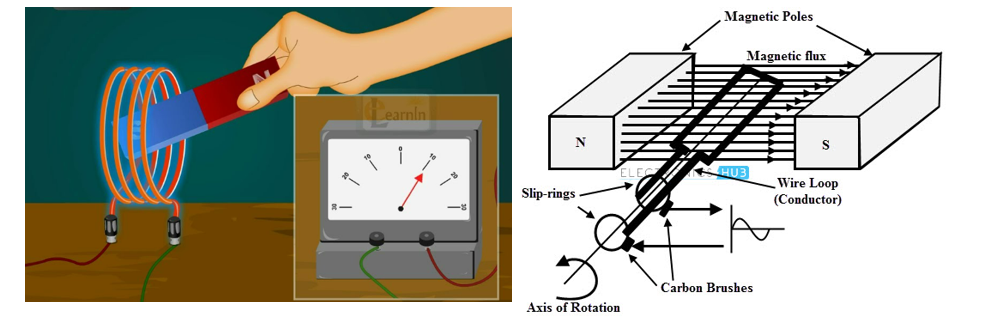
Permanent magnets and copper coils used to induce current manually and mechanically
An industrial generator uses attaches an armature (electromagnet) to a shaft. The stator is a stationary magnet with copper windings wrapped around it (there are multiple stators in a generator). When the armature rotates a current is induced in the copper windings which is transferred to the commutator via conduction. The brush assembly rubs against the commutator to send out electrical current.
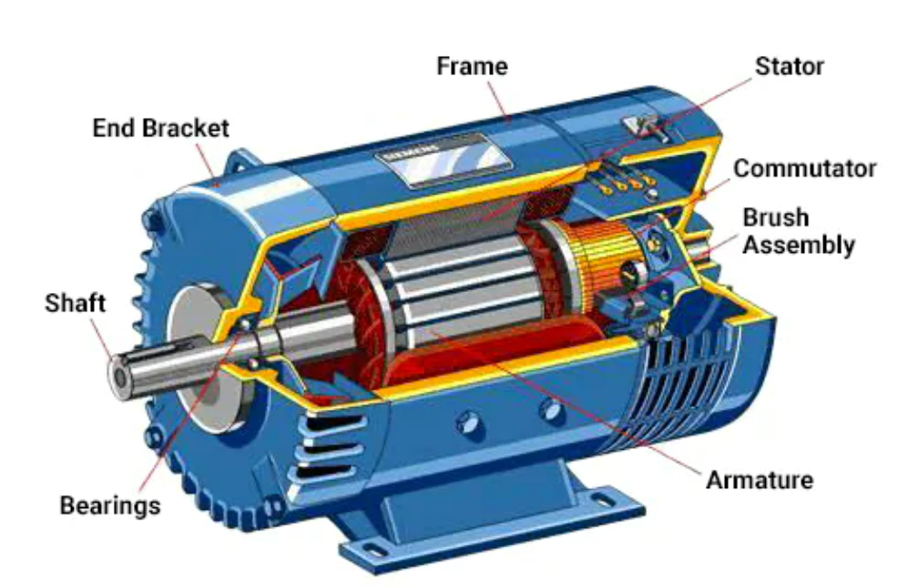
Diagram of an industrial generator
Energy can neither be created or destroyed; it can only be transferred from one form to another. For example, a combustion engine converts chemical energy stored in the petrol into motion energy by turning the crankshaft which turns the wheels. In simple terms power stations generate electricity by turning a generator (except solar panels), some power stations turn the generator directly like wind farms or hydroelectric dams. Others heat water into steam and feed the steam into a turbine which turns the generator like an oil power station, biofuel power station or nuclear power station.
Types of Power Station
Types of Power Station
Industrial power stations all use generators to generate electricity apart from solar farms. Power stations like nuclear, fossil fuels heat water to generate steam and drive turbines, which powers the generator. Some of the other power stations drive the turbine directly using a single source of energy, for example, hydroelectric plants uses gravitational energy (water falling down from a height) to drive the turbine which powers the generator.
The industrial power stations are:
- Fossil fuel: Burn coal, oil and gas to generate electricity
- Biomass: wood or other waste is burnt to generate electricity
- Geothermal: use hot rocks beneath the earths surface to heat water to drive the turbine
- Nuclear Fission: particles split apart to heat water to drive the turbine
- Wind: use motion energy from the wind to power the generator
- Hydroelectric: use water falling from height to drive the turbine
- Tidal: Use waves from the currents of the sea to drive the turbine
- Solar: uses the photons from sunlight to release electrons via the silicon semiconductors. The movement of electrons is the current required for electricity.
The advantages and disadvantage of each power station is described below.
Explore Further
Choose from the articles below to continue learning about nuclear.
What does a nuclear power station look like?
Fukushima – The World’s Worst Nuclear Accident Since Chernobyl
Boiling Water Reactor (BWR) – an introduction to this type of nuclear power plant
Magnox Reactors – At the Forefront of a New Age
Did you know? Explore Nuclear also offers great careers information and learning resources.
Below you can find references to the information and images used on this page.
Content References
- Physics of Energy | Canada Science and Technology Museum (ingeniumcanada.org)
- Forms of energy – U.S. Energy Information Administration (EIA)
- How Does a Generator Work? – How Generators Work (electricgeneratorsdirect.com)
- Energy sources and power plants lifetime by type | Statista
- Gas Plants – UK Electricity Production
- Emissions by sector: where do greenhouse gases come from? – Our World in Data
- Biomass Energy (nationalgeographic.org)
- Biomass and the environment – U.S. Energy Information Administration (EIA)
- Energy density – Energy Education
- What is nuclear waste and what do we do with it? – World Nuclear Association (world-nuclear.org)
- Geothermal Energy – What is it, where is it, and how do we capture it? – Enbridge Inc.
- Geothermal energy and the environment – U.S. Energy Information Administration (EIA)
- Cerro Prieto Geothermal Power Station – Wikipedia
- What is the role of nuclear in the energy mix and in reducing greenhouse gas emissions? – Grantham Research Institute on climate change and the environment (lse.ac.uk)
- Advantages & Disadvantages of Geothermal Energy | Eco Experts (theecoexperts.co.uk)
- Uranium Supplies: Supply of Uranium – World Nuclear Association (world-nuclear.org)
- When Will Fossil Fuels Run Out? – Infinity Renewables (infinity-renewables.com)
- Wind Farms Advantages and Disadvantages – Environment Co
- Dinorwig Power Station – Wikipedia
- List of tidal power stations – Wikipedia
- Tidal energy advantages and disadvantages: key points to consider (power-technology.com)
- Advantages & Disadvantages of Solar Energy | GreenMatch
Image References
- Electromagnetic Induction | CK-12 Foundation (ck12.org)
- Núcleo del reactor nuclear RA-3 – Gaunper – CC BY-SA 4.0
- American Heritage Biomass – Americanheritagebiomass – CC BY-SA 4.0
- NesjavellirPowerPlant – Gretar Ívarsson – Edited by Fir0002 – Public Domain
- PLAT-I in-stream tidal energy platform – Gordon Leggett – CC BY 4.0