
Arthur Eddington's Life
Life and Work
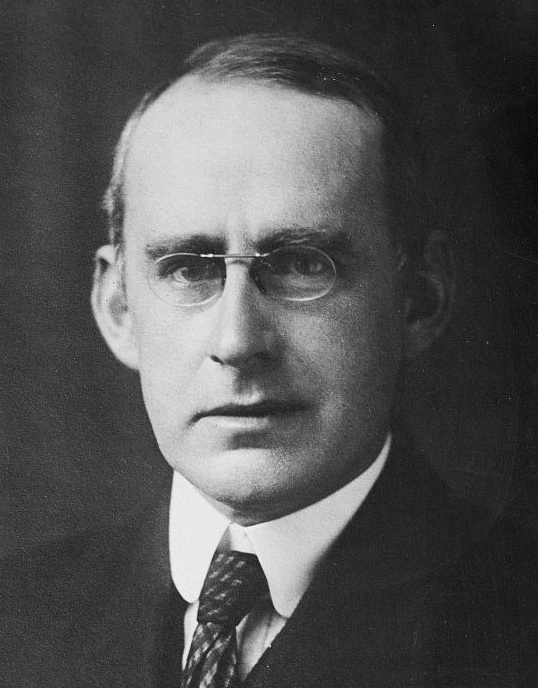
Born on December 28, 1882, in Kendal, England, Arthur Stanley Eddington was raised in a Quaker household. After his father died of typhoid when Arthur was just two, the family moved to Weston-super-Mare. He excelled academically, earning a scholarship to Owens College, Manchester, and later studying at Trinity College, Cambridge. His early promise in mathematics and physics led to a career in astronomy, beginning at the Royal Observatory in Greenwich and later as Plumian Professor of Astronomy at Cambridge.
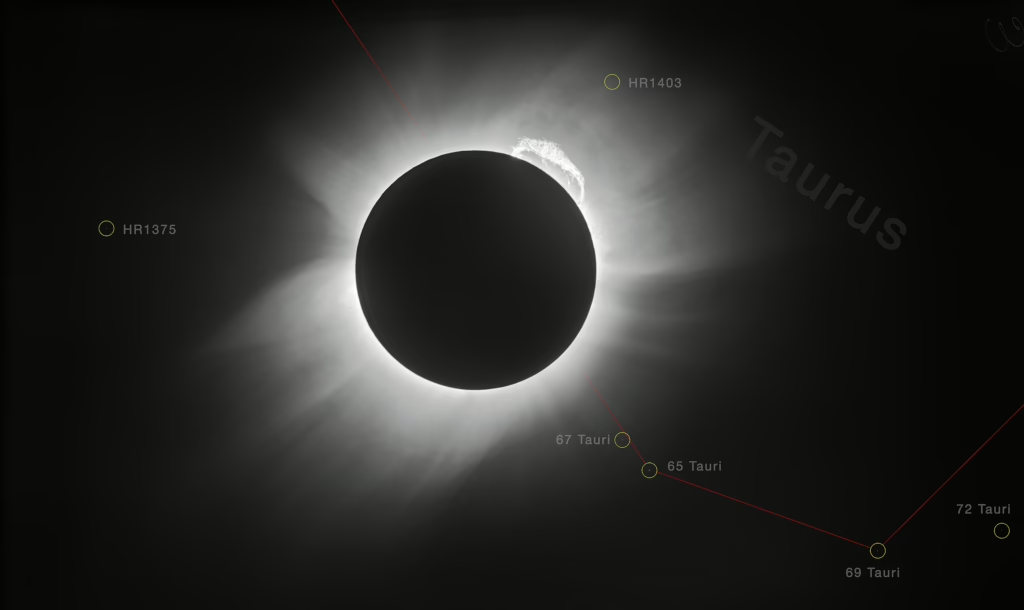
Eddington is perhaps best known for his 1919 expedition to observe a solar eclipse, during which he provided the first experimental confirmation of Einstein’s general theory of relativity. By measuring the bending of starlight around the Sun, he offered compelling evidence that gravity could warp space-time. This work not only validated Einstein’s theory but also catapulted both men into international fame.
Beyond relativity, Eddington made foundational contributions to stellar astrophysics. He developed the first detailed models of stellar structure and evolution, introducing concepts such as the Eddington limit, which defines the maximum luminosity a star can achieve before radiation pressure blows away its outer layers. His 1926 book The Internal Constitution of the Stars became a cornerstone of astrophysical theory.
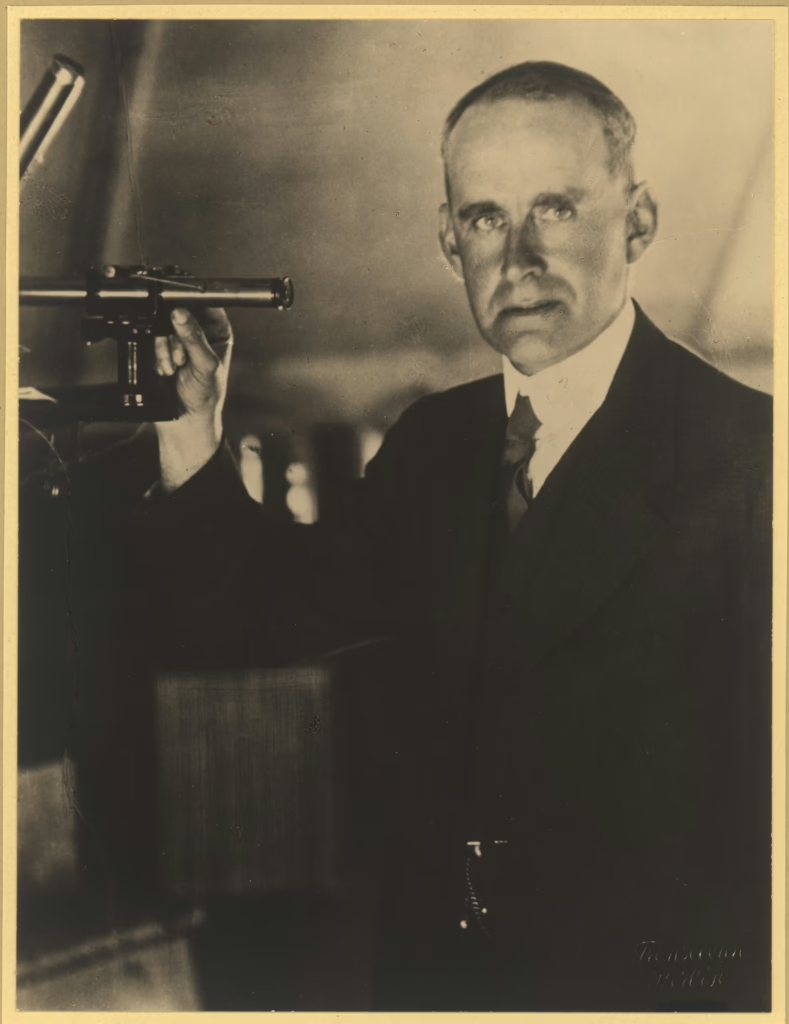
Eddington was also a philosopher of science and a skilled communicator. He wrote several popular science books, including The Nature of the Physical World and Science and the Unseen World, which explored the philosophical implications of modern physics. His writing helped bridge the gap between scientific theory and public understanding, making complex ideas accessible to a broader audience.
He was knighted in 1930 and received numerous honours, including the Royal Society’s Royal Medal and the Order of Merit. Eddington remained active in both scientific and philosophical circles until his death on November 22, 1944, in Cambridge. His legacy endures in the fields of astrophysics, cosmology, and the philosophy of science.
Arthur Eddington's Scientific Contributions
General Relativity and the 1919 Eclipse Expedition
Eddington’s most famous contribution was his experimental confirmation of Albert Einstein’s general theory of relativity. In 1919, he led an expedition to observe a solar eclipse from the island of Príncipe and Brazil. By measuring the deflection of starlight around the Sun, he provided the first empirical evidence that gravity could bend light; a cornerstone of Einstein’s theory. This not only validated relativity but also helped elevate Einstein to global fame and marked a turning point in modern physics.
Stellar Structure and the Eddington Limit
Eddington made foundational advances in stellar astrophysics, particularly in understanding how stars maintain equilibrium. He developed mathematical models describing the internal structure of stars, including the balance between gravitational collapse and radiation pressure. His work led to the formulation of the Eddington limit, which defines the maximum luminosity a star can achieve before radiation pressure overcomes gravitational pull, causing mass loss. This concept remains vital in the study of high-energy astrophysical phenomena.
Popular Science and Philosophy of Physics
Beyond technical research, Eddington was a gifted communicator and philosopher of science. His books, such as The Nature of the Physical World and Science and the Unseen World, explored the philosophical implications of quantum mechanics and relativity. He emphasised the limits of human knowledge and the role of intuition in scientific discovery, blending rigorous science with metaphysical reflection. His writing helped make complex theories accessible to the public and inspired generations of scientists and thinkers.
Contributions to Quantum Theory and Cosmology
Although less central than his work on relativity and stars, Eddington also engaged with quantum mechanics and cosmology. He proposed speculative ideas about the fundamental constants of nature and attempted to unify quantum theory with relativity. While some of these efforts were controversial or ultimately unproven, they reflected his deep commitment to understanding the universe’s underlying principles.
Arthur Eddington's Accomplishments
Awards and Honours
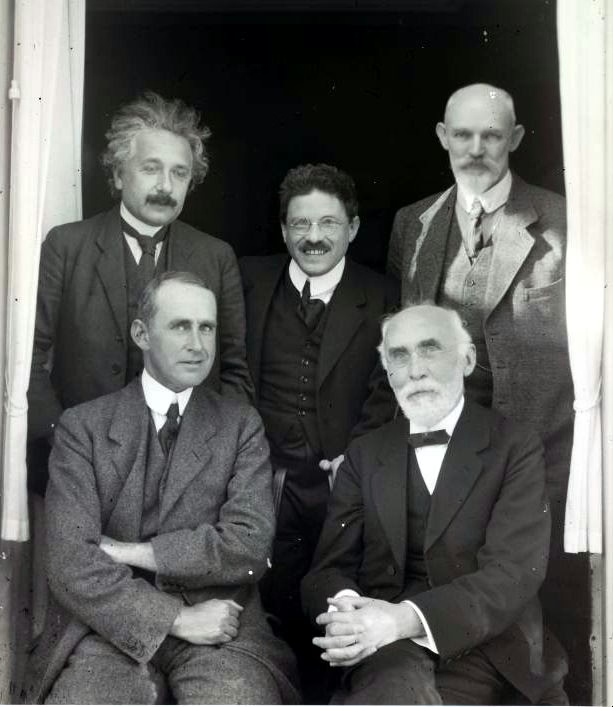
Arthur Eddington received numerous prestigious awards in recognition of his contributions to astrophysics and the philosophy of science. Early in his career, he was awarded the Smith’s Prize in 1907 for his mathematical work at Cambridge. His observational confirmation of Einstein’s general relativity earned him international acclaim, leading to the Gold Medal of the Royal Astronomical Society in 1924 and the Henry Draper Medal from the U.S. National Academy of Sciences the same year.
He continued to receive accolades throughout the 1920s, including the Bruce Medal (1924), the Royal Medal of the Royal Society (1928), and the Prix Jules Janssen (1928), France’s highest honour in astronomy. In 1930, Eddington was knighted by King George V, becoming Sir Arthur Eddington, and in 1938, he was awarded the Order of Merit, one of Britain’s most exclusive honours for exceptional service in science.
Named Tributes and Memorials
Eddington’s legacy is commemorated through various named tributes in astronomy and academia. The Eddington Medal, awarded by the Royal Astronomical Society, honours outstanding contributions to theoretical astrophysics. A lunar crater and asteroid 2761 Eddington bear his name, symbolising his lasting impact on space science.
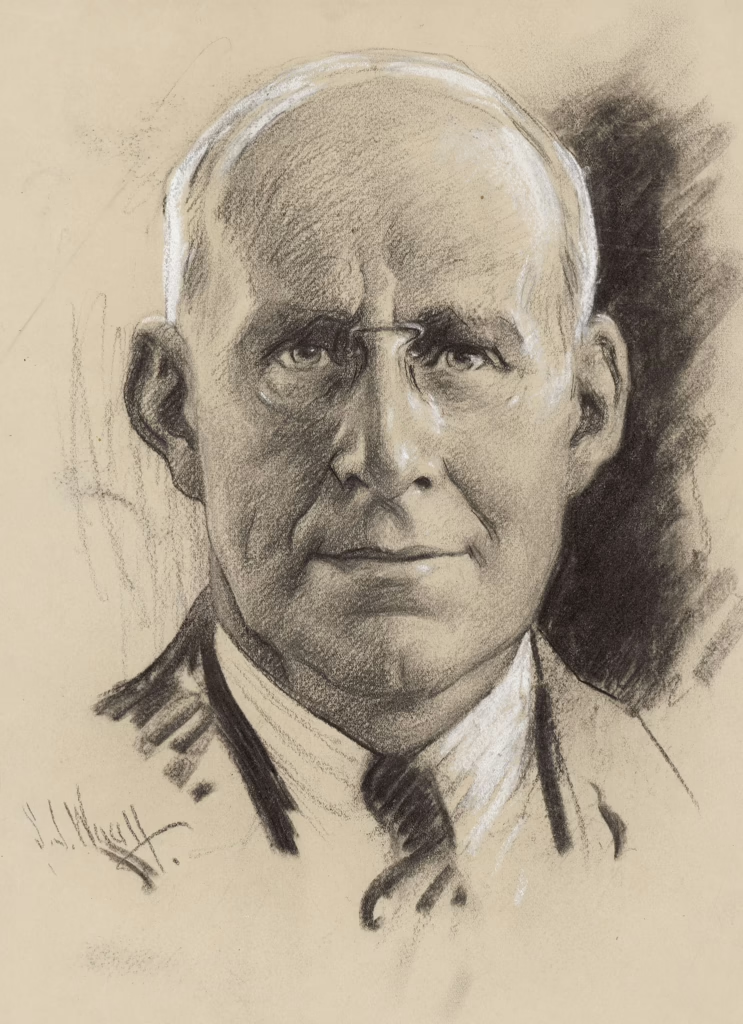
Scientific and Philosophical Legacy
Eddington’s legacy goes far beyond awards. He was instrumental in introducing Einstein’s theory of general relativity to the English-speaking world, helping to shift the paradigm of physics in the early 20th century. His work on stellar structure, including the formulation of the Eddington limit, remains foundational in astrophysics.
As a philosopher of science, Eddington explored the metaphysical implications of quantum mechanics and relativity. His writings, such as The Nature of the Physical World, bridged the gap between scientific theory and philosophical inquiry, influencing both scientists and thinkers. He also mentored future luminaries like Subrahmanyan Chandrasekhar, extending his impact across generations.
Explore Further
Continue learning about the lives of the people that shaped nuclear history.
Eugene Wigner – A Life Shaped by Symmetry and Science
Leo Szilard – The Man Who Warned the World
Ellen Gleditsch – Norway’s Pioneer of Radiochemistry
Marie Curie – A Symbol of Perseverance, Intelligence and Scientific Curiosity
Did you know? Explore Nuclear also offers great careers information and learning resources.
Below you can find references to the information and images used on this page.
Content References
- People: Arthur Stanley Eddington
- Arthur Stanley Eddington | Science Museum Group Collection
- ESA – Studying the stars, testing relativity: Sir Arthur Eddington
- Arthur Eddington – Wikipedia
- Arthur Eddington | British Astronomer & Physicist | Britannica
- Arthur Eddington – Important Scientists – The Physics of the Universe
- Arthur Eddington – Honours
Image References
- Arthur Stanley Eddington – George Grantham Bain Collection – Public Domain
- Portrait of Arthur Stanley Eddington – Smithsonian Institution – No known copyright restrictions
- 1919 solar eclipse – European Southern Observatory – CC BY 4.0
- Physicists in Leiden – H. van Batenburg – CC BY-SA 3.0
- Arthur Stanley Eddington by Samuel Johnson Woolf – Samuel Johnson Woolf – CC0 1.0