
John Cockcroft's Life
Life and Work
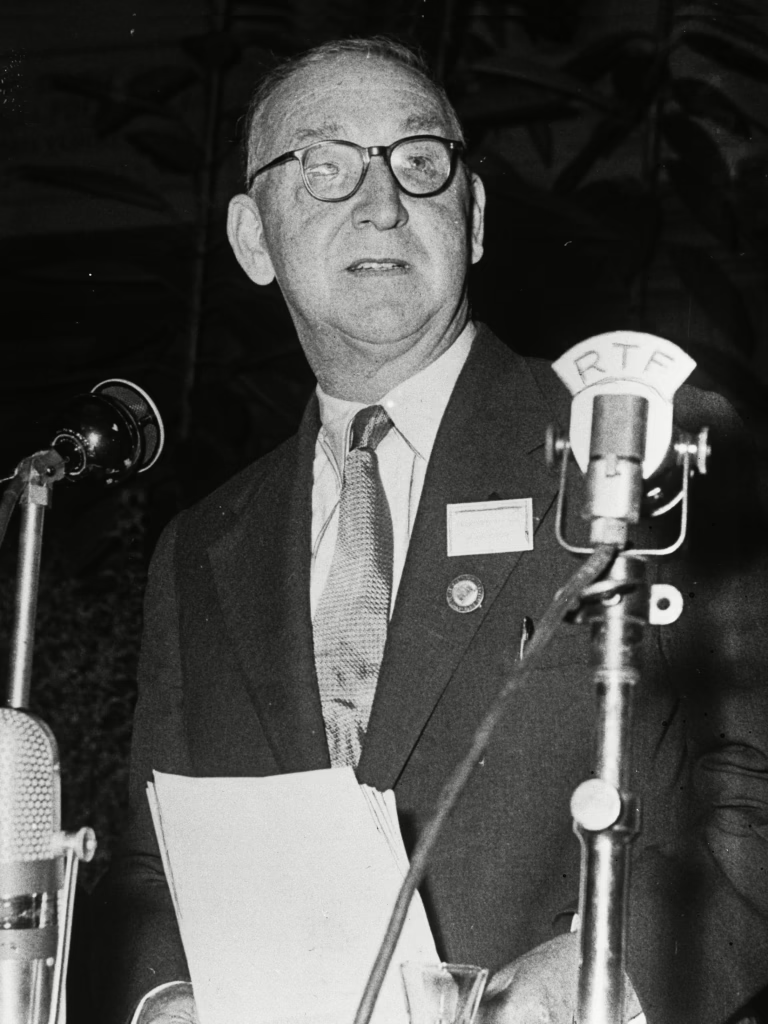
John Cockcroft was born on 27 May 1897 in Todmorden, Yorkshire, England, into a family of cotton manufacturers. He attended Todmorden Secondary School and later studied mathematics at Manchester University under Horace Lamb. His education was interrupted by the First World War, during which he served in the Royal Field Artillery. After the war, he pursued electrical engineering at the Manchester College of Technology and apprenticed with Metropolitan Vickers Electrical Company before moving to St. John’s College, Cambridge, where he studied under Lord Rutherford at the Cavendish Laboratory.
At Cambridge, Cockcroft initially worked with Pyotr Kapitsa on magnetic fields and low temperatures, but in 1928 he shifted focus to proton acceleration experiments. Partnering with Ernest Walton, he built one of the first particle accelerators. In 1932, they achieved the first artificial nuclear disintegration, bombarding lithium with protons to split its nucleus. This pivotal experiment not only confirmed Einstein’s equation E=mc² but also laid the foundation for nuclear power and weapons.
Cockcroft’s career extended beyond laboratory research. During the Second World War, he played a crucial role in radar development and later became deeply involved in Britain’s nuclear program. He served as the first director of the Atomic Energy Research Establishment at Harwell, guiding the UK’s early nuclear energy efforts. His leadership helped shape both military and civilian applications of nuclear science.
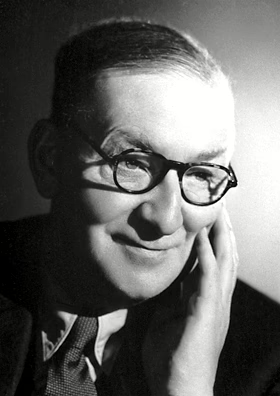
For his contributions, Cockcroft received numerous honours, including a knighthood in 1948 and the Nobel Prize in Physics in 1951. He was also recognised with fellowships and honorary degrees worldwide. Cockcroft remained active in scientific administration and policy until his death on 18 September 1967 in Cambridge.
John Cockcroft's Scientific Contributions
Early Work and the Cockcroft–Walton Generator
Cockcroft’s most famous achievement was the design of the Cockcroft–Walton generator in 1932, developed with Ernest Walton. This high-voltage accelerator allowed them to bombard atomic nuclei with protons, leading to the first artificial nuclear reaction when they split lithium into helium nuclei. This experiment confirmed Einstein’s mass–energy equivalence and demonstrated the potential of particle accelerators in nuclear physics.
Nobel Prize and Nuclear Physics
For this pioneering work, Cockcroft and Walton were awarded the 1951 Nobel Prize in Physics. Their success established particle accelerators as essential tools for probing atomic structure and laid the foundation for modern nuclear physics. The experiment was a turning point, showing that nuclear transmutation could be achieved in the laboratory.
Wartime Contributions
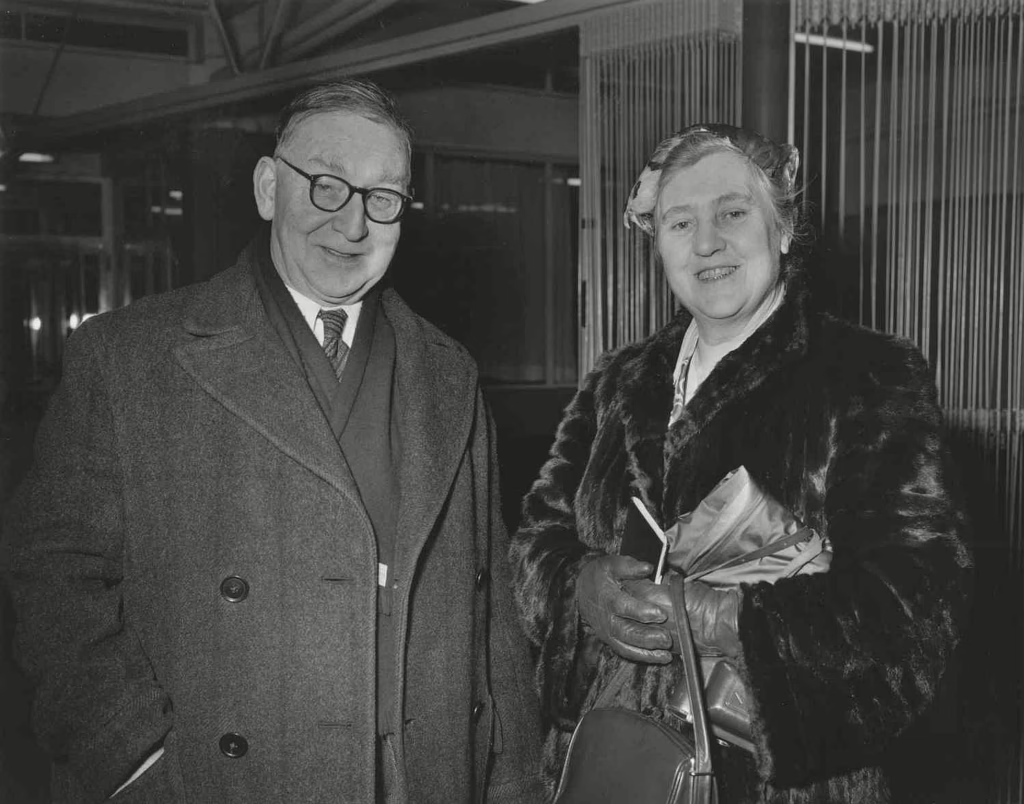
During the Second World War, Cockcroft applied his expertise to radar technology. He served as Assistant Director of Scientific Research in the Ministry of Supply, working on radar for coastal and air defense. He was also part of the Tizard Mission to the United States in 1940, which shared critical British scientific advances, including radar, with American researchers.
Leadership in Atomic Energy
After the war, Cockcroft became a central figure in Britain’s nuclear program. He directed the Atomic Energy Research Establishment at Harwell, overseeing the development of nuclear reactors and guiding research into both military and civilian applications of atomic energy. His leadership ensured that Britain remained at the forefront of nuclear science during the post-war era.
Leadership in Atomic Energy
Cockcroft also played a role in international nuclear research. In 1944, he moved to Canada to lead the Montreal and Chalk River Laboratories, contributing to the Canadian atomic energy project. His work helped establish nuclear research infrastructure that supported both the Manhattan Project and later peaceful applications of nuclear power.
John Cockcroft's Accomplishments
Major Awards and Distinctions
Cockcroft’s most celebrated recognition was the Nobel Prize in Physics (1951), awarded jointly with Ernest Walton for their pioneering work in splitting the atomic nucleus using a particle accelerator. This achievement marked a turning point in nuclear physics and secured their place among the great experimental scientists of the 20th century.
In addition to the Nobel Prize, Cockcroft received numerous other honours. He was knighted in 1948 for his contributions to science and national defence. He was also elected a Fellow of the Royal Society (FRS), one of the highest distinctions in British science, and later served as its vice-president. His international reputation led to honorary degrees from universities across Europe and North America.
National and International Recognition
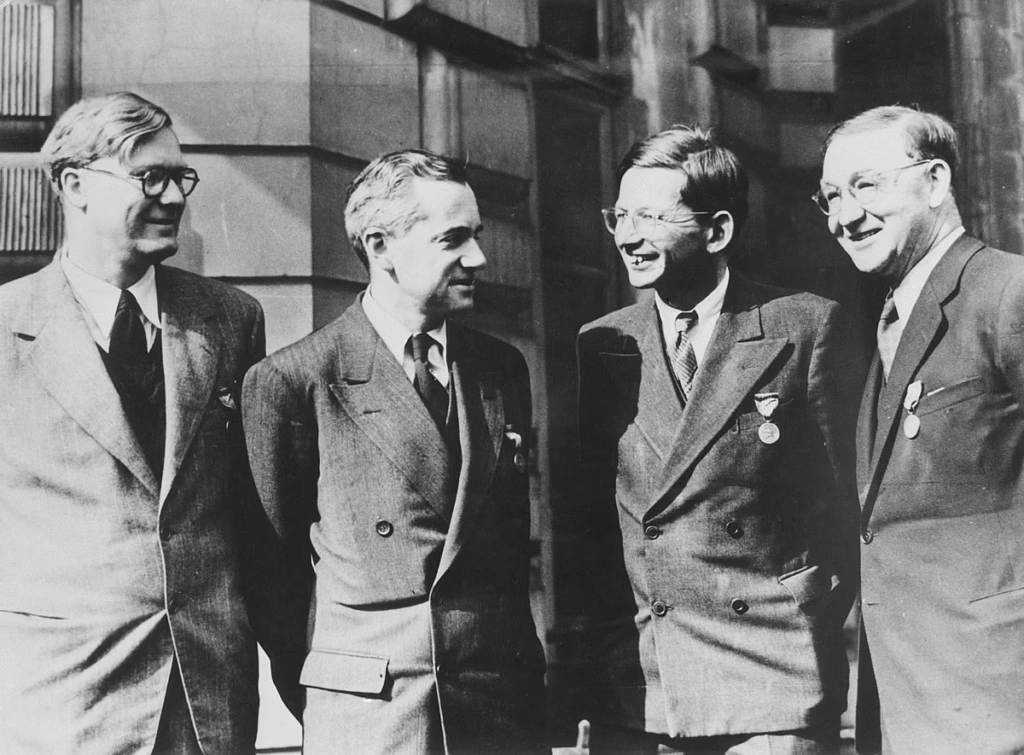
Cockcroft’s leadership in nuclear research earned him recognition beyond academia. He was awarded the Order of Merit in 1956, a rare honour bestowed by the British monarch for exceptional contributions to the arts, sciences, and public life. His role in the wartime Tizard Mission and his directorship at Harwell further cemented his reputation as a scientist who bridged pure research with practical national service.
Internationally, Cockcroft was respected as a scientific diplomat. He played a role in fostering collaboration between Britain, Canada, and the United States during and after the Second World War, ensuring that nuclear research advanced in a cooperative framework.
Legacy and Impact
Cockcroft’s contributions combined groundbreaking experimental physics with strategic leadership in nuclear research. His work not only advanced fundamental science but also shaped the technological landscape of the mid-20th century, influencing energy production, defense systems, and the global trajectory of nuclear research.
Explore Further
Continue learning about the lives of the people that shaped nuclear history.
Ernest Rutherford – The Father of Nuclear Physics
Rudolf Peierls – The Physicist Who Made the Atomic Bomb Possible
Harold Urey – From Deuterium to the Dawn of Life
Lise Meitner – A Pioneering Physicist and Educator
Did you know? Explore Nuclear also offers great careers information and learning resources.
Below you can find references to the information and images used on this page.
Content References
- John Cockcroft – Biographical – NobelPrize.org
- History – The Cockcroft Institute
- Biography of Famous Physicists John Cockcroft – The Engineers Blog
- John Douglas Cockcroft – Nuclear Museum
- Sir John Douglas Cockcroft | Atomic Structure, Nuclear Physics & Quantum Mechanics | Britannica
- John Cockcroft – Wikipedia
- John Cockcroft – Biography, Facts and Pictures
- Sir John Cockcroft
Image References
- John Douglas Cockcroft 1961 – Unknown author – CC BY-SA 3.0 NL
- Cockcroft – Nobel foundation – Public Domain
- 01-09-1959 Sir John Cockcroft – IISG – CC BY-SA 2.0
- William Penney, Otto Frisch, Rudolf Peierls and John Cockroft – Los Alamos National Laboratory – Unless otherwise indicated, this information has been authored by an employee or employees of the Los Alamos National Security, LLC (LANS), operator of the Los Alamos National Laboratory under Contract No. DE-AC52-06NA25396 with the U.S. Department of Energy. The U.S. Government has rights to use, reproduce, and distribute this information. The public may copy and use this information without charge, provided that this Notice and any statement of authorship are reproduced on all copies. Neither the Government nor LANS makes any warranty, express or implied, or assumes any liability or responsibility for the use of this information.