
Table of Contents
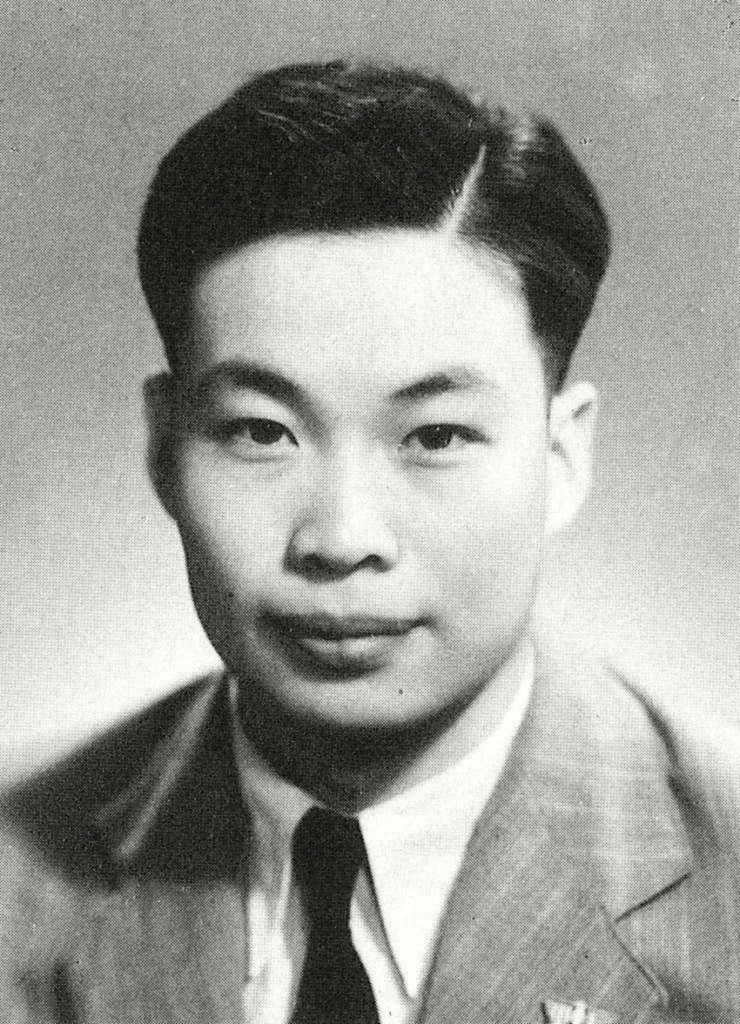
Qian Sanqiang's Life
Life and Work
Qian Sanqiang was born on 16 October 1913 in Shaoxing, Zhejiang Province, into a scholarly family; his father, Qian Xuantong, was a prominent intellectual. He studied physics at Tsinghua University, graduating in 1936, and soon after travelled to France to continue his research. There, he worked under Frédéric Joliot-Curie at the Collège de France, becoming an expert in uranium fission and earning recognition such as the Henri de Parville Award from the French Academy of Sciences.
In 1948, Qian returned to China, where the newly established government supported his efforts to acquire nuclear research equipment from Europe. By the mid‑1950s, he was advising top Chinese leaders, including Mao Zedong, on the development of an atomic bomb. He became the administrative head of China’s nuclear weapons program and played a central role in the successful detonation of the country’s first atomic bomb in 1964, an event that coincidentally occurred on his 51st birthday.
Beyond weapons development, Qian oversaw the construction of China’s first heavy‑water reactor and cyclotron in the 1950s, laying the groundwork for the nation’s broader nuclear science capabilities. His leadership and scientific vision earned him the title “father of China’s atomic bomb,” reflecting both his technical contributions and his role in organising large‑scale national research efforts.
Qian Sanqiang remained dedicated to scientific advancement throughout his life. He died on 28 June 1992, leaving behind a legacy that continues to shape China’s scientific and technological trajectory.
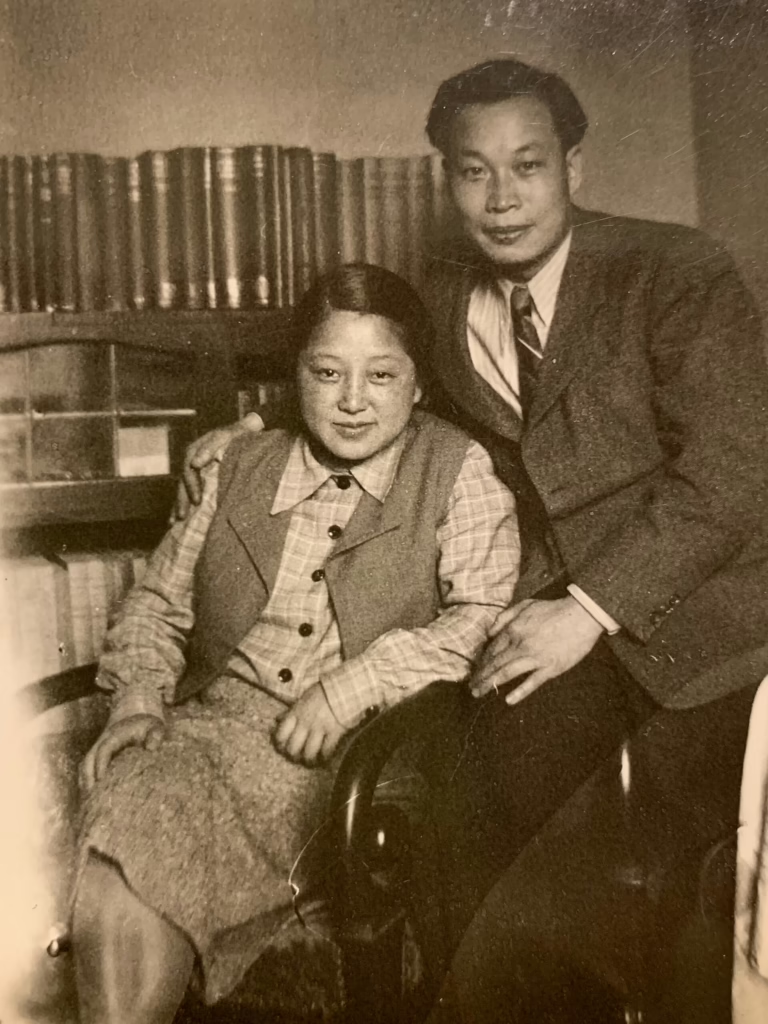
Qian Sanqiang's Work
Contributions to Nuclear Physics
During his time in Europe, Qian published important papers on the mechanisms of nuclear fission, contributing to the understanding of how heavy nuclei split and release energy. His research earned recognition from the French Academy of Sciences and placed him among the leading young physicists of the era. This foundational work later became essential to China’s own nuclear research efforts.
Leadership in China’s Nuclear Program
After returning to China in 1948, Qian became a central figure in the establishment of the country’s nuclear science infrastructure. He advised national leaders on atomic research, helped secure advanced laboratory equipment from abroad, and played a key role in organising China’s early nuclear research institutions. By the mid‑1950s, he was leading the administrative and scientific coordination of China’s atomic bomb project.
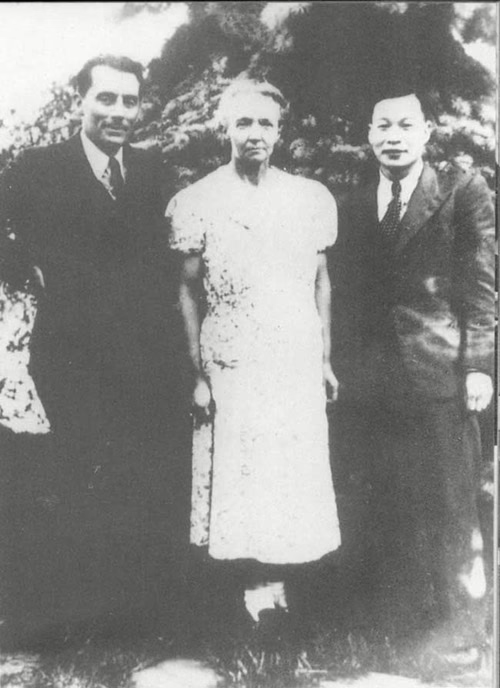
Development of Nuclear Facilities
Qian oversaw the construction of China’s first heavy‑water reactor and cyclotron, both crucial for training scientists and conducting nuclear experiments. These facilities formed the backbone of China’s early nuclear capabilities and enabled the country to pursue both civilian and military applications of atomic science.
Role in China’s First Atomic Bomb
As the chief organiser of the nuclear weapons program, Qian guided the scientific teams responsible for designing and testing China’s first atomic bomb. The successful detonation in 1964 marked a major milestone for the nation and cemented his reputation as the “father of China’s atomic bomb.” His leadership combined scientific expertise with the ability to coordinate large, complex national projects.
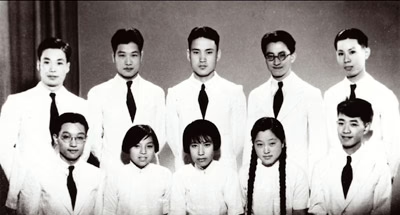
Qian Sanqiang's Legacy
Awards and Honours
Qian Sanqiang received wide recognition for his scientific achievements both in China and abroad. Early in his career, while working in France, he was awarded the Henri de Parville Prize by the French Academy of Sciences for his contributions to nuclear fission research. After returning to China, he became a leading figure in the nation’s scientific community and was elected a founding member of the Chinese Academy of Sciences (CAS). Over the decades, he received numerous state commendations for his leadership in establishing China’s nuclear science infrastructure and guiding the atomic bomb program. His work earned him a reputation as one of the most respected physicists of his generation.
Enduring Influence
Qian’s legacy extends far beyond the atomic bomb project. He helped shape China’s scientific institutions, influenced national science policy, and inspired generations of researchers. His emphasis on perseverance, rigorous thinking, and service to national development continues to be cited in Chinese scientific culture. Today, he is remembered as a foundational figure whose work transformed China’s scientific landscape and secured its place in global nuclear research.
Explore Further
Continue learning about the lives of the people that shaped nuclear history.
Frédéric Joliot-Curie – A Life of Science and Conscience
Andrei Sakharov – Scientist, Dissident, Icon
John Cockcroft – The Man Who Split the Atom
Leslie Groves – The Race to Build the Atomic Bomb
Did you know? Explore Nuclear also offers great careers information and learning resources.
Below you can find references to the information and images used on this page.
Content References
Image References
- 年轻的钱三强 – Unknown author – Public Domain
- 钱三强何泽慧 – Fotobaby – CC BY-SA 4.0
- Qian Sanqiang with the Joliot-Curies – Unknown author – Public Domain
- 1936 Graduation Class in Physics at Tsinghua University – Unknown author – Public Domain
- He Zehui 3 – Unknown author – Public Domain