
James Chadwick's Life
Life and Work
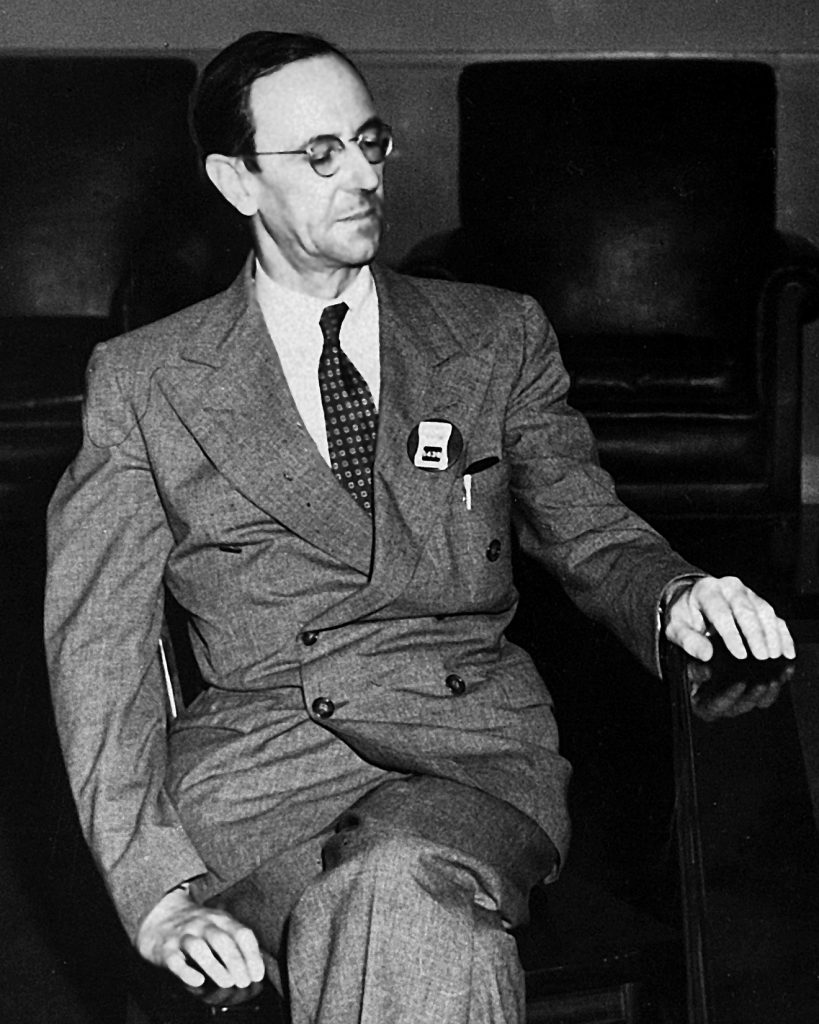
Sir James Chadwick (1891–1974) was a pioneering English physicist best known for discovering the neutron in 1932, a breakthrough that transformed nuclear physics. Born in Cheshire, England, Chadwick studied physics at the University of Manchester under Ernest Rutherford, later continuing his research at Cambridge. His early work focused on radioactivity, and during World War I, he was interned in Germany, where he managed to conduct rudimentary experiments despite harsh conditions.
After the war, Chadwick resumed work with Rutherford at the Cavendish Laboratory, where he identified the neutron; a neutral particle within the atomic nucleus. This discovery earned him the Nobel Prize in Physics in 1935 and laid the foundation for nuclear fission and atomic energy
During World War II, Chadwick led the British scientific delegation to the Manhattan Project, contributing to the development of the atomic bomb. Post-war, he served as Master of Gonville and Caius College, Cambridge, and continued advocating for responsible nuclear research.
Chadwick received numerous honours, including the Copley Medal and knighthood, and his work remains central to modern physics. His legacy is marked by scientific brilliance, resilience, and a profound impact on both theoretical and applied nuclear science.
James Chadwick's Scientific Contributions
Discovery of the Neutron
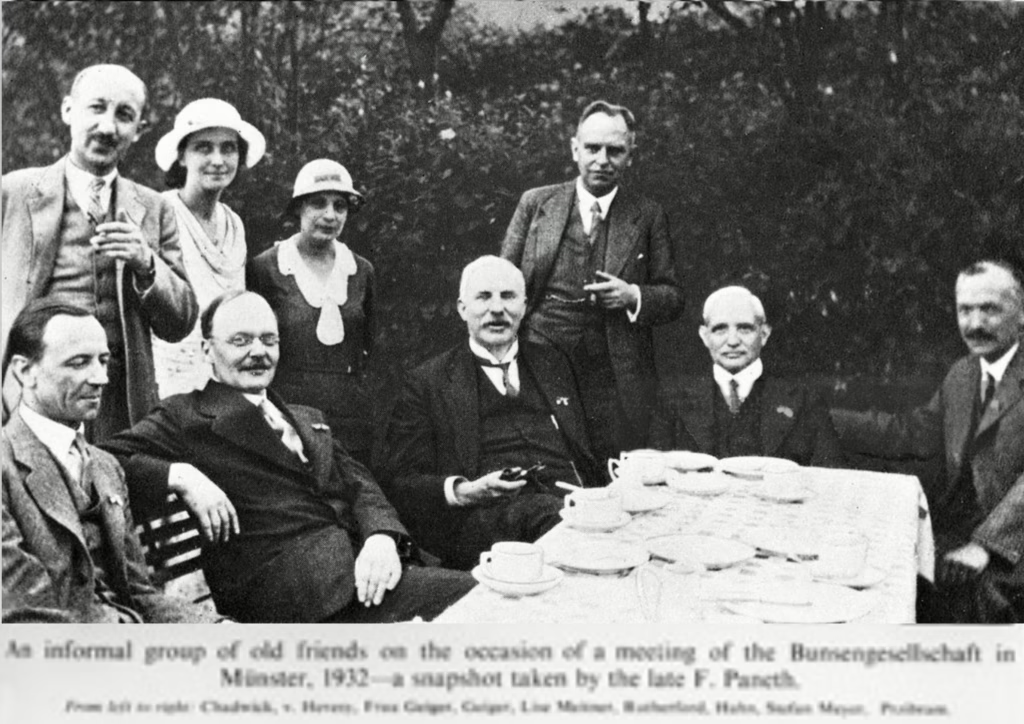
James Chadwick’s most celebrated achievement was the discovery of the neutron, a neutral subatomic particle residing in the nucleus of atoms. Prior to this, atomic theory only accounted for protons and electrons. Chadwick’s experiments, inspired by earlier work by Frédéric and Irène Joliot-Curie, demonstrated that beryllium bombarded with alpha particles emitted a neutral radiation capable of dislodging protons from other substances. This led him to conclude that the radiation consisted of neutral particles—neutrons. The discovery revolutionized nuclear physics and earned him the Nobel Prize in Physics in 1935.
Contributions to Nuclear Physics
Chadwick’s identification of the neutron provided the missing piece in understanding atomic structure and enabled the development of nuclear models that accounted for isotopes and nuclear stability. It also paved the way for nuclear fission, as neutrons could penetrate atomic nuclei more easily than charged particles, making them ideal for initiating chain reactions.
Role in the Manhattan Project
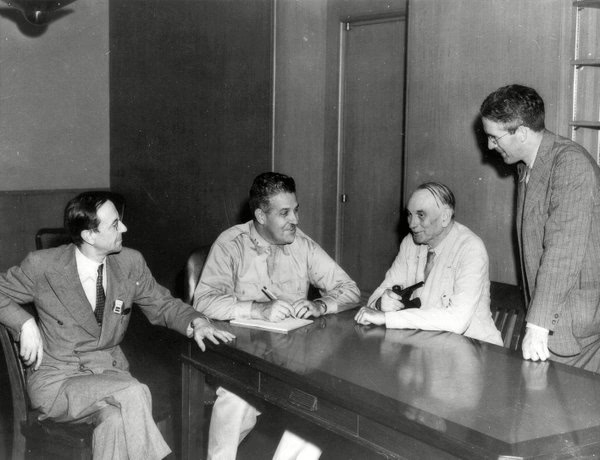
James Chadwick played a crucial role in the Manhattan Project as the head of the British Mission, facilitating scientific collaboration between the United Kingdom and the United States during World War II. His leadership helped integrate British nuclear expertise into the American-led effort to develop atomic weapons, ensuring that key British scientists had access to top-secret research at Los Alamos. Though not directly involved in bomb design, Chadwick provided strategic oversight and scientific counsel, leveraging his authority as a Nobel laureate and respected physicist. His diplomatic skill was instrumental in overcoming political barriers, and his presence reinforced the credibility and unity of the Allied scientific endeavor that ultimately led to the creation of the first atomic bombs.
James Chadwick's Accomplishments
Awards and Honors
James Chadwick received numerous prestigious awards throughout his career, reflecting the global recognition of his scientific contributions. He was elected a Fellow of the Royal Society (FRS) in 1927, and awarded the Hughes Medal in 1932 for his work on the neutron. His landmark discovery earned him the Nobel Prize in Physics in 1935. During and after World War II, he was further honored with a knighthood in 1945, the Melchett Medal in 1946, and the Copley and Faraday Medals in 1950. He also received the Franklin Medal in 1951 and the Guthrie Medal and Prize in 1967. In 1970, he was appointed to the Order of the Companions of Honour.
Academic and Scientific Leadership
Beyond his research, Chadwick held influential academic positions. He served as Professor of Physics at the University of Liverpool from 1935 to 1948, and later became Master of Gonville and Caius College, Cambridge, from 1948 to 1959. His leadership helped shape post-war scientific education and research in Britain.
Legacy and Impact
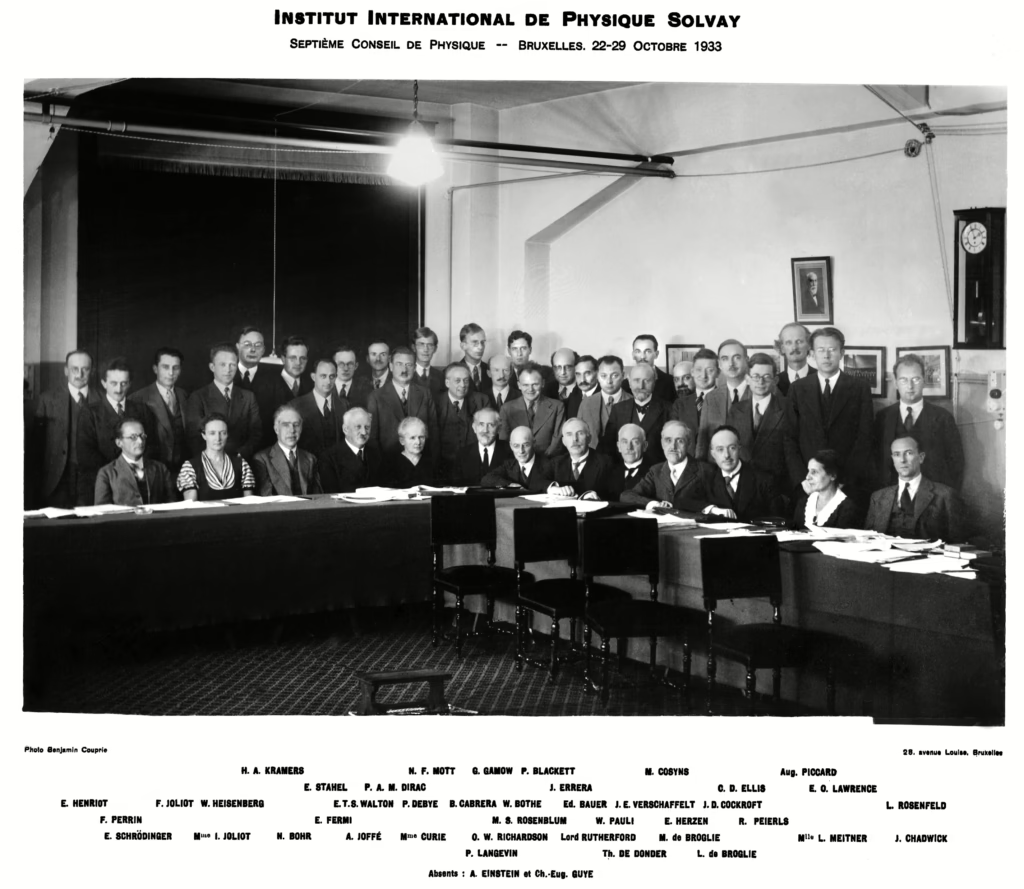
Chadwick’s discovery of the neutron fundamentally changed atomic theory and enabled the development of nuclear energy and weapons. His role in the Manhattan Project and his advocacy for responsible nuclear science positioned him as a key figure in 20th-century physics. His legacy endures in textbooks, scientific institutions, and the continued relevance of his work in both theoretical and applied physics.
Explore Further
Continue learning about the lives of the people that shaped nuclear history.
Leo Szilard – The Man Who Warned the World
John Cockcroft – The Man Who Split the Atom
Maria Goeppert Mayer – The Forgotten Genius of Nuclear Physics
Leona Woods – The Lone Woman of Chicago Pile-1
Did you know? Explore Nuclear also offers great careers information and learning resources.
Below you can find references to the information and images used on this page.
Content References
Image References
- James Chadwick – Los Alamos National Laboratory – Free Use – Unless otherwise indicated, this information has been authored by an employee or employees of the Los Alamos National Security, LLC (LANS), operator of the Los Alamos National Laboratory under Contract No. DE-AC52-06NA25396 with the U.S. Department of Energy. The U.S. Government has rights to use, reproduce, and distribute this information. The public may copy and use this information without charge, provided that this Notice and any statement of authorship are reproduced on all copies. Neither the Government nor LANS makes any warranty, express or implied, or assumes any liability or responsibility for the use of this information.
- James Chadwick, Leslie Groves, Richard Tolman, & Henry deWolf Smyth – United States Army Signal Corps – Public Domain
- Bunsentagung 1932 Münster – Friedrich Paneth – Public Domain
- Solvay 1933 – Benjamin Couprie – Public Domain