
Joseph John Thomson's Life
Life and Work
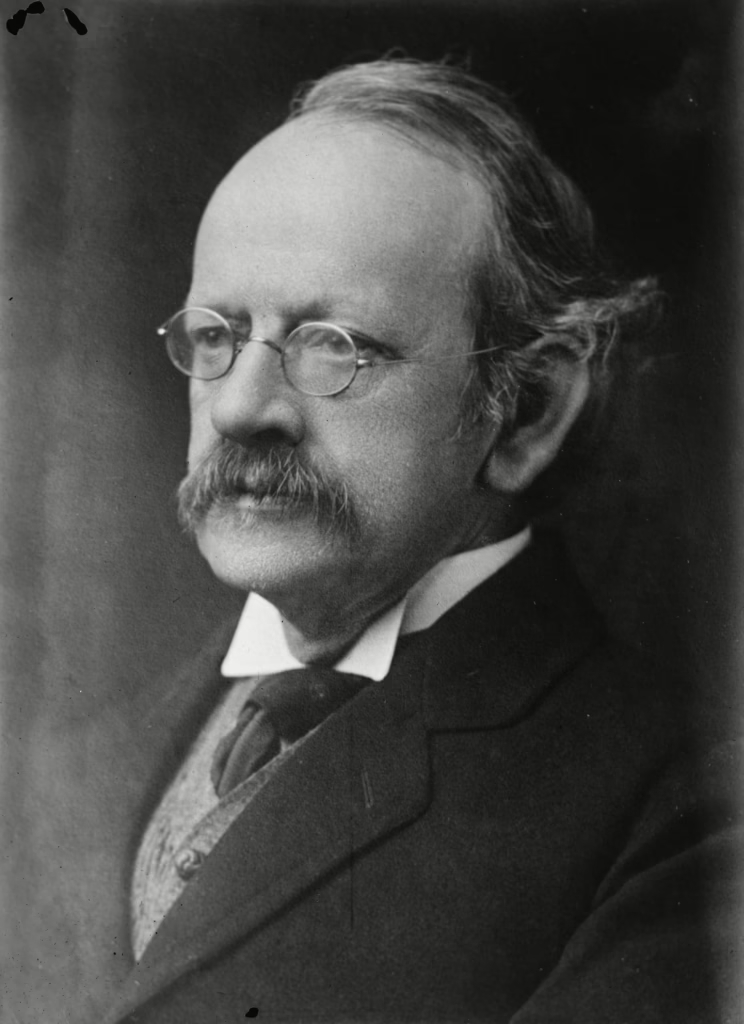
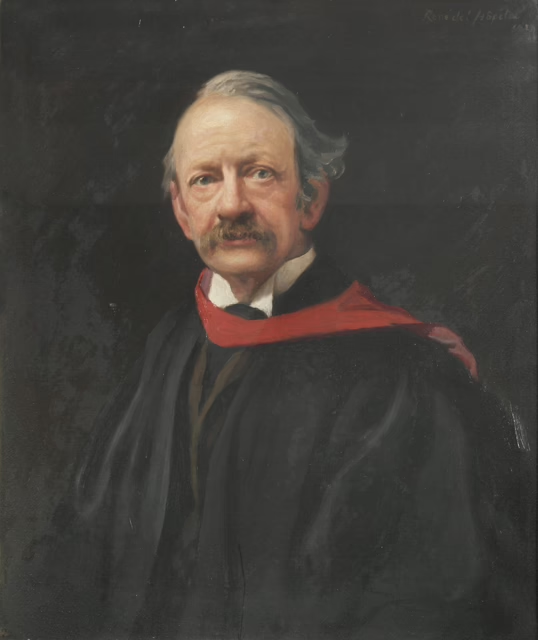
Joseph John Thomson was a pioneering British physicist best known for discovering the electron in 1897, a breakthrough that revolutionised atomic theory.
Born on December 18, 1856, in Cheetham Hill, Manchester, Thomson studied at Owens College before earning a scholarship to Trinity College, Cambridge. He became Cavendish Professor of Experimental Physics in 1884, succeeding Lord Rayleigh, and held the position until 1919. His most famous work involved experiments with cathode rays, which led him to identify particles smaller than atoms—later named electrons. This discovery challenged the prevailing notion that atoms were indivisible and laid the foundation for modern particle physics.
Thomson also proposed the plum pudding model of the atom, envisioning electrons embedded in a positively charged sphere. Though later replaced by more accurate models, it was a crucial step in atomic theory. He invented the mass spectrograph, enabling the identification of isotopes, and mentored future Nobel laureates, including his son, George Paget Thomson.
In 1906, Thomson received the Nobel Prize in Physics for his work on the conduction of electricity in gases. He died on August 30, 1940, in Cambridge, leaving behind a legacy that transformed our understanding of matter and inspired generations of physicists.
Joseph John Thomson's Scientific Contributions
Discovery of the Electron
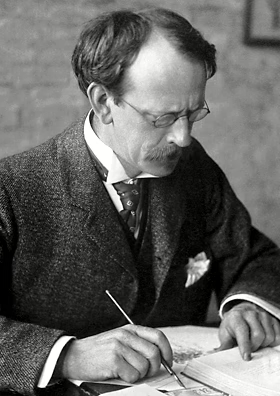
Thomson’s most celebrated achievement was identifying the electron, the first subatomic particle ever discovered. While experimenting with cathode ray tubes, he observed that the rays were deflected by electric and magnetic fields, suggesting they were composed of negatively charged particles. He calculated their mass-to-charge ratio and found they were much lighter than atoms—about 1/1836 the mass of a hydrogen atom. This discovery shattered the notion of the atom as indivisible and marked the beginning of particle physics.
The Plum Pudding Model
To explain the presence of electrons within atoms, Thomson proposed the “plum pudding” model. He theorised that atoms consisted of a positively charged ‘pudding’ with negatively charged electrons scattered throughout, like raisins. Although later disproven by Rutherford’s gold foil experiment, this model was a vital step in the evolution of atomic theory and helped scientists begin to visualise atomic structure.
Work on Isotopes and Mass Spectrometry
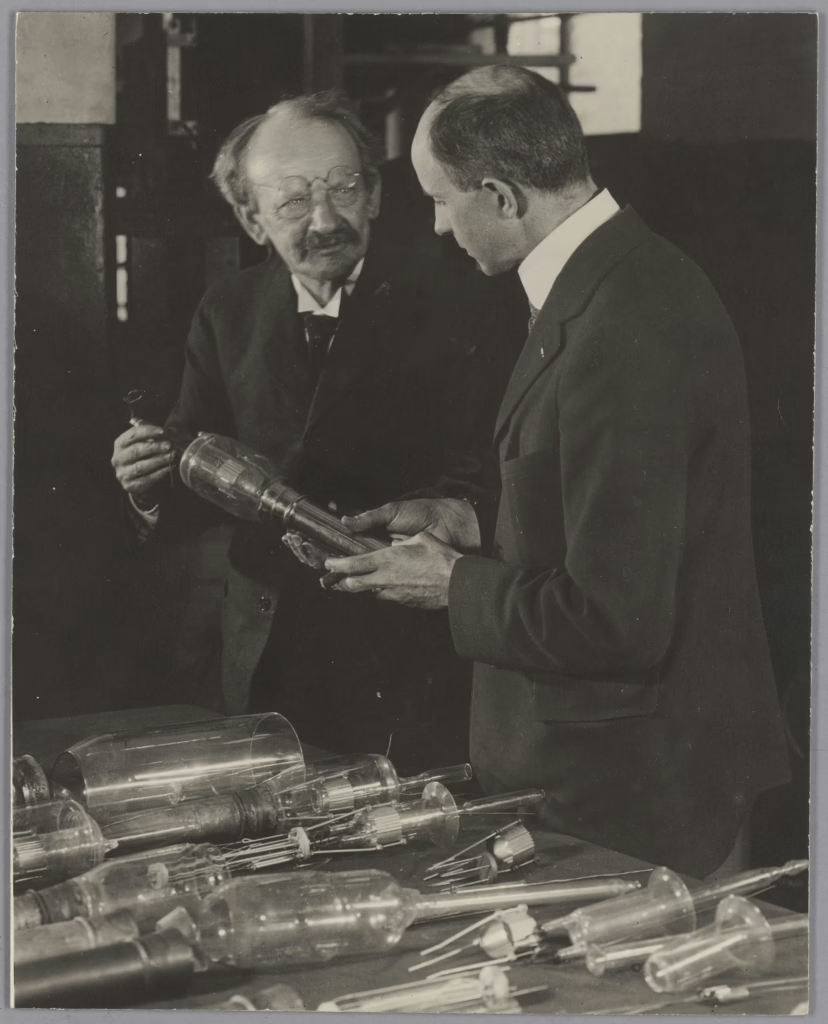
Thomson’s work with positive rays (canal rays) led to the discovery of isotopes; atoms of the same element with different masses. While studying neon, he found two distinct types of atoms, proving that elements could exist in multiple forms. He also developed the first rudimentary mass spectrograph, a device that could separate ions based on their mass-to-charge ratio, laying the groundwork for modern mass spectrometry used in chemistry and physics today.
Joseph John Thomson's Accomplishments
Awards and Distinctions
Joseph John Thomson received numerous accolades throughout his career, reflecting the significance of his contributions to physics. Most notably, he was awarded the Nobel Prize in Physics in 1906 for his work on the conduction of electricity in gases, which included his discovery of the electron. He also received the Royal Medal in 1894 and the Copley Medal in 1914 from the Royal Society, two of Britain’s most prestigious scientific honours. Additional recognitions included the Hughes Medal, the Franklin Institute’s Elliott Cresson Medal, and international awards that acknowledged his pioneering research.
Academic and Professional Honours
Thomson’s influence extended beyond his research. He was knighted in 1908, becoming Sir Joseph John Thomson, and served as President of the Royal Society from 1915 to 1920. In 1918, he was appointed Master of Trinity College, Cambridge, a role he held until his death. These positions placed him at the heart of British scientific and academic life, where he shaped policy, mentored future leaders, and promoted research excellence.
Mentorship and Influence
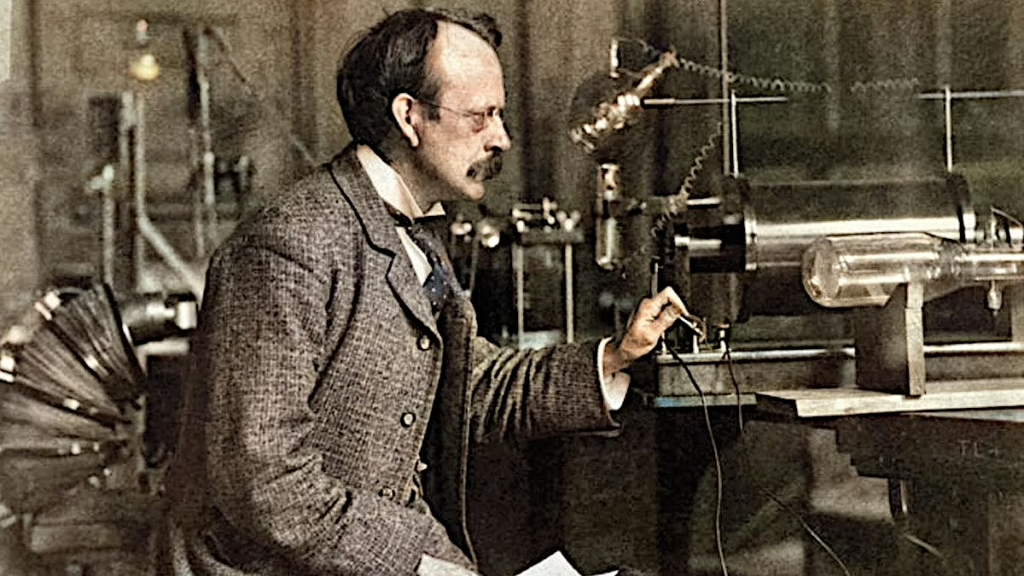
As head of the Cavendish Laboratory, Thomson mentored a generation of physicists who would go on to make groundbreaking discoveries. His students included Ernest Rutherford, who discovered the atomic nucleus, and Niels Bohr, who developed the quantum model of the atom. Remarkably, his son, George Paget Thomson, also won the Nobel Prize in Physics in 1937 for demonstrating the wave-like nature of electrons—completing a scientific arc begun by his father.
Enduring Recognition
Thomson’s contributions were so significant that he was buried in Westminster Abbey, among Britain’s most revered figures. His name remains synonymous with the birth of modern atomic theory, and his work continues to influence physics, chemistry, and engineering. Institutions, awards, and laboratories around the world still bear his name, ensuring that his legacy endures in both education and research.
Explore Further
Continue learning about the lives of the people that shaped nuclear history.
Rudolf Peierls – The Physicist Who Made the Atomic Bomb Possible
Leo Szilard – The Man Who Warned the World
Ellen Gleditsch – Norway’s Pioneer of Radiochemistry
Otto Hahn – The Dawn of the Atomic Age
Did you know? Explore Nuclear also offers great careers information and learning resources.
Below you can find references to the information and images used on this page.
Content References
- J.J. Thomson – Biographical – NobelPrize.org
- J.J. Thomson | Biography, Nobel Prize, & Facts | Britannica
- J.J. Thomson – Experiment, Theory & Life
- Subatomic science: JJ Thomson’s discovery of the electron | Royal Institution
- Joseph John “J. J.” Thomson | Science History Institute
- J. J. Thomson – Wikipedia
- J. J. Thomson – Biography, Facts and Pictures
- J.J. Thomson | Biographies
Image References
- J.J. Thomson LCCN – Bain News Service – No known restrictions on publication
- J.J. Thomson Frank B. Jewett Bell Labs 1923 – Unknown author – Public Domain
- JJ Thomson (Nobel) – Nobel foundation – Public Domain
- J. J. Thomson with his cathode-ray tube – Unknown author – CC BY-SA 2.0
- Joseph John Thomson – Royal Institution – CC BY-NC-ND 2.0