
Albert Einstein's Life
Life and Work
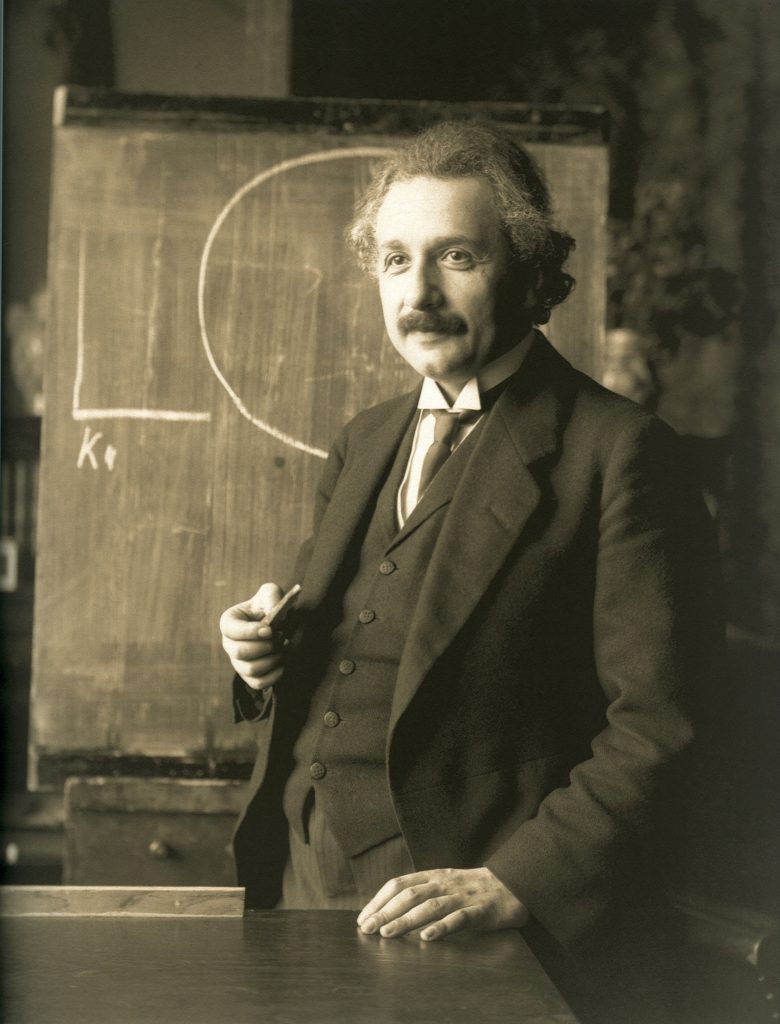
Albert Einstein was born in 1879 in Ulm, Germany, into a middle-class Jewish family. As a child, he showed curiosity about the natural world but struggled in traditional schooling. He later studied at the Swiss Federal Polytechnic in Zurich, graduating in 1900. After a brief period of unemployment, he secured a position at the Swiss Patent Office in Bern, where he had the time and freedom to develop his ground-breaking scientific ideas.
In 1905, often referred to as his “miracle year”, Einstein published four papers that transformed physics. These included his explanation of the photoelectric effect, which laid the foundation for quantum theory, and his special theory of relativity, which introduced the famous equation E=mc². These works challenged classical Newtonian physics and opened new paths for understanding space, time, and energy.
Einstein continued to refine his theories, and in 1915 he presented the general theory of relativity, which described gravity not as a force but as the curvature of spacetime caused by mass and energy. This theory was confirmed in 1919 when observations of a solar eclipse showed light bending around the sun, catapulting Einstein to international fame. His work also influenced cosmology, predicting an expanding universe, and contributed to the development of quantum mechanics, though he remained sceptical of its probabilistic nature.
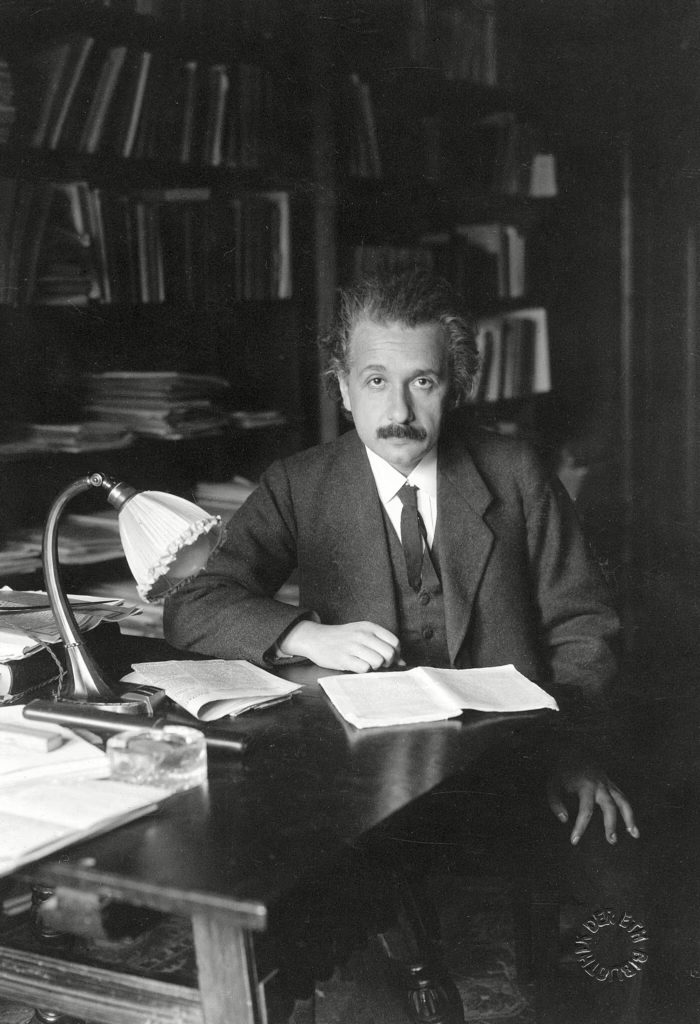
Beyond science, Einstein was deeply engaged in social and political issues. He was an outspoken advocate for peace, civil rights, and international cooperation. In 1933, he fled Nazi Germany and settled in the United States, taking a position at Princeton University. During World War II, he signed a letter warning of Germany’s potential development of nuclear weapons, which indirectly led to the Manhattan Project, though he himself opposed the use of atomic bombs.
Einstein spent his later years searching for a unified field theory that could reconcile relativity and quantum mechanics, a quest that remained unfinished at his death in 1955. His legacy endures not only in physics but also in his role as a public intellectual, humanitarian, and symbol of scientific creativity.
Albert Einstein's Scientific Contributions
Special Theory of Relativity (1905)
Einstein’s special theory of relativity revolutionised physics by showing that the laws of physics are the same for all non-accelerating observers, and that the speed of light is constant regardless of motion. This theory introduced the famous equation E=mc², which revealed the equivalence of mass and energy. It overturned Newtonian mechanics at high speeds and became a cornerstone of modern physics.
General Theory of Relativity (1915)
Building on his earlier work, Einstein developed the general theory of relativity, which described gravity not as a force but as the curvature of spacetime caused by mass and energy. This theory explained phenomena such as the bending of light around massive objects and predicted black holes and gravitational waves. Observations during the 1919 solar eclipse confirmed his predictions, making him a global scientific icon.
Photoelectric Effect (1905)
Einstein’s explanation of the photoelectric effect demonstrated that light can behave as particles (quanta) rather than just waves. This discovery was crucial in the development of quantum mechanics and earned him the Nobel Prize in Physics in 1921. His work paved the way for technologies like solar cells and modern electronics.
Contributions to Quantum Theory
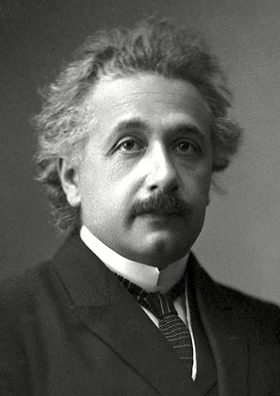
Although sceptical of quantum mechanics’ probabilistic nature, Einstein made significant contributions. He introduced the concept of wave-particle duality and worked on the theory of stimulated emission, which later became the basis for lasers. His debates with Niels Bohr highlighted fundamental questions about determinism and reality in quantum physics.
Cosmology and Unified Field Theory
Einstein applied relativity to cosmology, predicting an expanding universe. Though he initially introduced the “cosmological constant” to allow for a static universe, later discoveries showed expansion was correct. In his later years, he sought a unified field theory to reconcile relativity and quantum mechanics, a quest that remains unfinished but inspired future research.
Other Contributions
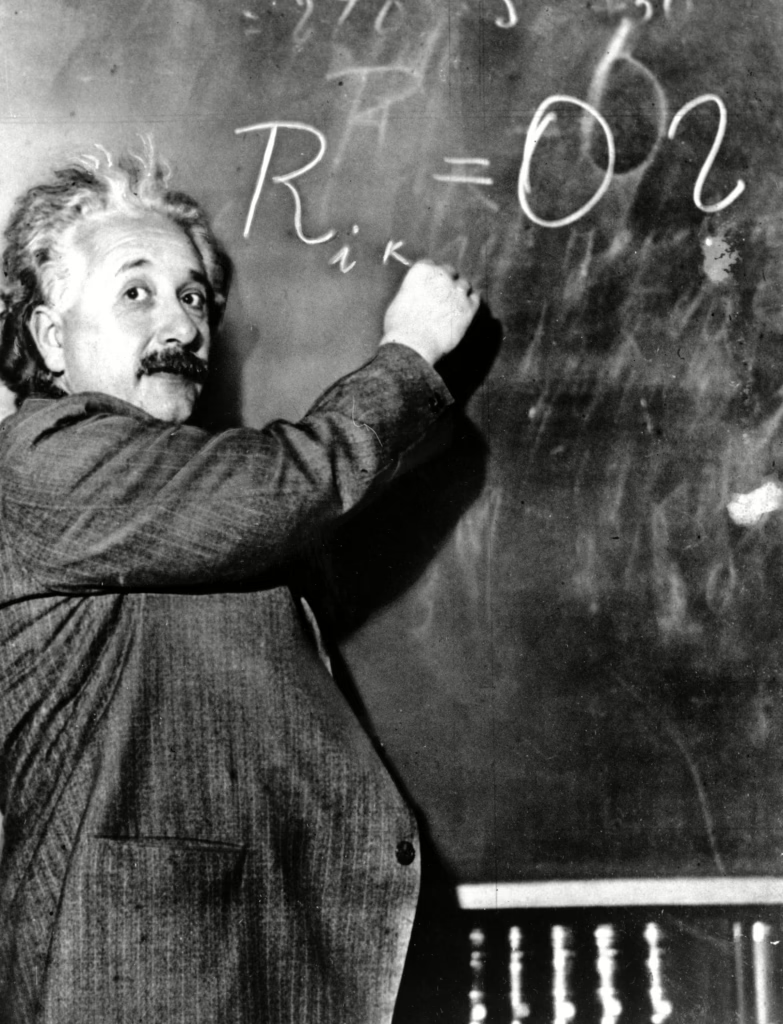
- Brownian motion: Provided theoretical proof of atoms’ existence by explaining the random motion of particles in fluids.
- Bose-Einstein statistics: Collaborated with Satyendra Nath Bose to describe the behaviour of bosons, leading to the prediction of Bose-Einstein condensates.
- Advances in thermodynamics and statistical mechanics: His early work clarified fundamental principles of heat and molecular motion.
Albert Einstein's Accomplishments
Awards and Honours
Albert Einstein received widespread recognition for his contributions to physics. His most notable accolade was the Nobel Prize in Physics in 1921, awarded for his explanation of the photoelectric effect, which laid the foundation for quantum theory. Beyond the Nobel, he was granted honorary doctorates from universities across Europe and America, and memberships in prestigious academies such as the Prussian Academy of Sciences. He was also invited to lecture worldwide, becoming one of the most celebrated scientists of his era.
Activism and Public Engagement
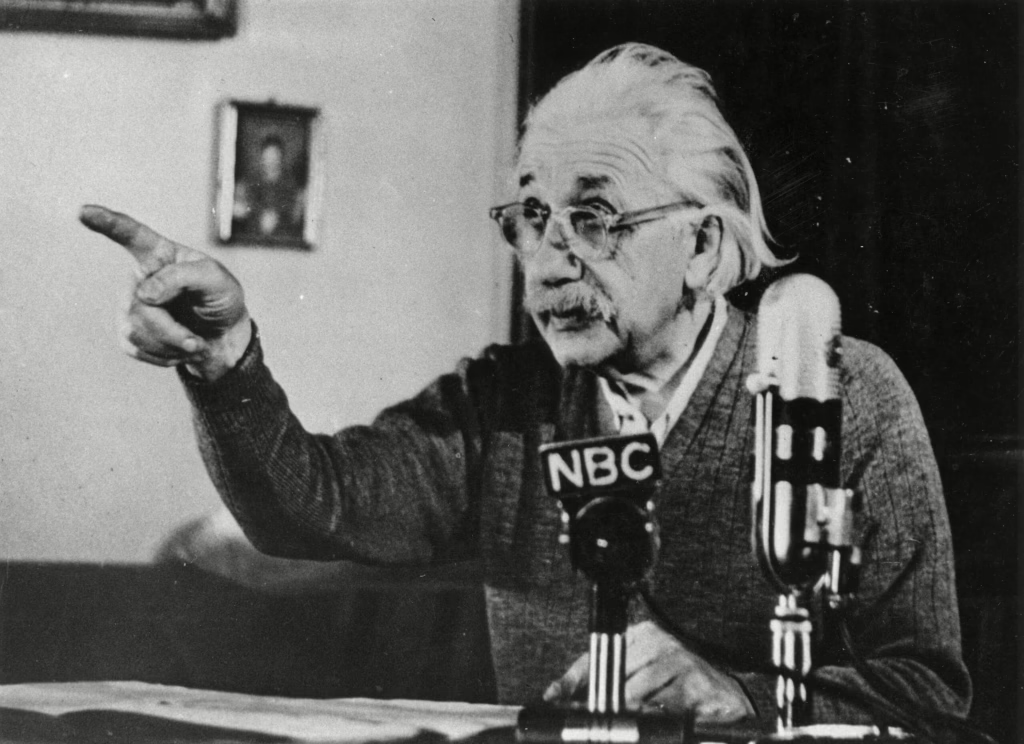
Einstein was not only a scientist but also a passionate advocate for social justice and peace. He spoke out against militarism and nationalism, particularly after witnessing the devastation of World War I. In the 1930s, he became an outspoken critic of fascism and fled Nazi Germany, settling in the United States. He supported civil rights, publicly opposing racial segregation in America, and was a member of the NAACP. During World War II, he co-signed a letter to President Roosevelt warning of Nazi Germany’s potential development of nuclear weapons, which indirectly led to the Manhattan Project. After the war, he campaigned against nuclear proliferation and promoted international cooperation.
Legacy in Science and Society
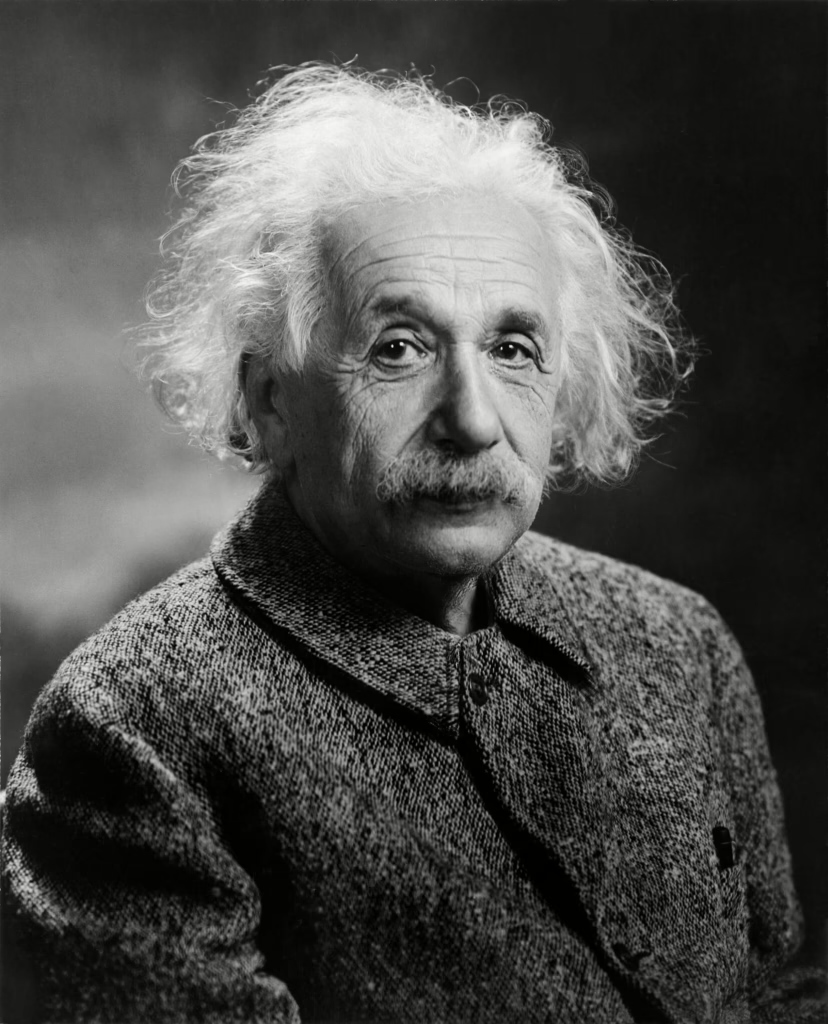
Einstein’s legacy extends far beyond his scientific theories. His work on relativity and quantum mechanics reshaped modern physics and continues to influence research in cosmology, particle physics, and technology. He became a symbol of intellectual curiosity and creativity, embodying the image of the “scientific genius.” His humanitarian efforts and outspoken advocacy for peace and equality cemented his role as a moral voice in the 20th century. Today, Einstein’s name is synonymous with brilliance, and his contributions remain central to both science and global culture.
Explore Further
Continue learning about the lives of the people that shaped nuclear history.
Rosalyn Sussman Yalow – Revolutionising Diagnostic Medicine
Mark Oliphant – The Fusion Pioneer Who Shaped Modern Physics
John Cockcroft – The Man Who Split the Atom
Werner Heisenberg – The Man Behind the Uncertainty
Did you know? Explore Nuclear also offers great careers information and learning resources.
Below you can find references to the information and images used on this page.
Content References
- Albert Einstein – Biographical – NobelPrize.org
- Albert Einstein – The Official Website of Albert Einstein
- Albert Einstein: A life spent re-imagining physics – BBC Teach
- Albert Einstein | Biography, Education, Discoveries, & Facts | Britannica
- Albert Einstein – Wikipedia
- Albert Einstein: Biography, Physicist, Nobel Prize Winner
Image References
- Einstein 1921 by F Schmutzer – restoration – Ferdinand Schmutzer – Public Domain
- Albert Einstein photo 1920 – Unknown photographer – Public Domain
- Albert Einstein (Nobel) – Herman Mishkin – Public Domain
- Albert Einstein writing on a blackboard in Pasadena (1931) – Associated Press – Public Domain
- Albert Einstein – Oren Jack Turner – Public Domain
- Albert Einstein declares his opposition to the atomic bomb – Associated Press – Public Domain