
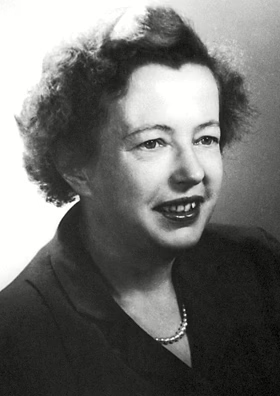
Maria Goeppert Mayer's Life
Life and Work
Maria Goeppert Mayer was born on June 28, 1906, in Kattowitz, Germany (now Katowice, Poland). She was the only child of Friedrich Goeppert, a professor of pediatrics, and Maria Wolff, a former music teacher. In 1910, her family moved to Göttingen, where she grew up in an academic environment. Despite the limited opportunities for women in higher education at the time, she pursued physics at the University of Göttingen, studying under renowned scientists including Max Born. She completed her Ph.D. in 1930 with a thesis on two-photon absorption, a process that would later become important in laser technology.
That same year, she married American chemist Joseph Edward Mayer and moved to the United States. Despite her brilliance, she faced significant barriers as a woman in academia, often working without pay or in unofficial positions. She taught and conducted research at institutions such as Johns Hopkins University and Sarah Lawrence College, while continuing to publish influential work. During World War II, she contributed to the Manhattan Project at Los Alamos, applying her expertise in nuclear physics.
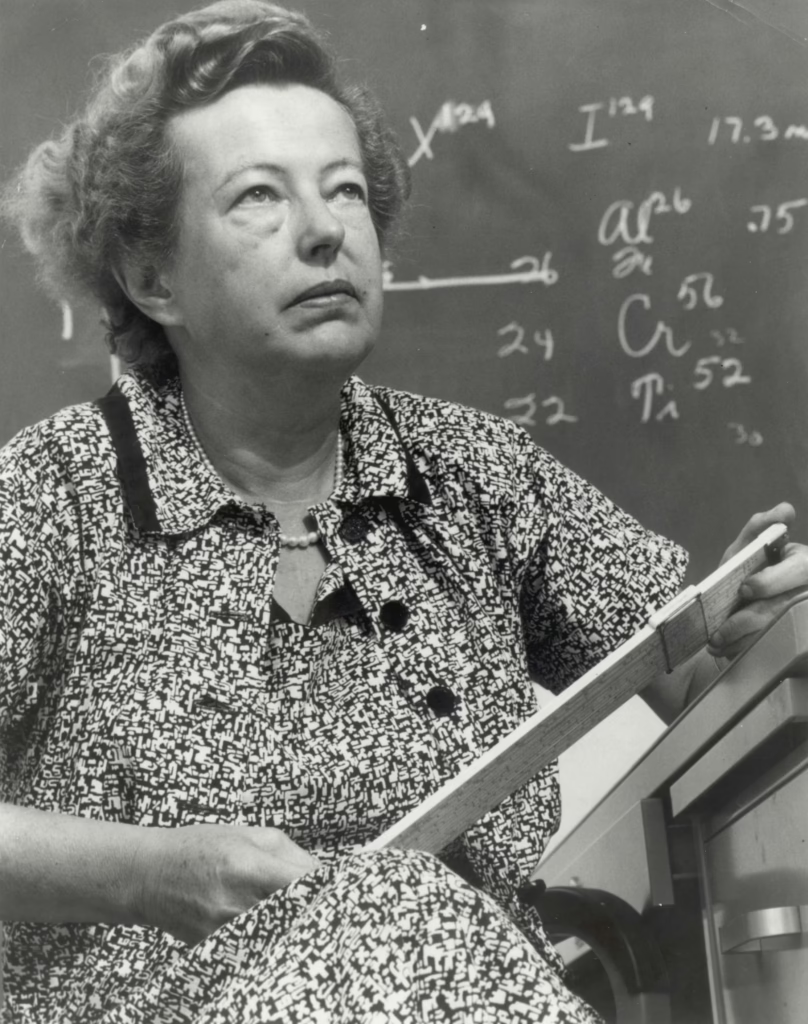
Her most significant scientific achievement came in the late 1940s at the University of Chicago and Argonne National Laboratory. Mayer developed the nuclear shell model, which explained the stability of atomic nuclei by showing that protons and neutrons are arranged in shells, similar to electrons in atoms. This model clarified why certain numbers of nucleons (called “magic numbers”) lead to especially stable nuclei. For this work, she shared the 1963 Nobel Prize in Physics with J. Hans D. Jensen, while Eugene Wigner received the other half for unrelated contributions.
In addition to her Nobel-winning research, Mayer made contributions to statistical mechanics and molecular physics, co-authoring a respected textbook with her husband. Later in her career, she joined the University of California, San Diego, where she continued her research and teaching until her death on February 20, 1972, in San Diego, California.
Maria Goeppert Mayer's Scientific Contributions
Two-Photon Absorption
Goeppert Mayer’s doctoral thesis at the University of Göttingen in 1930 focused on two-photon absorption, a process in which an atom simultaneously absorbs two photons. At the time, this was a purely theoretical prediction, but decades later it became foundational in laser spectroscopy and nonlinear optics. Her insight anticipated technologies that would only emerge with the invention of lasers in the 1960s.
Contributions During World War II
During World War II, Goeppert Mayer worked on the Manhattan Project at Los Alamos, applying her expertise in nuclear physics to problems related to atomic energy and weaponry. Although much of this work was classified, it demonstrated her ability to apply theoretical physics to urgent practical challenges.
The Nuclear Shell Model
Her most celebrated achievement was the nuclear shell model, developed in the late 1940s while working at the University of Chicago and Argonne National Laboratory. Goeppert Mayer proposed that protons and neutrons in the nucleus are arranged in shells, similar to the way electrons orbit in atomic shells. She identified the concept of “magic numbers” (2, 8, 20, 28, 50, 82, 126), which correspond to especially stable configurations of nucleons. This breakthrough explained why certain isotopes are more stable than others and revolutionised nuclear physics.
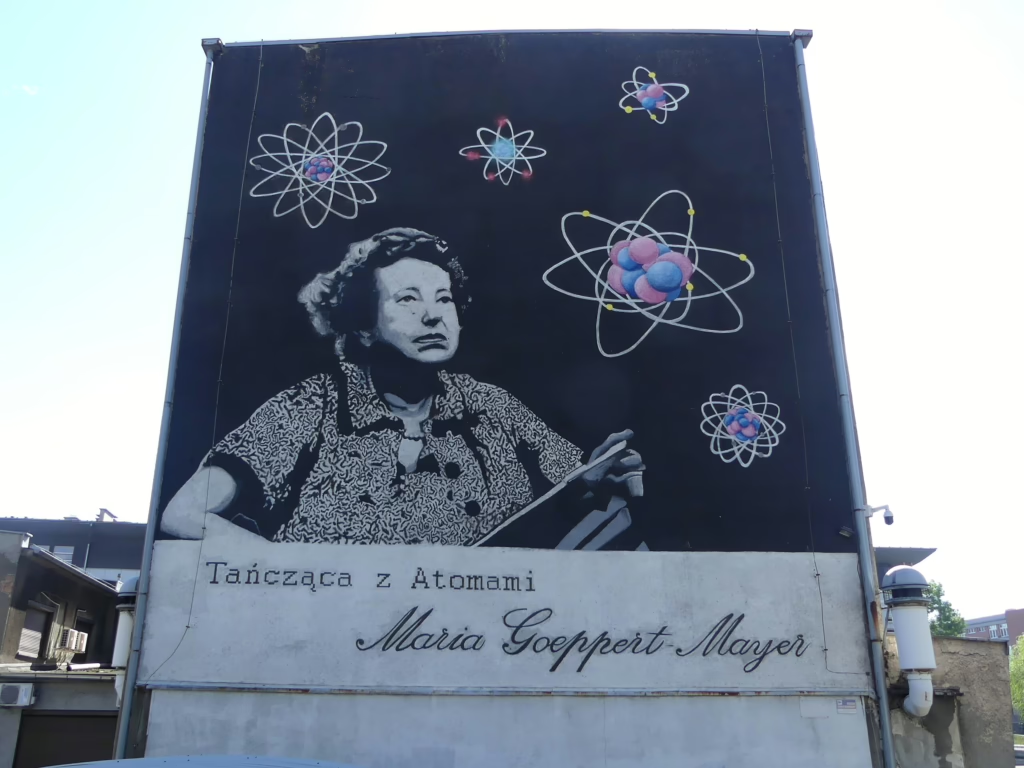
Other Contributions
- Double beta decay research, helping to clarify rare nuclear processes.
- Statistical mechanics and molecular physics, co-authoring a respected textbook with her husband Joseph Mayer.
- Atomic structure studies, which deepened understanding of how quantum mechanics governs matter.
Maria Goeppert Mayer's Accomplishments
Nobel Prize in Physics
Maria Goeppert Mayer’s most prestigious recognition was the 1963 Nobel Prize in Physics, which she shared with J. Hans D. Jensen for their discovery of the nuclear shell structure. This achievement made her only the second woman ever to win the Nobel Prize in Physics, after Marie Curie, and the first to receive it for theoretical physics.
Other Academic and Professional Recognition
Although she spent much of her career working without pay or formal positions, Mayer eventually became a full professor at the University of California, San Diego in 1960. Her election to the National Academy of Sciences and her recognition by peers reflected her standing as one of the foremost physicists of her time.
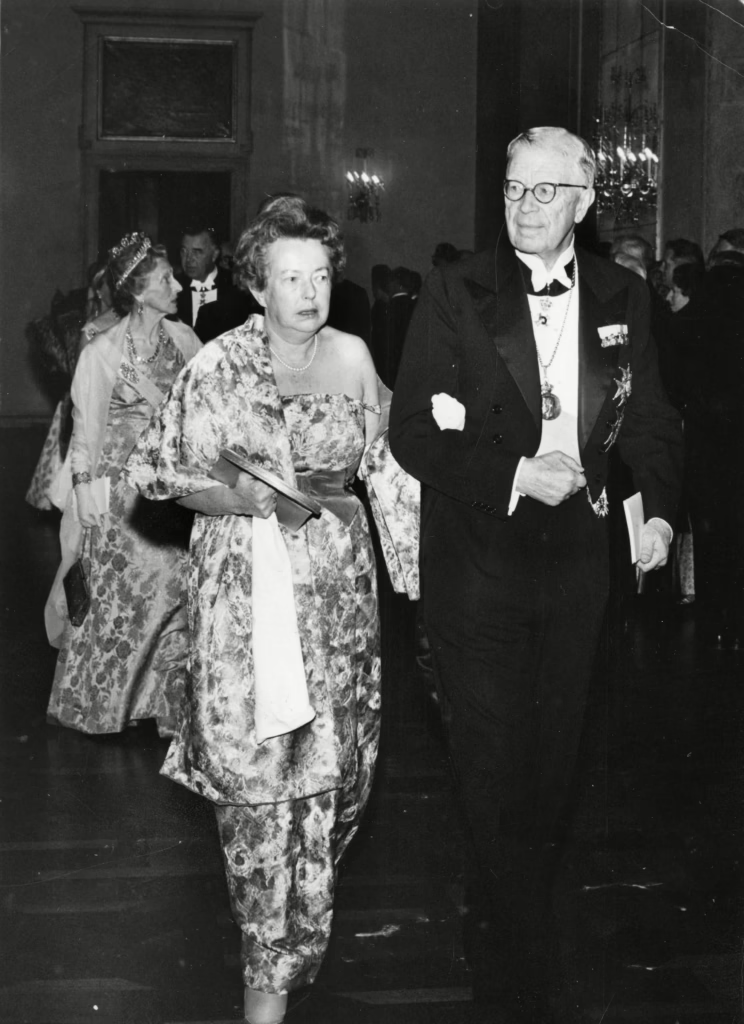
Other Academic and Professional Recognition
Her legacy is honoured through the Maria Goeppert Mayer Award, established in 1986 by the American Physical Society. This annual prize recognises outstanding contributions to physics research by women in the early stages of their careers, providing both financial support and opportunities to present their work publicly. The award symbolises Mayer’s role as a pioneer who opened doors for future generations of women physicists.
Legacy and Influence
Maria Goeppert Mayer’s contributions to the nuclear shell model remain central to nuclear physics, influencing research in nuclear energy, astrophysics, and particle physics. Beyond her scientific impact, she is remembered as a trailblazer for women in science, overcoming systemic barriers to achieve international recognition. Her story underscores the importance of perseverance and intellectual curiosity, inspiring efforts to promote gender equality in STEM fields
Explore Further
Continue learning about the lives of the people that shaped nuclear history.
Glenn T. Seaborg – The Man Who Rewrote the Periodic Table
Andrei Sakharov – Scientist, Dissident, Icon
Lise Meitner – A Pioneering Physicist and Educator
Willard Libby – Reshaping Our Understanding of the Ancient World
Did you know? Explore Nuclear also offers great careers information and learning resources.
Below you can find references to the information and images used on this page.
Content References
Image References
- Maria Goeppert-Mayer – Nobel foundation – Public Domain
- Maria Goeppert-Mayer portrait – ENERGY.GOV – Public Domain
- Mural Maria Goeppert-Mayer – Bärbel Miemietz – CC BY-SA 4.0
- Mural Maria Goeppert-Mayer – Bärbel Miemietz – CC BY-SA 4.0
- Maria Goeppert-Mayer – Smithsonian Institution – No known copyright restrictions