
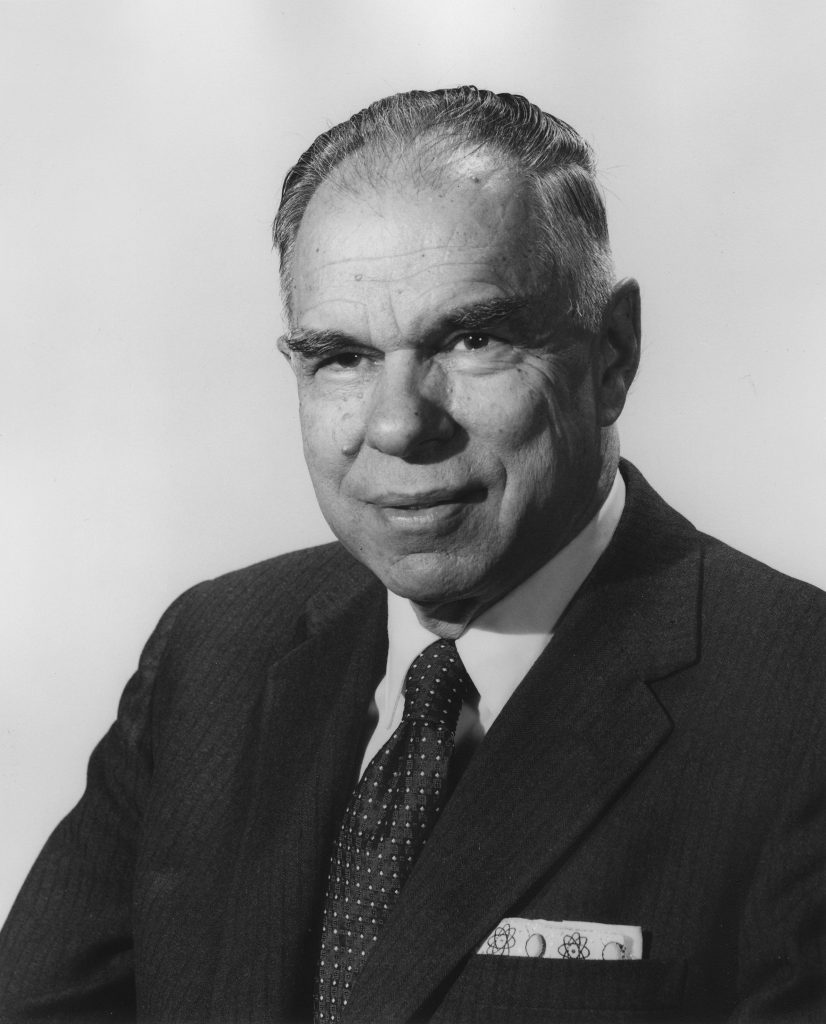
Glenn T. Seaborg's Life
Life and Work
Glenn T. Seaborg was born on April 19, 1912, in Ishpeming, Michigan, before moving with his family to California at age ten. A gifted student, he graduated as valedictorian from David Starr Jordan High School and went on to study chemistry at UCLA, later earning his PhD from the University of California, Berkeley, in 1937. Early in his career, he worked closely with the influential chemist G. N. Lewis, publishing several papers and establishing himself as a rising figure in the field.
Seaborg’s scientific achievements accelerated rapidly once he joined the Berkeley faculty in 1939. Working with colleagues, he co-discovered plutonium in 1940 and went on to identify numerous other transuranium elements, i.e. elements beyond uranium on the periodic table. His contributions reshaped modern chemistry and nuclear science, culminating in the 1951 Nobel Prize in Chemistry, which he shared with Edwin McMillan for their work on these elements. His research also produced radioisotopes that would later be used in medical treatments for millions of patients.
During World War II, Seaborg played a key role in the Manhattan Project, contributing to the development of nuclear materials used in atomic weapons. After the war, he continued to influence U.S. science policy. He served as chairman of the U.S. Atomic Energy Commission under Presidents Kennedy, Johnson, and Nixon, advising nine presidents over the course of his career. He also held leadership roles at the University of California, including serving as chancellor at Berkeley.
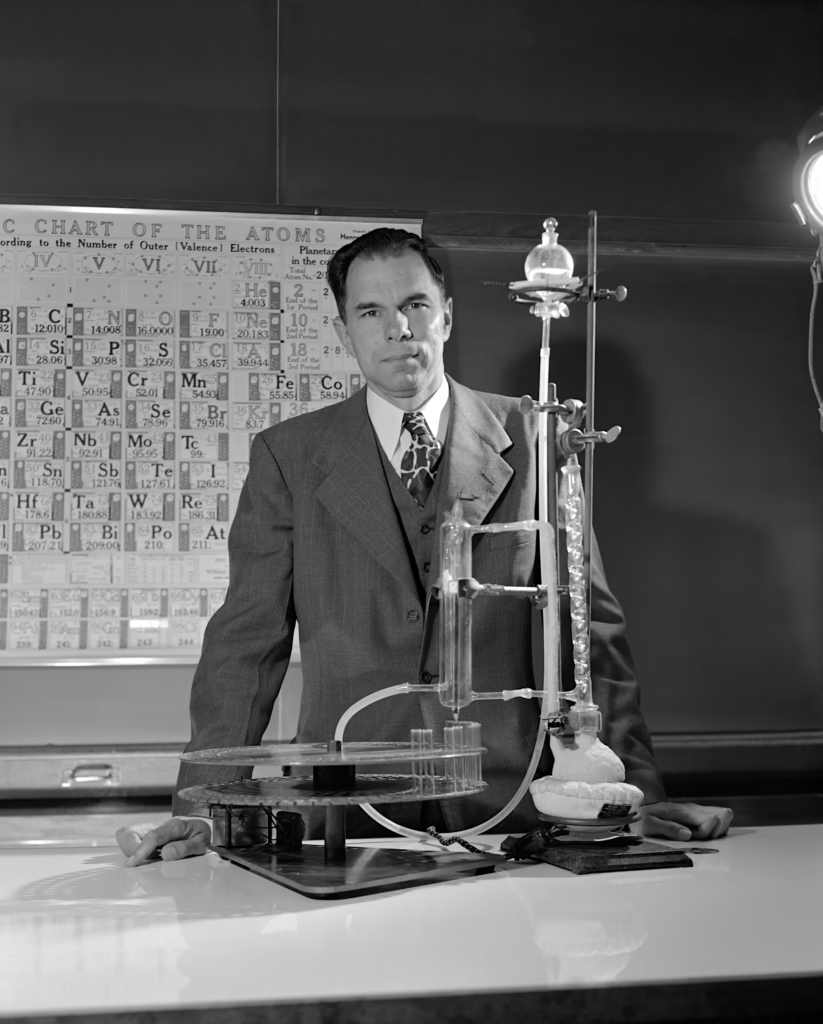
Beyond his scientific and governmental work, Seaborg was a prolific educator and advocate for science. He co-founded the Lawrence Hall of Science and remained deeply involved in national science education initiatives, including President Reagan’s National Commission on Excellence in Education. His legacy was further cemented when element 106 was named seaborgium in his honour.
Glenn T. Seaborg died on February 25, 1999, in Lafayette, California, leaving behind a monumental legacy in chemistry, nuclear science, and public service.
Glenn T. Seaborg's Scientific Contributions
Discovery of Transuranium Elements
Glenn T. Seaborg is best known for his pioneering work in the discovery and investigation of the transuranium elements—those with atomic numbers greater than uranium’s 92. Working at the University of California, Berkeley, he co‑discovered plutonium in 1940, an achievement that became central to both nuclear weapons and nuclear energy. Over the course of his career, he contributed to the discovery or isolation of ten elements, including americium, curium, berkelium, californium, einsteinium, fermium, mendelevium, and nobelium. These discoveries fundamentally expanded the periodic table and reshaped modern nuclear chemistry.
The Actinide Concept
One of Seaborg’s most influential theoretical contributions was the actinide concept. He proposed that the elements from actinium onward formed a distinct series analogous to the lanthanides. This insight led to the modern arrangement of the periodic table, placing the actinides in their own row beneath the main body of the table. The actinide concept resolved longstanding inconsistencies in element classification and remains a cornerstone of chemical education and research.
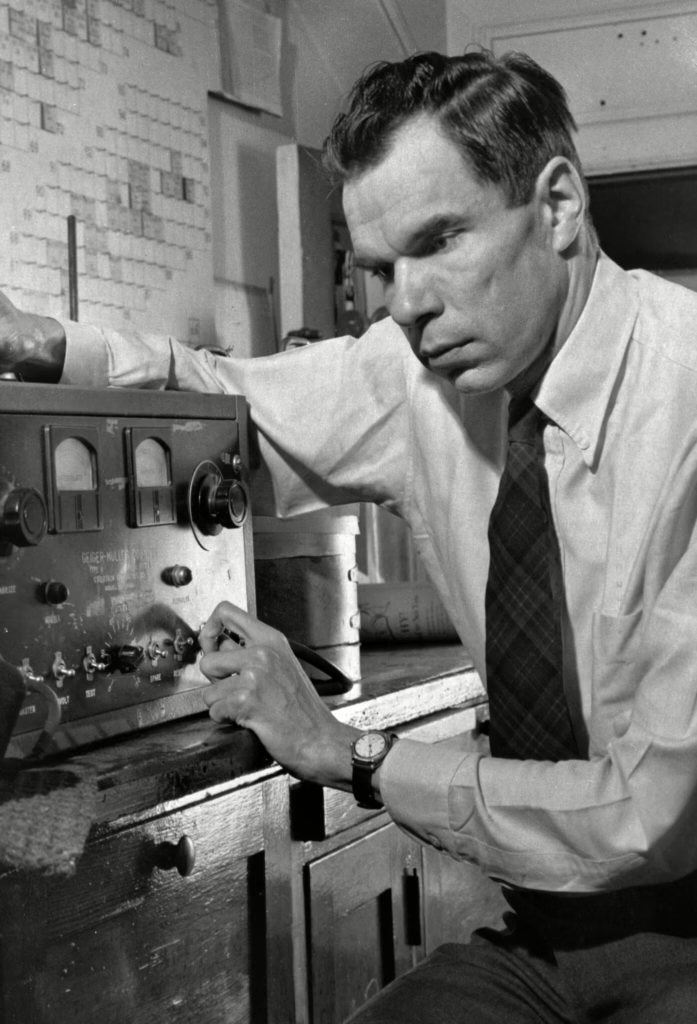
Advances in Nuclear Chemistry
Seaborg’s work extended beyond element discovery. He helped develop methods for producing and isolating radioactive isotopes, many of which became essential in medicine, industry, and research. His early work with particle bombardment demonstrated how heavier elements could be synthesised artificially, a breakthrough that opened the door to modern nuclear science. His research also contributed to understanding the chemical behaviour of highly radioactive materials, enabling safer handling and practical applications.
Contributions to National Science and Policy
Although not strictly laboratory science, Seaborg’s leadership roles had major scientific impact. He served as chairman of the U.S. Atomic Energy Commission, influencing nuclear research, energy policy, and safety standards for more than a decade. His guidance shaped national priorities in nuclear technology and education, and he remained a prominent scientific advisor to multiple U.S. presidents.
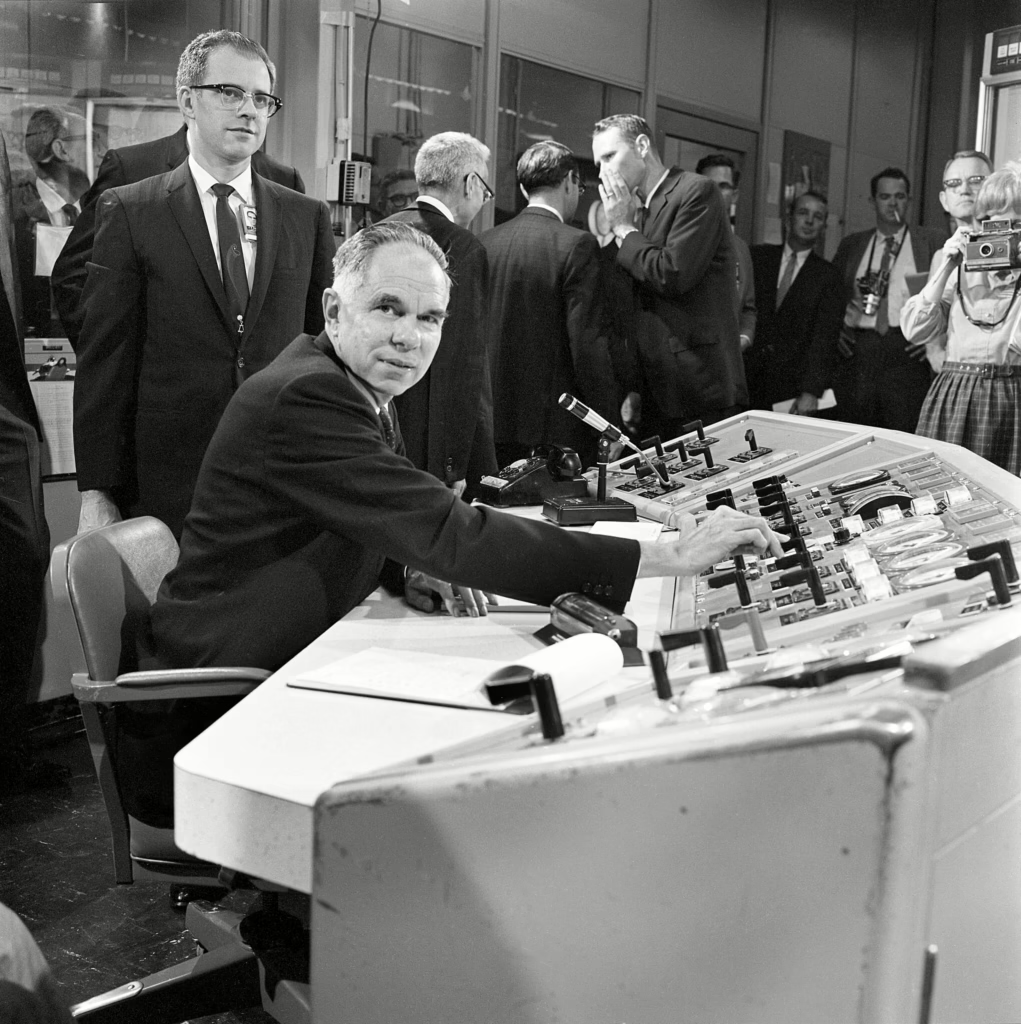
Glenn T. Seaborg's Accomplishments
Awards and Honours
Glenn T. Seaborg received an extraordinary number of awards throughout his career, reflecting his central role in shaping modern nuclear chemistry. Among his most prestigious honours was the 1951 Nobel Prize in Chemistry, awarded for his discoveries of transuranium elements. He also earned the American Chemical Society’s Award in Pure Chemistry (1947), the Nichols Medal (1948), and the John Ericsson Gold Medal (1948). His scientific peers recognised him with election to the National Academy of Sciences (1948) and later honours such as the Enrico Fermi Award (1959), the Franklin Medal (1963), the Willard Gibbs Award (1966), and the Priestley Medal (1979).
Public Recognition and Career Distinctions
Beyond scientific circles, Seaborg was widely celebrated for his public service and educational leadership. He was named one of the Ten Outstanding Young Men in America (1947) and received the Alumnus of the Year Award from the University of California, Berkeley in 1948. His long record of contributions to national science policy, including his tenure as chairman of the U.S. Atomic Energy Commission, further elevated his public profile. At one point, he even held a place in the Guinness Book of World Records for having the longest entry in Marquis Who’s Who.
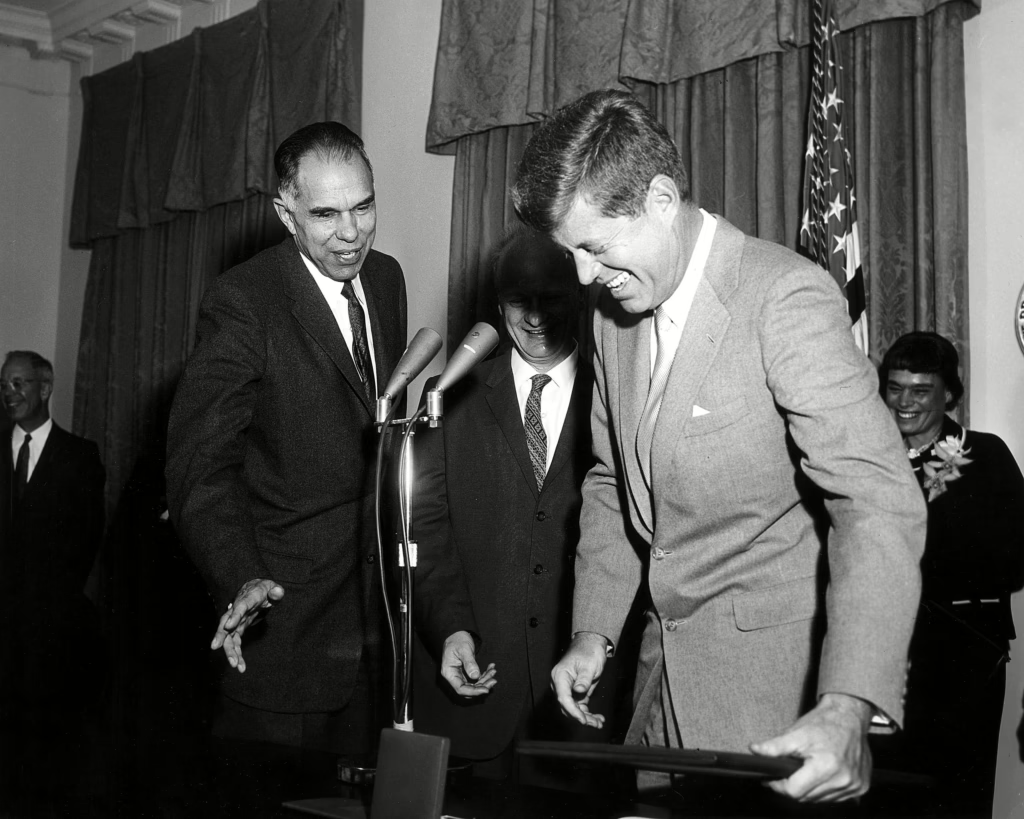
A Legacy Etched Into the Periodic Table
Seaborg’s legacy is uniquely immortalised in the periodic table itself. Element 106, seaborgium, was named in his honour, an unprecedented tribute, as he was alive at the time of the naming. This distinction symbolises his transformative impact on the understanding and expansion of the periodic table, particularly through his co‑discovery of ten transuranium elements and his formulation of the actinide concept.
Enduring Influence on Science and Education
Seaborg’s influence extends far beyond his laboratory achievements. His work reshaped nuclear chemistry, informed national science policy, and contributed to the development of medical isotopes used worldwide. His leadership in science education, including his involvement in national commissions and university governance, helped shape generations of scientific thinking. Today, his name appears on awards, institutions, and scientific literature, ensuring his contributions remain central to the history of modern chemistry.
Explore Further
Continue learning about the lives of the people that shaped nuclear history.
Otto Hahn – The Dawn of the Atomic Age
Abram Alikhanov – The Rise of Soviet Nuclear Research
Eugene Wigner – A Life Shaped by Symmetry and Science
Ernest Lawrence – The Physicist Who Built Big Science
Did you know? Explore Nuclear also offers great careers information and learning resources.
Below you can find references to the information and images used on this page.
Content References
- Glenn T. Seaborg – Biographical – NobelPrize.org
- Glenn Theodore Seaborg | Science History Institute
- Glenn T. Seaborg | Nobel Prize-Winning Chemist | Britannica
- Glenn Seaborg – Biography, Facts and Pictures
- Glenn T. Seaborg – Wikipedia
- Manhattan Project: People > Scientists > GLENN T. SEABORG
- Glenn Seaborg
- Glenn T. Seaborg – His Biography
Image References
- Glenn Seaborg – 1964 – Atomic Energy Commission – Public Domain
- Glenn T. Seaborg – Nobel Prize 1951 Chemistry – Berkeley Lab – CC BY-NC-ND 2.0
- Seaborg in lab – restoration – Unknown Author – Public Domain
- MSRE U-233 Seaborg – doe-oakridge – Public Domain
- HD.3C.027 – ENERGY.GOV – Public Domain