
Table of Contents
Homi J. Bhabha's Life
Life and Work
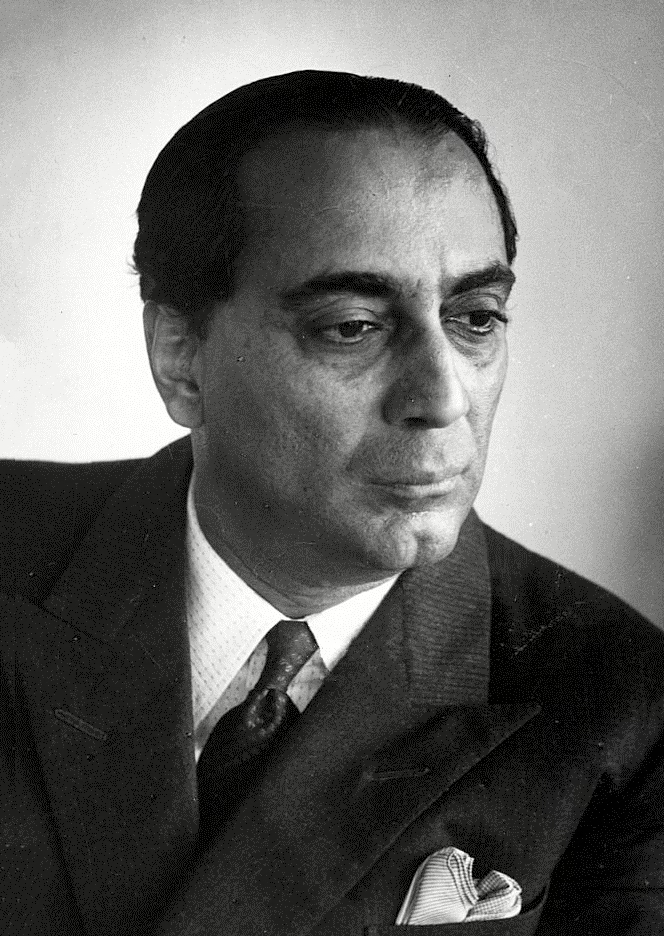
Born into a prominent Parsi family in Bombay, Homi Jehangir Bhabha grew up in an environment that valued education and culture. His early academic brilliance led him to the University of Cambridge, where he studied mechanical engineering before shifting to theoretical physics, a field that captured his imagination. His research during this period, particularly on cosmic rays and the behaviour of elementary particles, earned him early recognition, including the prestigious Adams Prize.
When the Second World War broke out, Bhabha returned to India and joined the Indian Institute of Science in Bangalore, working under Nobel laureate C.V. Raman. Recognising the need for a world-class research institution in fundamental science, he persuaded the Tata Trust to support the creation of the Tata Institute of Fundamental Research (TIFR) in 1945, where he served as founding director. His leadership extended beyond pure science; he became the driving force behind India’s atomic energy programme, chairing the newly formed Atomic Energy Commission from 1948. His vision laid the groundwork for India’s three-stage nuclear power strategy and its long-term scientific self-reliance.
Bhabha was also known for his deep appreciation of the arts, architecture, and music, embodying a rare blend of scientific rigour and cultural sensitivity. His life was tragically cut short in 1966 when he died in an air crash near Mont Blanc while travelling to Vienna for an International Atomic Energy Agency meeting. Despite his early death, Bhabha’s legacy endures in India’s scientific institutions, its nuclear capabilities, and the generations of researchers inspired by his vision.
Homi J. Bhabha's Work
Early Theoretical Physics Contributions
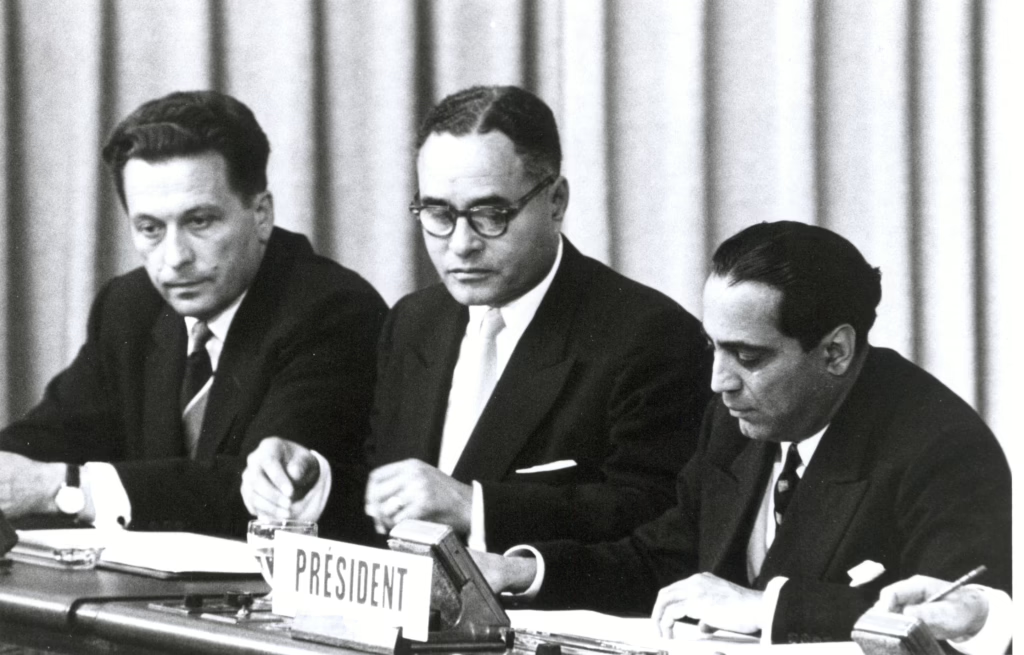
Homi Jehangir Bhabha’s scientific career began with groundbreaking work in theoretical physics, particularly during his years at Cambridge. He made major contributions to the understanding of cosmic rays, positron interactions, and particle physics. His most famous early achievement was the calculation of the cross‑section for electron–positron scattering, now known as Bhabha scattering, a foundational result in quantum electrodynamics. He also collaborated with Walter Heitler to develop the Bhabha–Heitler theory, which explained how cosmic ray showers develop in the atmosphere. Another significant insight was his theoretical prediction of the muon, a heavier cousin of the electron, before it was experimentally confirmed.
Cosmic Rays and High‑Energy Physics
Bhabha’s fascination with cosmic rays shaped much of his early research. His work helped establish cosmic rays as a powerful tool for probing high‑energy processes in nature. His analyses of cascade processes and point particles contributed to the emerging field of high‑energy physics, earning him international recognition and awards such as the Adams Prize.
Institution Building and Scientific Leadership
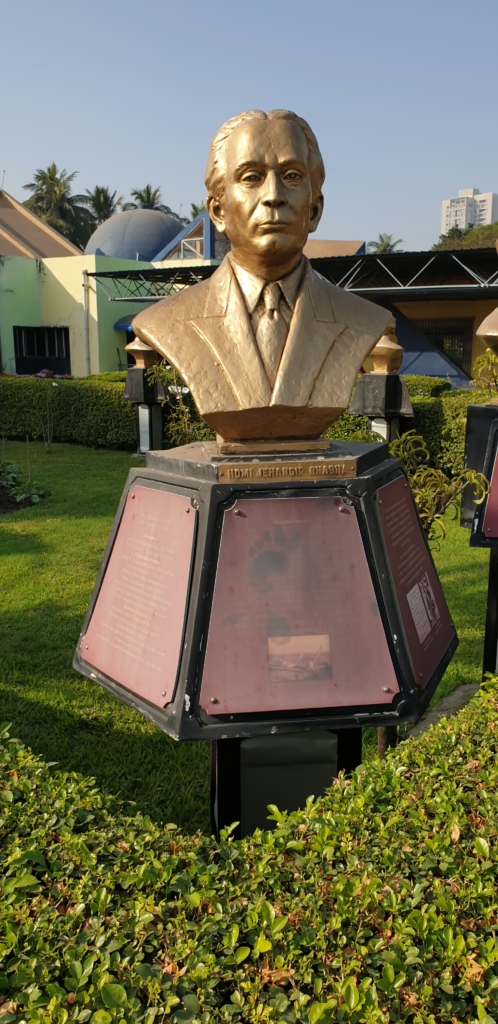
Beyond research, Bhabha was a visionary institution builder. After returning to India during World War II, he played a central role in shaping the country’s scientific landscape. He founded the Tata Institute of Fundamental Research (TIFR) in 1945, which became India’s premier centre for advanced research in physics and mathematics. Later, he established the Atomic Energy Establishment, Trombay, which was renamed the Bhabha Atomic Research Centre (BARC) after his death.
Architect of India’s Nuclear Programme
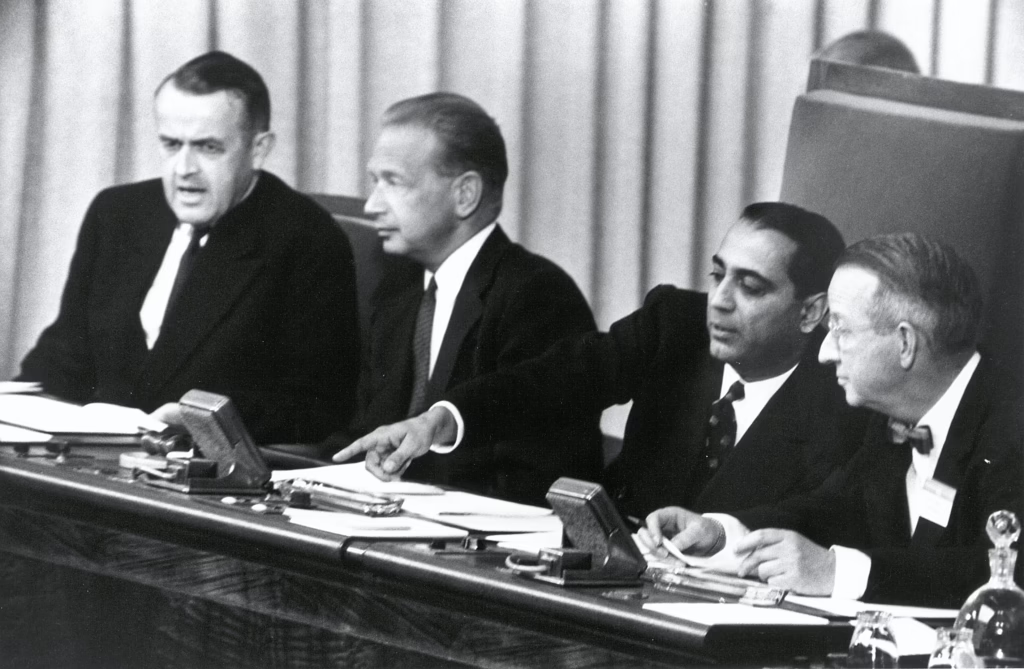
Bhabha’s most enduring legacy lies in his leadership of India’s nuclear programme. As the first chairman of the Atomic Energy Commission of India (1948–1966), he laid the foundations for the country’s civilian nuclear energy strategy. He championed a three‑stage nuclear power programme aimed at achieving long‑term energy independence and oversaw the development of research reactors, nuclear laboratories, and training programmes.
Homi J. Bhabha's Legacy
Awards and Honours
During his lifetime, Homi J. Bhabha became one of India’s most celebrated scientists, though many of the awards in his name were established posthumously. His pioneering work in cosmic rays and nuclear science inspired the creation of several honours, the most prominent being the Homi Bhabha Medal and Prize, awarded jointly by the International Union of Pure and Applied Physics (IUPAP) and the Tata Institute of Fundamental Research (TIFR). Established in 2010, it recognises distinguished contributions to high‑energy cosmic‑ray physics and astroparticle physics. The award includes a medal, a certificate, a monetary prize, and invitations to lecture at TIFR and the Cosmic Ray Laboratory in Ooty.
Institutional Legacy
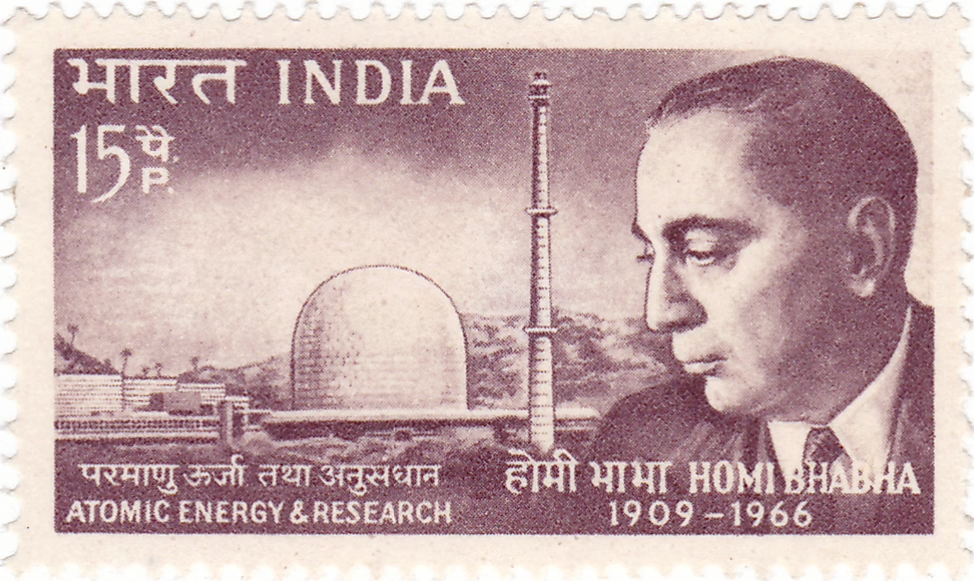
Bhabha’s legacy is deeply embedded in India’s scientific infrastructure. The Bhabha Atomic Research Centre (BARC), named in his honour, remains the country’s premier nuclear research facility. The institutions he founded continue to train generations of scientists, engineers, and researchers. His emphasis on combining scientific excellence with cultural and artistic sensibility also shaped the aesthetic and intellectual character of these institutions.
Enduring Recognition
The continued awarding of the Homi Bhabha Medal and Prize at the International Cosmic Ray Conference (ICRC) reflects his lasting global impact on high‑energy physics. His name is invoked not only in awards but also in scientific terminology, research programmes, and national policy frameworks. His legacy endures as a symbol of India’s scientific ambition and its commitment to self‑reliance in advanced research.
Explore Further
Continue learning about the lives of the people that shaped nuclear history.
Ellen Gleditsch – Norway’s Pioneer of Radiochemistry
Leona Woods – The Lone Woman of Chicago Pile-1
Lewis Strauss – Visionary or Villain of the Atomic Era
Mark Oliphant – The Fusion Pioneer Who Shaped Modern Physics
Did you know? Explore Nuclear also offers great careers information and learning resources.
Below you can find references to the information and images used on this page.
Content References
- Life and work of the great Visionary, Homi J. Bhabha — Google Arts & Culture
- Homi J. Bhabha – Nuclear Museum
- Homi J. Bhabha Biography, Early Life, Career, Contributions & Achievements
- Homi J. Bhabha – New World Encyclopedia
- Homi J. Bhabha – Wikipedia
- Homi Bhabha | Physicist, Biography, Early Life, Education, Scientific Contributions, Leadership, Atomic Energy Program, & Facts | Britannica
Image References
- Homi Jehangir Bhabha 1960s – Unknown Author – Public Domain
- Atoms for Peace (01280007) – IAEA Imagebank – CC BY-SA 2.0
- Science city Kolkata in 2023 05 – Rajasekhar1961 – CC BY-SA 4.0
- Atoms for Peace (01280005) – IAEA Imagebank – CC BY-SA 2.0
- Homi Jehangir Bhabha 1966 stamp of India – India Post, Government of India – GODL