
Table of Contents
Ellen Gleditsch's Life
Life and Work
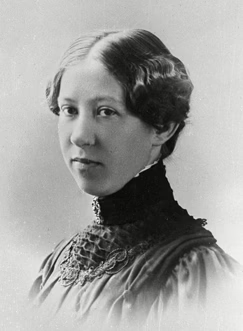
Born in Mandal, Norway, Ellen Gleditsch began her working life as a pharmacy apprentice, a path that sparked her interest in chemistry. Determined to pursue scientific training at a time when opportunities for women were limited, she moved to Kristiania (now Oslo) and later to Paris, where she worked in Marie Curie’s laboratory. This period proved formative: she contributed to research on radium and refined her expertise in radiochemical methods.
After returning to Norway, Gleditsch became one of the country’s first female university scientists. Her research focused on determining the half-life of radium and establishing the atomic weight of lead derived from radioactive sources. This work helped confirm the existence of isotopes, a major scientific breakthrough of the early 20th century. She earned international recognition for her precision and methodological rigour, becoming a respected figure in the global scientific community.
Beyond her laboratory achievements, Gleditsch was a committed advocate for women in science and higher education. She became Norway’s second female professor and played an active role in international scientific organisations, including the International Federation of University Women, where she served as president. Her long career blended scientific excellence with public engagement, and she remained a prominent voice for academic freedom and women’s rights throughout her life.
Ellen Gleditsch's Work
Early Radiochemical Training
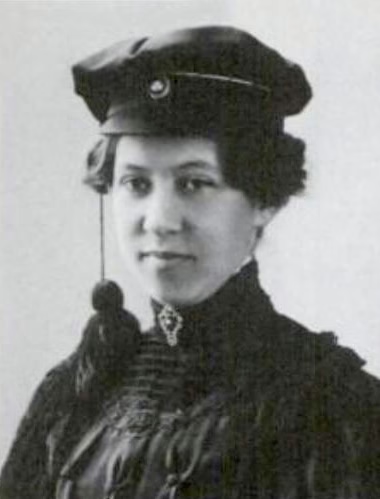
Gleditsch’s scientific career began in the early 1900s, when she left Norway to work in Marie Curie’s Paris laboratory. There she learned the demanding techniques of radiochemical separation and purification, especially those used to isolate radium. This training placed her among the earliest specialists in the new field of radioactivity and gave her the methodological foundation for the rest of her career.
Work on Radium and Half‑Life Determination
One of Gleditsch’s most significant contributions was her precise measurement of the half‑life of radium. At a time when the properties of radioactive elements were still being established, her careful experimental work helped refine the accepted value. Her results were widely respected for their accuracy and became part of the international scientific consensus on radium’s behaviour.
Establishing Atomic Weights and Evidence for Isotopes
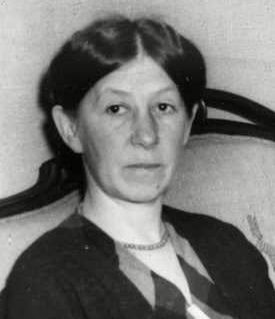
Gleditsch also played a key role in determining the atomic weight of lead derived from radioactive decay. By comparing this “radioactive lead” with ordinary lead, she produced evidence that elements could exist in multiple forms with different atomic weights; what Frederick Soddy later termed isotopes. Her work provided some of the earliest experimental confirmation of this concept, which became central to modern chemistry and nuclear science.
Building Radiochemistry in Norway
Returning to Norway, Gleditsch helped establish radiochemistry as a recognised scientific discipline. She developed teaching programmes, trained new researchers, and built laboratory capacity at the University of Oslo. Her efforts ensured that Norway participated in international research on radioactivity at a time when the field was rapidly expanding.
Ellen Gleditsch's Legacy
Major Awards and Honours
Ellen Gleditsch received wide recognition for her scientific contributions, particularly in radiochemistry. She was elected to the Norwegian Academy of Science and Letters, a significant achievement at a time when few women were admitted to such institutions. Her international reputation also led to honorary memberships in several scientific societies abroad. Throughout her career, she was frequently invited to speak at major scientific congresses, reflecting the esteem in which her work was held.
Leadership Roles and International Influence
Gleditsch became a prominent figure in international scientific cooperation. One of her most notable roles was serving as president of the International Federation of University Women (IFUW), where she championed academic freedom and the advancement of women in higher education. She also contributed to international committees on radioactivity standards, helping shape the protocols and measurements that guided early nuclear science.
Advocacy for Women in Academia
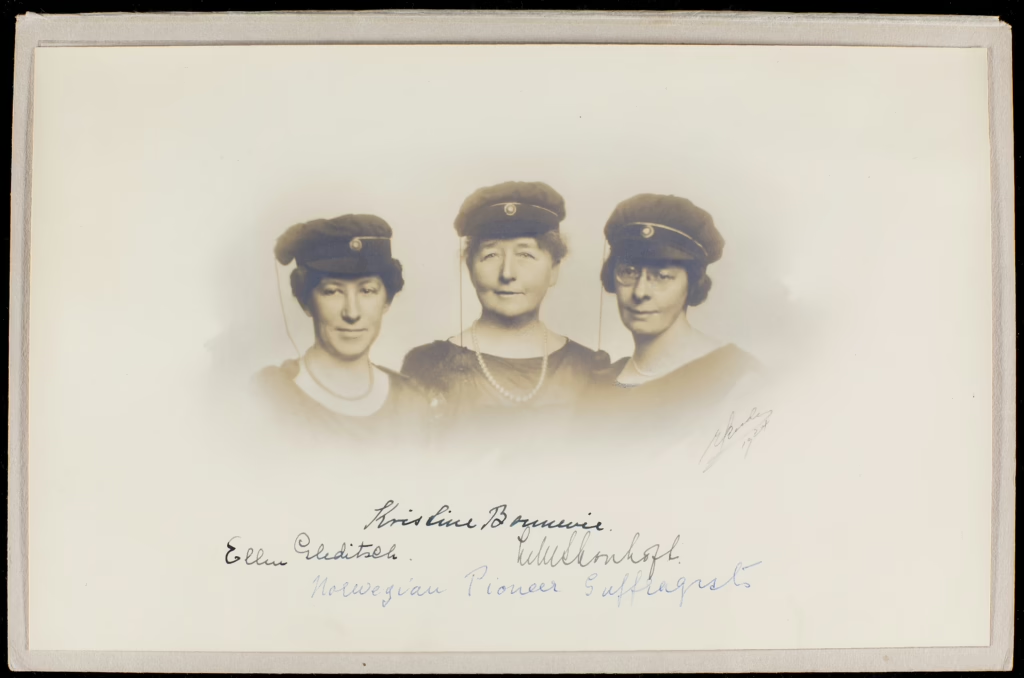
Beyond her laboratory achievements, Gleditsch was a lifelong advocate for women’s rights in education and research. She worked to expand opportunities for women scientists, both in Norway and internationally, and became a role model for women entering scientific fields. Her leadership in the IFUW and her public engagement cemented her reputation as a pioneer for gender equality in academia.
Explore Further
Continue learning about the lives of the people that shaped nuclear history.
Chien-Shiung Wu – The First Lady of Physics
He Zehui – Pioneer of Modern Chinese Physics
Eugene Wigner – A Life Shaped by Symmetry and Science
Homi J. Bhabha – Father of the Indian Nuclear Programme
Did you know? Explore Nuclear also offers great careers information and learning resources.
Below you can find references to the information and images used on this page.
Content References
Image References
- Ellen Gleditsch2 – Aune – Public Domain
- Ellen Gleditsch – T. Kronnen and A.C. Pappas – Public Domain
- EllenGleditsch – Unknown author – CC BY-SA 3.0
- Group Portraits- Norwegian Pioneer Suffragists, 1924 – LSE Library – No known copyright restrictions