
Table of Contents
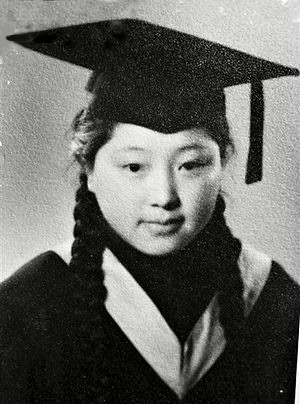
He Zehui's Life
Life and Work
Born on 5 March 1914 in Suzhou, He Zehui excelled academically from an early age and entered the physics department at Tsinghua University in 1931, graduating in 1936. She later pursued doctoral studies in Germany, earning her PhD from the Technical University of Berlin in 1940, where she also completed a thesis on measuring the speed of flying bullets.
During the 1940s, He Zehui worked in Europe at Siemens AG, the Kaiser Wilhelm Institute, and later the Curie Institute in Paris. Her research contributed to the discovery of ternary and quaternary fission of uranium, a significant advancement in nuclear physics. She collaborated with leading scientists of the era, including Walther Bothe, and became one of the few Chinese women engaged in high‑level nuclear research abroad during World War II.
In 1948, she returned to China and joined the Institute of Atomic Science in Peiping. After the founding of the People’s Republic of China, she played a central role in building the country’s nuclear science capabilities. She served as a research fellow and later deputy director at both the Institute of Atomic Energy and the Institute of High Energy Physics under the Chinese Academy of Sciences. Her leadership and scientific contributions earned her recognition as one of the founders of modern physics research in China and the nickname “China’s Madame Curie.”
Beyond her scientific achievements, He Zehui was also active in national affairs, serving as a member of the 5th, 6th, and 7th CPPCC National Committees. She was married to fellow physicist Qian Sanqiang, with whom she formed a prominent scientific partnership. He Zehui passed away on 20 June 2011 in Beijing at the age of 97, leaving behind a legacy as one of China’s most influential women in science.
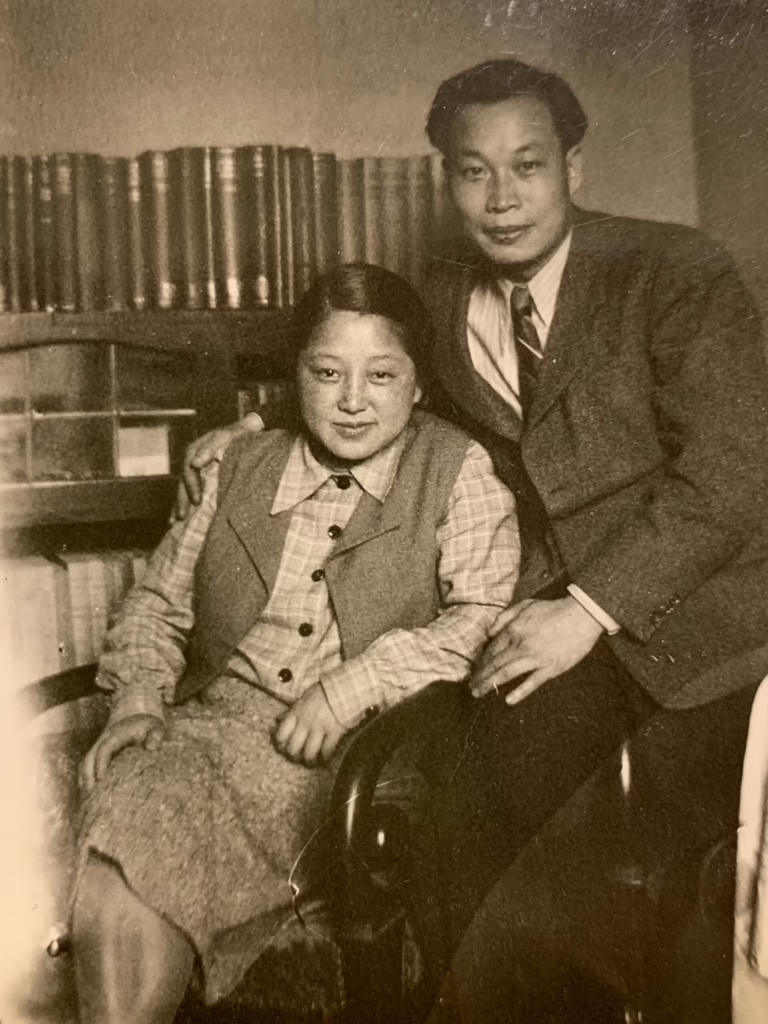
He Zehui's Work
Contributions to Nuclear Fission Research
During the 1940s, He Zehui worked at the Kaiser Wilhelm Institute and later at the Curie Institute in Paris. In collaboration with leading physicists such as Walther Bothe, she conducted experiments that helped identify ternary and quaternary fission in uranium. These discoveries expanded scientific understanding of how heavy nuclei split and provided important data for the emerging field of nuclear science. Her work placed her among the earliest Chinese scientists to contribute directly to cutting‑edge nuclear research in Europe.
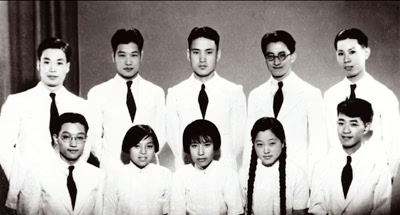
Building China’s Nuclear Science Infrastructure
After returning to China in 1948, He Zehui became a central figure in establishing the country’s nuclear research capabilities. She joined the Institute of Atomic Energy under the Chinese Academy of Sciences, where she helped develop laboratories, train young physicists, and guide early research programs. Her leadership supported China’s broader efforts to build an independent scientific foundation in nuclear physics during the mid‑20th century.
High‑Energy Physics and Later Scientific Leadership
In the decades following the founding of the People’s Republic of China, He Zehui expanded her work into high‑energy physics, contributing to the development of particle accelerators and experimental facilities. She served as deputy director of both the Institute of Atomic Energy and the Institute of High Energy Physics, shaping research priorities and mentoring a new generation of scientists. Her influence extended beyond her own experiments, helping to define the trajectory of modern physics research in China.
National Service and Scientific Legacy
Alongside her scientific work, He Zehui participated in national advisory roles, serving on several committees of the Chinese People’s Political Consultative Conference. Her career earned her the reputation of being one of China’s most important women in science, sometimes referred to as “China’s Madame Curie.” Her legacy endures in the institutions she helped build and the scientific fields she advanced.
He Zehui's Legacy
Awards and Honours
He Zehui received wide recognition for her scientific achievements and her role in building China’s nuclear and high‑energy physics research. Over the course of her career, she was awarded several national science prizes, including honours from the Chinese Academy of Sciences for her contributions to nuclear fission research and the development of experimental physics in China.
Enduring Influence
He Zehui’s legacy extends far beyond her individual research. She helped build laboratories, train generations of physicists, and shape the direction of China’s nuclear and high‑energy physics programs. Many of the institutions she helped establish—particularly within the Chinese Academy of Sciences—remain central to China’s scientific development today. Her career demonstrated the vital role of women in major scientific fields, and she continues to be celebrated as a symbol of intellectual dedication, scientific courage, and national contribution.
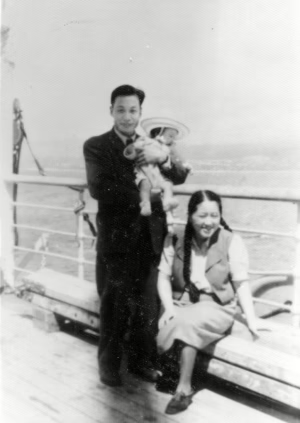
Explore Further
Continue learning about the lives of the people that shaped nuclear history.
Chien-Shiung Wu – The First Lady of Physics
Irène Joliot-Curie – A Legacy of Science and Service
Dmitri Mendeleev – The Man Who Brought Structure to the Elements
George de Hevesy – The Founder of Nuclear Medicine
Did you know? Explore Nuclear also offers great careers information and learning resources.
Below you can find references to the information and images used on this page.
Content References
Image References
- He Zehui – Unknown author – Public Domain
- 钱三强何泽慧 – Fotobaby – CC BY-SA 4.0
- 1936 Graduation Class in Physics at Tsinghua University – Unknown author – Public Domain
- He Zehui 3 – Unknown author – Public Domain