
Table of Contents
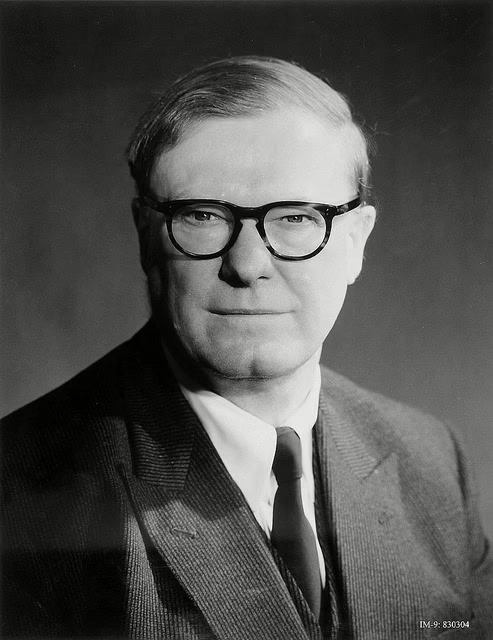
William Penney's Life
Life and Work
William Penney, born William George Penney on 24 June 1909 in Gibraltar, emerged as one of Britain’s most influential nuclear physicists. His early education was shaped by a technical path encouraged by his father, a sergeant major in the British Army. After excelling at Sheerness Junior Technical School, he progressed to Imperial College London, where he demonstrated exceptional mathematical ability, earning a ‘First’ at age 20 and later completing a Ph.D. His academic journey continued with advanced study at the University of Wisconsin–Madison and a D.Sc. from Trinity College, Cambridge.
During the Second World War, Penney applied his expertise to military research, initially working with the Royal Navy on explosions and shockwaves. In 1943, he joined Tube Alloys, the secret British–Canadian atomic weapons programme, and soon after became head of the British delegation to the Manhattan Project at Los Alamos. There, he played a crucial role in predicting the destructive effects of atomic blast waves, contributing directly to the development and deployment of early nuclear weapons.
After the war, Penney became central to Britain’s independent nuclear ambitions. He led High Explosive Research, the clandestine programme that produced the first British atomic bomb in 1952. His leadership cemented his reputation as the architect of the UK’s nuclear deterrent. Alongside his scientific work, he held prominent academic and administrative roles, including professorships and eventually the rectorship of Imperial College London. His contributions earned him numerous honours, including a knighthood, the Order of Merit, and a life peerage as Baron Penney.
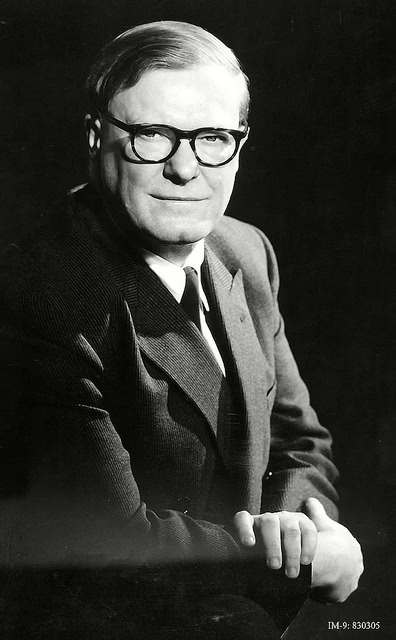
William Penney's Work
Early Scientific Foundations
William Penney began his career as a gifted mathematician, specialising in elasticity, shock waves, and the behaviour of materials under extreme conditions. His early academic work at Imperial College London and later at Cambridge established him as an authority on blast physics, expertise that would define his wartime and post‑war contributions.
Second World War Research
During the Second World War, Penney applied his mathematical skills to military problems. Working first for the Royal Navy, he analysed underwater explosions and shock effects on ships. His work quickly gained strategic importance, and in 1943 he joined Tube Alloys, the British–Canadian atomic weapons project. Soon after, he was sent to Los Alamos as part of the Manhattan Project, where he became a leading figure in modelling the destructive effects of nuclear blast waves.
Role in the Manhattan Project
At Los Alamos, Penney’s calculations were central to predicting how atomic explosions would affect cities, infrastructure, and populations. He contributed to the planning of the Hiroshima and Nagasaki bombings by estimating blast radii and optimal detonation heights. His calm, analytical approach earned him deep respect among American colleagues and positioned him as Britain’s foremost nuclear expert.
Architect of Britain’s Nuclear Programme
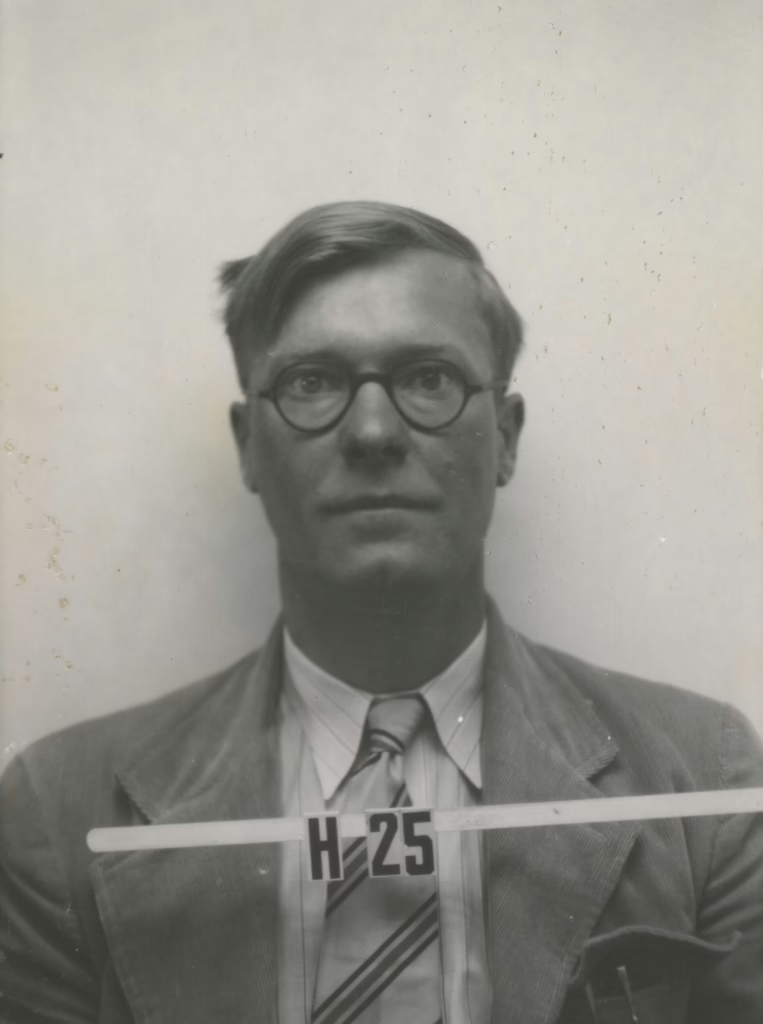
After the war, Penney returned to the UK to lead High Explosive Research, the secret programme to build an independent British atomic bomb. Under his direction, Britain successfully tested its first nuclear device in 1952, making it the world’s third nuclear power. Penney oversaw subsequent developments, including the move toward thermonuclear weapons, and shaped the strategic direction of the UK’s nuclear deterrent for decades.
Scientific Leadership and Public Service
Beyond weapons development, Penney held influential roles in academia and government. He served as a professor, later Rector, of Imperial College London, and chaired numerous scientific committees. His expertise was also sought in civil matters, including investigations into major industrial accidents.
William Penney's Legacy
Major Awards and Honours
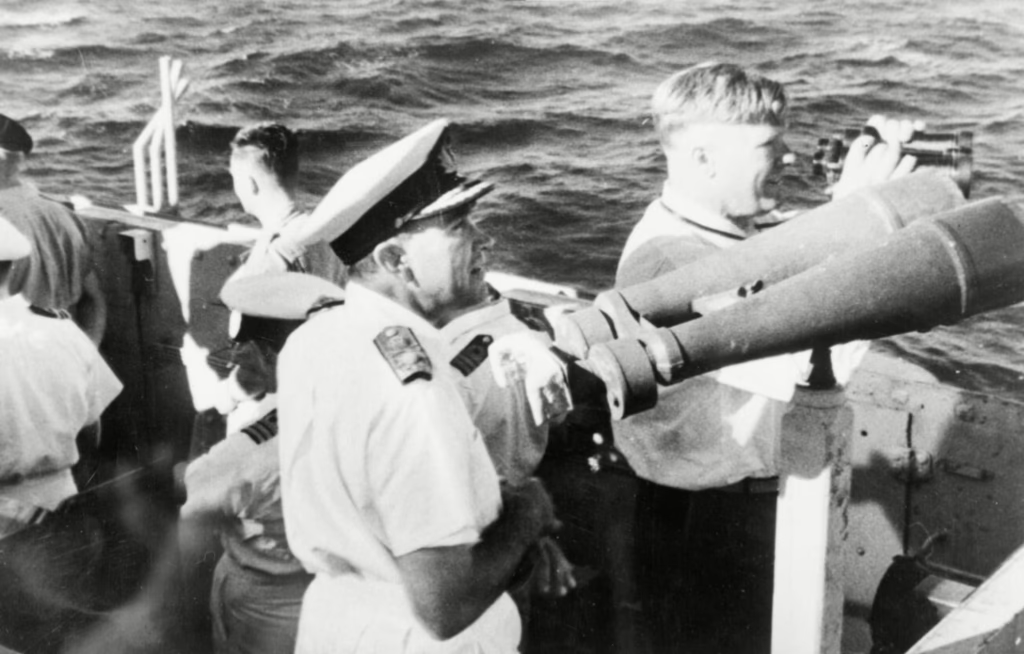
William Penney received some of the highest distinctions available to a British scientist. He was knighted in 1952 for his leadership of the UK’s atomic bomb programme, and in 1967 he was appointed to the Order of Merit, an honour reserved for individuals of exceptional achievement in the arts, sciences, and public life. In 1967 he was also created a life peer as Baron Penney of East Hendred, allowing him to sit in the House of Lords. His scientific standing was further recognised through fellowships in the Royal Society, the Royal Academy of Engineering, and numerous honorary degrees from leading universities.
Influence on British Nuclear Policy
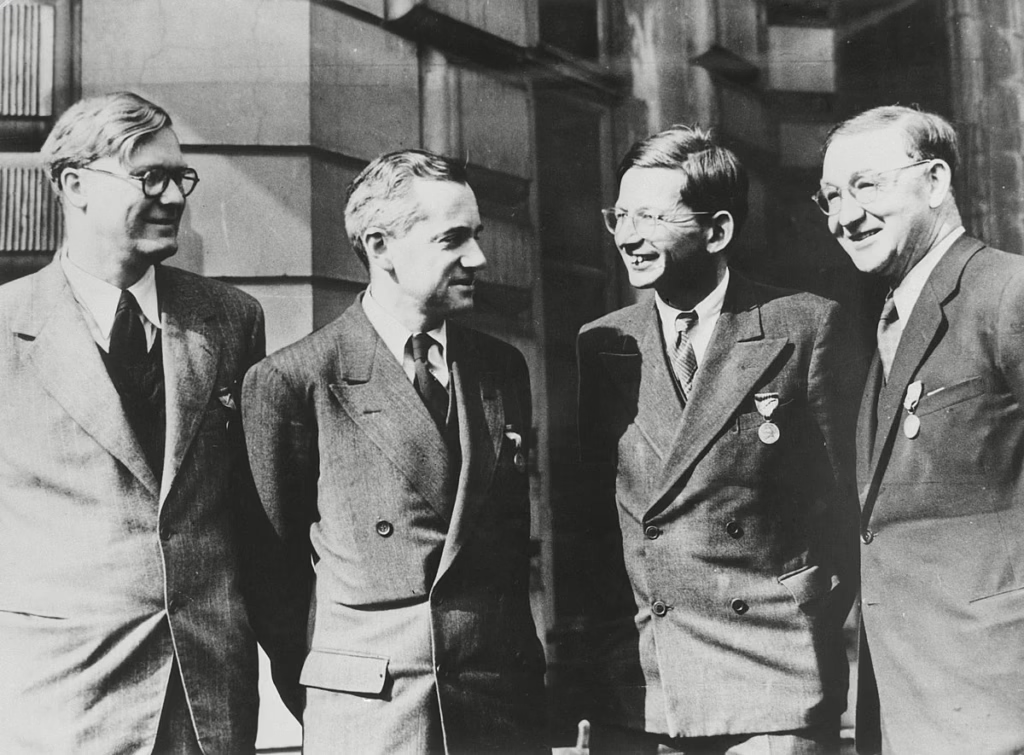
As the architect of Britain’s first atomic bomb and later a key figure in the thermonuclear programme, William Penney shaped the strategic direction of the UK’s nuclear deterrent during the Cold War. His advice was sought by successive governments, and he played a central role in negotiations and scientific exchanges with the United States, helping to restore nuclear cooperation through the 1958 US–UK Mutual Defence Agreement.
Leadership in Science and Academia
Beyond defence, Penney became a prominent national scientific leader. He served as Rector of Imperial College London, where he championed scientific education and research expansion. He chaired the UK Atomic Energy Authority and advised on major national projects, including safety investigations into industrial accidents. His reputation for calm judgement and technical clarity made him a trusted figure in both scientific and governmental circles.
Legacy and Historical Significance
Penney’s legacy is complex and far‑reaching. He is remembered as the driving force behind Britain’s emergence as a nuclear power, a status that continues to shape the country’s defence posture today. His work helped establish the UK as a credible partner in international nuclear science and policy. At the same time, his career raises enduring ethical questions about the responsibilities of scientists involved in weapons development. Nonetheless, his technical brilliance, administrative skill, and national service have secured him a lasting place in British scientific history.
Explore Further
Continue learning about the lives of the people that shaped nuclear history.
Ernest Lawrence – The Physicist Who Built Big Science
Enrico Fermi – Architect of the Nuclear Age
John Cockcroft – The Man Who Split the Atom
Abram Alikhanov – The Rise of Soviet Nuclear Research
Did you know? Explore Nuclear also offers great careers information and learning resources.
Below you can find references to the information and images used on this page.
Content References
- William Penney – Nuclear Museum
- William Penney – oxonblueplaques.org
- William Penney, Baron Penney | Nuclear Scientist, Atomic Weapons & Mathematics | Britannica
- William Penney – dulwichsociety
- William Penney, Baron Penney – Wikipedia
- Our history – AWE
- The blushing Englishman who stole nuclear secrets from the US | New Scientist
- William Penney and the British Nuclear Programme
- William Penney, Baron Penney Biography | Pantheon
Image References
- William Penney – Los Alamos National Laboratory – Unless otherwise indicated, this information has been authored by an employee or employees of the Los Alamos National Security, LLC (LANS), operator of the Los Alamos National Laboratory under Contract No. DE-AC52-06NA25396 with the U.S. Department of Energy. The U.S. Government has rights to use, reproduce, and distribute this information. The public may copy and use this information without charge, provided that this Notice and any statement of authorship are reproduced on all copies. Neither the Government nor LANS makes any warranty, express or implied, or assumes any liability or responsibility for the use of this information.
- William Penney portrait – Los Alamos National Laboratory – See copyright statement above
- William G. Penney Los Alamos badge photo – Los Alamos Laboratory – See copyright statement above
- Penney and Torlesse during Operation Hurricane – Ministry of Supply official photographer – Public Domain
- William Penney, Otto Frisch, Rudolf Peierls and John Cockroft – Los Alamos National Laboratory – See copyright statement above