
Table of Contents
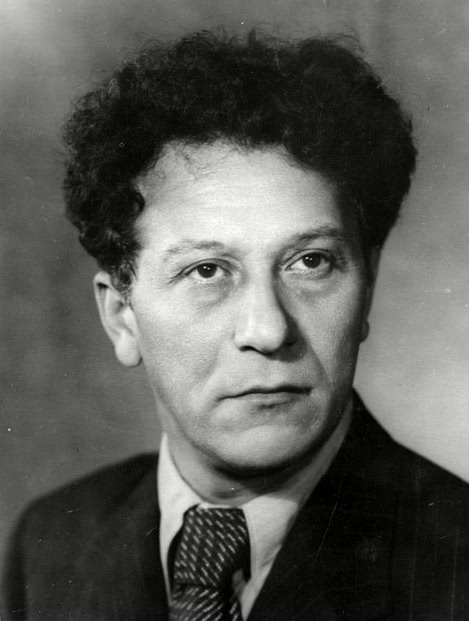
Abram Alikhanov 's Life
Life and Work
Abram Isaakovich Alikhanov was born on 4 March 1904 in Elizavetpol in the Russian Empire. He came from a family that later moved to Aleksandropol and then Tiflis, where he completed his early education before entering the Georgian Polytechnical Institute in 1921.
In 1923, he moved to Leningrad and enrolled in the chemistry department of the Polytechnic Institute. By 1927, he was working at the Physical-Technical Institute, focusing on X‑rays, diffraction, and solid‑state physics.
Alikhanov shifted to nuclear physics in 1933, following major discoveries in subatomic particles. In 1934, he and Igor Kurchatov built a “baby cyclotron,” the first cyclotron outside Berkeley, marking a milestone in Soviet accelerator technology.
During the 1940s, Alikhanov played a key role in the Soviet atomic bomb project. From 1945 to 1968, he directed the Institute for Theoretical and Experimental Physics (ITEP) in Moscow, later named in his honour.
He was also instrumental in building the 70 GeV Serpukhov synchrotron, which became the world’s largest accelerator at the time.
Abram Alikhanov died on 8 December 1970 in Moscow, leaving behind a legacy as one of the Soviet Union’s most influential physicists and a pioneer of its nuclear and accelerator programs.
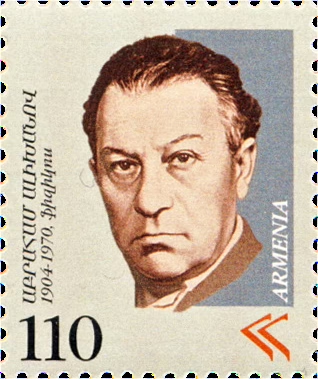
Abram Alikhanov's Work
Early Research in Solid‑State Physics
Alikhanov began his scientific career in the late 1920s at the Leningrad Physical‑Technical Institute, where he worked on X‑ray physics, diffraction, and the behaviour of solids. His early publications, many co‑authored with his brother Artem Alikhanian, helped establish experimental methods for studying crystal structures and the interaction of radiation with matter. This period laid the technical foundation for his later transition into nuclear physics.
Pioneering Contributions to Nuclear and Particle Physics
In the early 1930s, following global breakthroughs in subatomic physics, Alikhanov shifted his focus to nuclear processes. His group conducted influential studies on gamma‑ray interactions, pair production, and positron behaviour. These experiments placed Soviet physics on the map during a formative era for particle physics.
One of his most notable achievements was the construction of a small cyclotron in 1934 with Igor Kurchatov; the first such accelerator built outside the United States. This device enabled controlled nuclear reactions and marked the beginning of Soviet accelerator science.
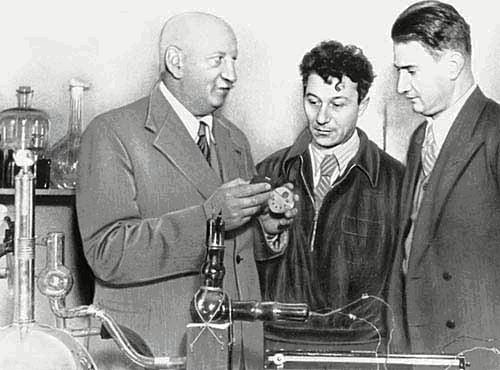
Role in the Soviet Atomic Project
During the Second World War and the immediate post‑war years, Alikhanov became a central figure in the Soviet Union’s nuclear weapons programme. He contributed to neutron research, reactor design, and the broader scientific infrastructure required for atomic development. His work supported the creation of the first Soviet heavy‑water reactors, which became operational in 1949 and 1951.
Founding and Leading ITEP
In 1945, Alikhanov founded the Institute for Theoretical and Experimental Physics (ITEP) in Moscow and served as its director until 1968. Under his leadership, ITEP became one of the Soviet Union’s premier centres for high‑energy physics, reactor research, and theoretical studies. The institute trained generations of physicists and became a hub for both fundamental and applied nuclear science.
Accelerator Development and the Serpukhov Synchrotron
Alikhanov played a decisive role in planning and constructing the 70 GeV proton synchrotron at Serpukhov, completed in the late 1960s. At the time, it was the most powerful particle accelerator in the world. This machine enabled pivotal experiments in high‑energy physics and positioned the USSR as a major player in global accelerator research.
Abram Alikhanov's Legacy
Major Awards and State Honours
Alikhanov received some of the highest scientific and state distinctions in the Soviet Union. He was twice awarded the Stalin Prize, recognising his contributions to nuclear physics and accelerator development. His work on the Soviet atomic programme earned him the Order of Lenin, one of the USSR’s most prestigious decorations. He also received the Order of the Red Banner of Labour and other state medals acknowledging his leadership in building the country’s nuclear and high‑energy physics infrastructure.
Academic and Institutional Recognition
Beyond state awards, Alikhanov was elected a full member of the USSR Academy of Sciences, reflecting his standing among the nation’s scientific elite. His leadership of the Institute for Theoretical and Experimental Physics (ITEP) for more than two decades cemented his reputation as a builder of institutions as well as a researcher. After his death, ITEP was renamed in his honour, a rare distinction that underscored his foundational role in its creation and success.
Lasting Legacy
Alikhanov’s legacy is visible in the institutions, technologies, and scientific communities he helped build. ITEP remains one of Russia’s leading physics institutes, continuing the research traditions he established. The accelerators and reactors he helped design laid the groundwork for decades of Soviet and post‑Soviet research in nuclear and particle physics.
Equally important is his legacy as a mentor and organiser. Many prominent Soviet physicists began their careers under his guidance, and his emphasis on rigorous experimentation and ambitious infrastructure projects shaped the culture of Soviet high‑energy physics. His name remains associated with both scientific excellence and the creation of enduring research institutions.
Explore Further
Continue learning about the lives of the people that shaped nuclear history.
Walter Zinn – Building the Foundations of Modern Nuclear Power
Niels Bohr – Architect of the Quantum World
John Cockcroft – The Man Who Split the Atom
George de Hevesy – The Founder of Nuclear Medicine
Did you know? Explore Nuclear also offers great careers information and learning resources.
Below you can find references to the information and images used on this page.
Content References
Image References
- Абрам Исаакович Алиханов – Unknown author – Public Domain
- Abram Alikhanov 2000 Armenia stamp – Post of Armenia – Non-protected work
- Alihanov Kurchatov Ioffe – Unknown author – Public Domain