
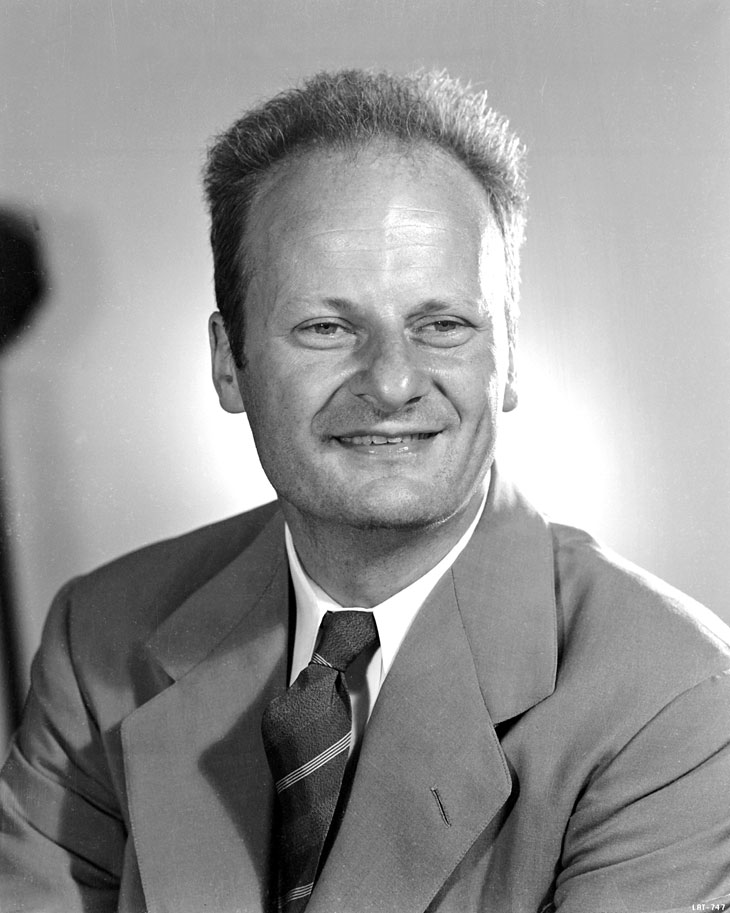
Hans Bethe's Life
Life and Work
Hans Bethe was born on 2 July 1906 in Strasbourg, then part of the German Empire. He grew up in an academically oriented family and showed early promise in mathematics and physics. Bethe studied at the University of Frankfurt and later at Munich, where he completed his PhD in theoretical physics under the renowned Arnold Sommerfeld in 1928.
In the early 1930s, Bethe held teaching and research positions in Frankfurt, Stuttgart, Munich, Cambridge, and Rome. His career in Germany was abruptly disrupted in 1933, when the rise of the Nazi regime forced him out of his post at the University of Tübingen due to his mother’s Jewish heritage. He emigrated first to England and then to the United States, where he eventually joined Cornell University, becoming a central figure in American physics.
Bethe made pivotal contributions across quantum mechanics, solid‑state physics, and nuclear physics. His most celebrated scientific achievement was explaining how stars produce energy, through nuclear fusion processes now known as the Bethe–Weizsäcker cycle, work that earned him the 1967 Nobel Prize in Physics. During World War II, he played a major role in the Manhattan Project, leading the theoretical division at Los Alamos and contributing to the development of the first atomic bombs.
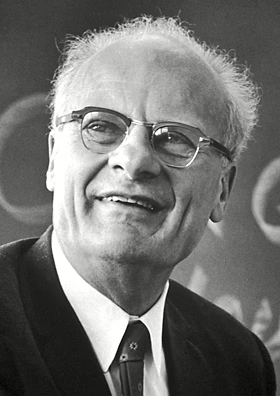
After the war, Bethe became a leading voice for arms control and ethical scientific practice, while continuing to produce influential research well into old age. He received numerous honours, including the National Medal of Science and the Enrico Fermi Award. Bethe remained active at Cornell until the end of his life, passing away on 6 March 2005 in Ithaca, New York, at the age of 98.
Hans Bethe's Scientific Contributions
Stellar Energy Production
One of Bethe’s most celebrated achievements was explaining how stars generate energy. In the 1930s, he identified the proton–proton chain and the CNO cycle as the nuclear fusion processes that power stars, work that earned him the 1967 Nobel Prize in Physics. His analysis of stellar nucleosynthesis became foundational to modern astrophysics and remains central to our understanding of stellar evolution.
Nuclear Physics and Reaction Theory
Bethe made extensive contributions to nuclear reaction theory, including the Bethe–Weizsäcker formula, which models nuclear binding energy and helps explain nuclear stability patterns. His work on nuclear cross‑sections, scattering, and reaction mechanisms shaped the theoretical framework of mid‑20th‑century nuclear physics. During World War II, he applied this expertise as head of the Theoretical Division at Los Alamos, contributing to the Manhattan Project’s calculations.
Quantum Mechanics and Mathematical Physics
Bethe introduced several powerful mathematical tools that remain widely used. The Bethe ansatz, developed in 1931, provided an exact solution for certain quantum many‑body problems and continues to influence condensed‑matter physics and integrable systems. He also contributed to quantum electrodynamics, helping clarify radiative corrections and advancing the understanding of electron–photon interactions.
Solid‑State and Condensed‑Matter Physics
Bethe’s work extended into solid‑state physics, where he developed concepts such as the Bethe lattice, a mathematical structure used in statistical mechanics and condensed‑matter theory. His research on crystal fields, electron behaviour in solids, and optical properties helped establish key principles in the field.
Hans Bethe's Accomplishments
Nobel Prize in Physics
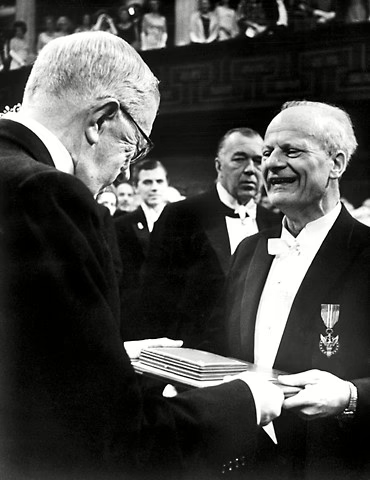
Hans Bethe received the 1967 Nobel Prize in Physics for his work on the theory of stellar nucleosynthesis, particularly his explanation of how stars generate energy through nuclear fusion. This remains his most widely recognised scientific honour.
Fellowships and Memberships
Bethe was elected a Foreign Member of the Royal Society in 1957, one of the highest distinctions in the scientific world. The Royal Society later described him as “one of the greatest physicists of the twentieth century” in its biographical memoirs.
Named Prizes
His influence is commemorated through the Hans A. Bethe Prize, awarded annually by the American Physical Society. The prize recognises outstanding work in astrophysics, nuclear physics, or nuclear astrophysics and is endowed by colleagues and scientific divisions in honour of Bethe’s contributions.
Legacy
Bethe’s legacy is defined by the breadth and depth of his contributions. The Royal Society’s memoir emphasises that his impact “will remain with physics and the wider science community for years to come,” reflecting his status as a towering figure in theoretical physics.
Beyond research, Bethe played a major role in shaping scientific policy and ethics. After contributing to the Manhattan Project, he became a prominent advocate for arms control and responsible scientific practice. His voice carried exceptional authority due to his technical expertise and moral clarity.
At Cornell University, Bethe trained generations of physicists, many of whom became leaders in their own right. His influence persists through his students, his writings, and the scientific institutions he helped strengthen.
Explore Further
Continue learning about the lives of the people that shaped nuclear history.
Qian Sanqiang – Architect of China’s Nuclear Dawn
Frédéric Joliot-Curie – A Life of Science and Conscience
Leo Szilard – The Man Who Warned the World
Lewis Strauss – Visionary or Villain of the Atomic Era
Did you know? Explore Nuclear also offers great careers information and learning resources.
Below you can find references to the information and images used on this page.
Content References
- Hans Bethe – Biographical – NobelPrize.org
- How Hans Bethe Stumbled Upon Perfect Quantum Theories | Quanta Magazine
- Hans Bethe – Nuclear Museum
- Manhattan Project: People > Scientists > HANS BETHE
- Hans Bethe – MIT Compton Lectures
- Hans Bethe – Wikipedia
- Hans Bethe | Nobel Prize Winner, Nuclear Physicist, Quantum Theory Pioneer | Britannica
Image References
- Hans Bethe – Los Alamos National Laboratory – Unless otherwise indicated, this information has been authored by an employee or employees of the Los Alamos National Security, LLC (LANS), operator of the Los Alamos National Laboratory under Contract No. DE-AC52-06NA25396 with the U.S. Department of Energy. The U.S. Government has rights to use, reproduce, and distribute this information. The public may copy and use this information without charge, provided that this Notice and any statement of authorship are reproduced on all copies. Neither the Government nor LANS makes any warranty, express or implied, or assumes any liability or responsibility for the use of this information.
- Bethe – Nobel foundation – Public Domain
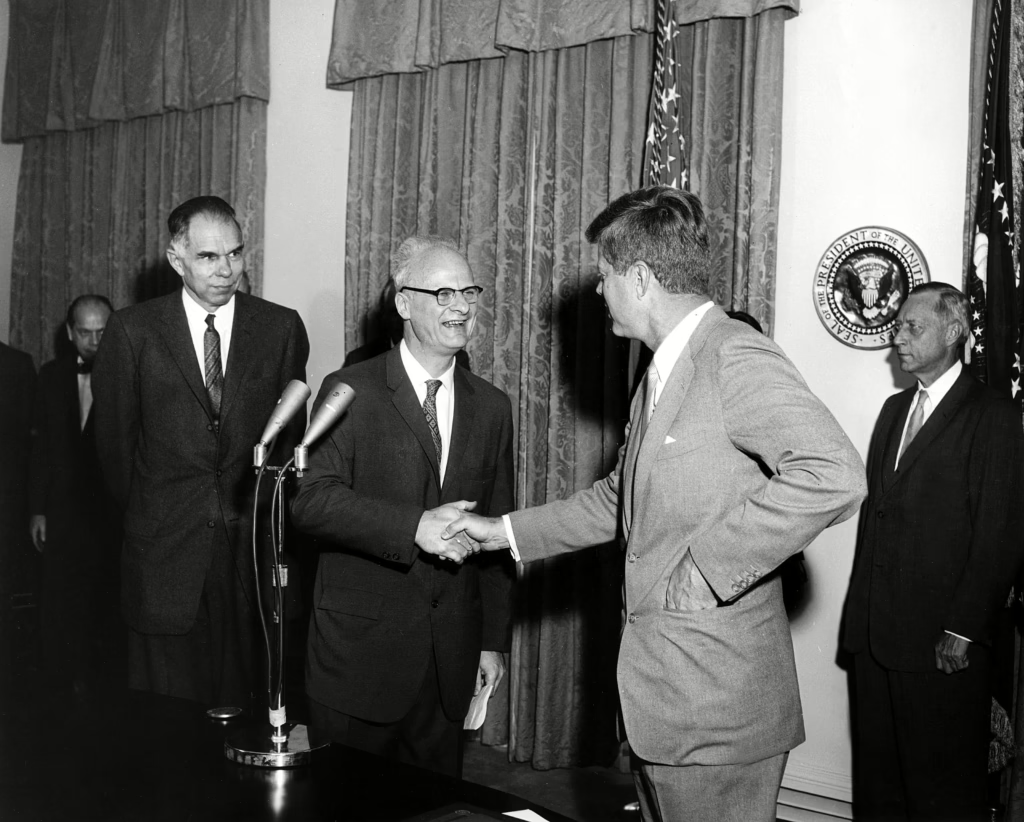
- Hans Bethe and President John F. Kennedy – ENERGY.GOV – Public Domain
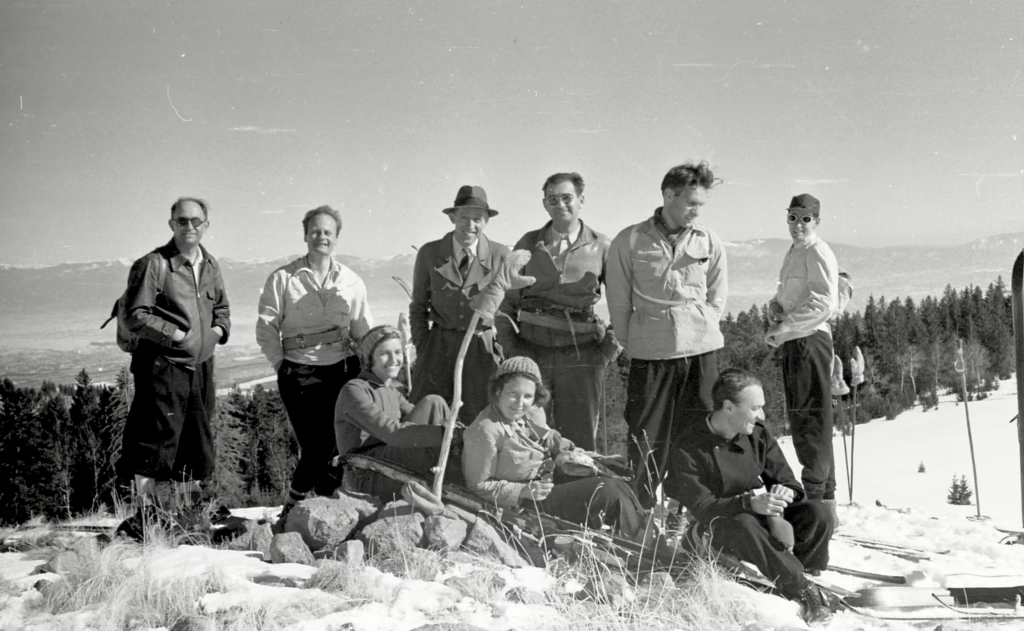
- Skiing Group at Los Alamos – Emilio Segrè – CC BY 4.0
- Hans Bethe and Swedish King – Unknown Author – Public Domain