
J. Robert Oppenheimer's Life
Life and Work
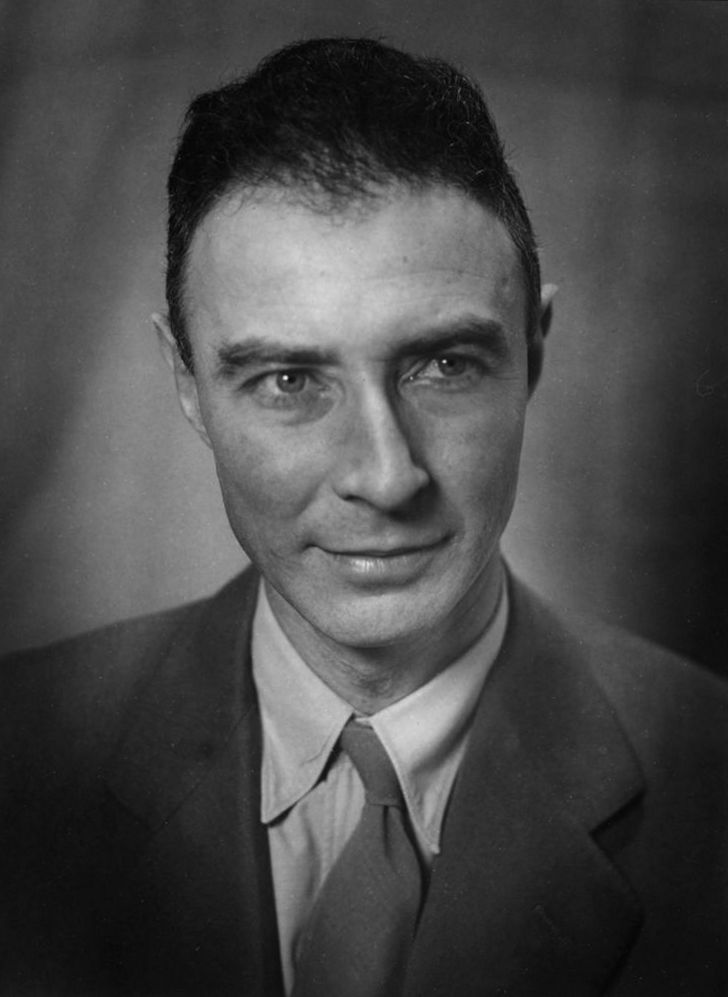
Julius Robert Oppenheimer was born on April 22, 1904, in New York City to a wealthy Jewish family. He grew up surrounded by art, literature, and culture, but his passion was science. After excelling at Harvard University, he studied theoretical physics in Europe, earning his PhD at the University of Göttingen under Max Born. During this period, he contributed to quantum mechanics and developed ideas that would later influence astrophysics and nuclear physics.
Returning to the United States, Oppenheimer became a professor at the University of California, Berkeley, and the California Institute of Technology. He was a brilliant teacher and researcher, making contributions such as the Born–Oppenheimer approximation in quantum chemistry and the Oppenheimer–Phillips process in nuclear reactions. His work also explored black holes and neutron stars, laying foundations for modern astrophysics.
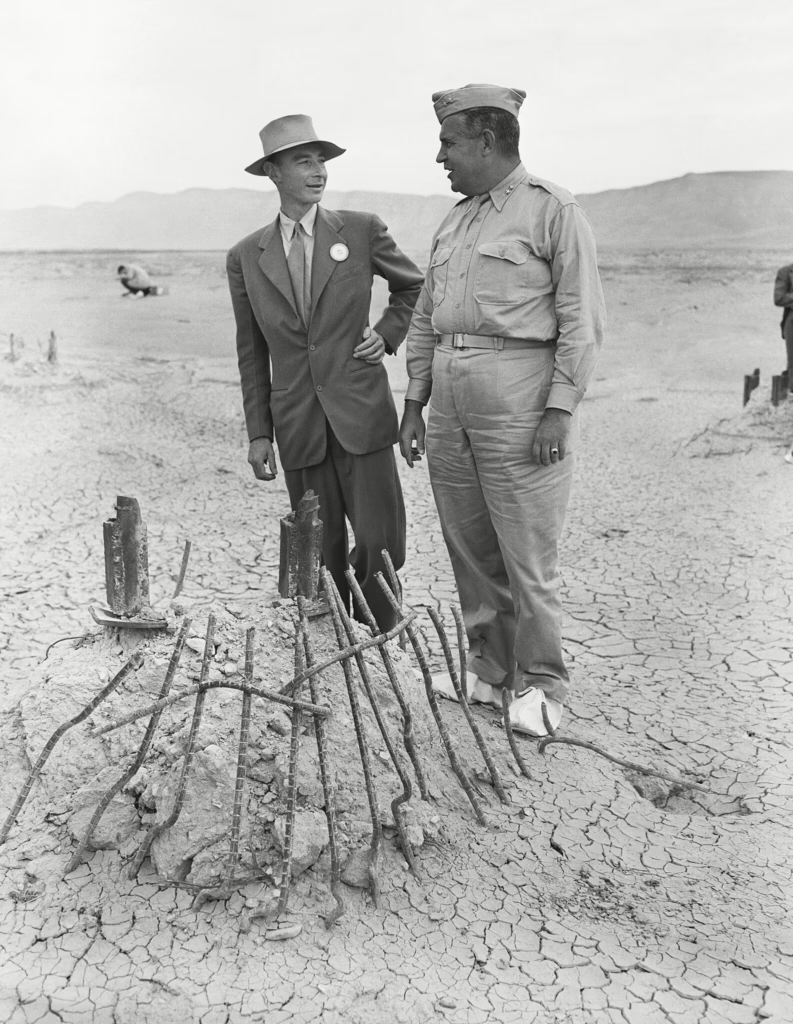
Oppenheimer’s most famous role came during World War II, when he was appointed director of the Los Alamos Laboratory in New Mexico. There, he led the Manhattan Project, coordinating scientists to build the atomic bomb. The project culminated in the Trinity test in July 1945, followed by the bombings of Hiroshima and Nagasaki. Oppenheimer later reflected on the moral weight of this achievement, famously quoting the Bhagavad Gita: “Now I am become Death, the destroyer of worlds.”
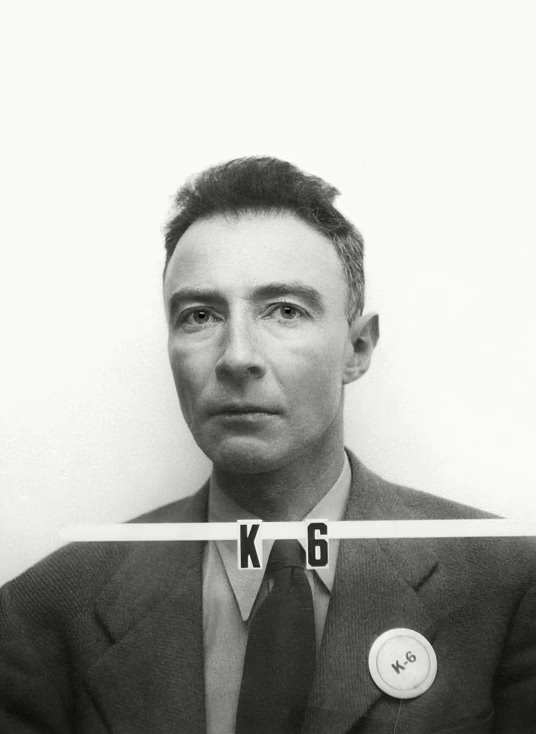
After the war, Oppenheimer became a public intellectual and advisor on nuclear policy. He served as chairman of the General Advisory Committee of the U.S. Atomic Energy Commission, where he advocated for international control of nuclear weapons and opposed the development of the hydrogen bomb. His stance led to political conflict during the Cold War. In 1954, amid suspicions of communist sympathies, he was stripped of his security clearance in a highly publicised hearing, which damaged his career and reputation.
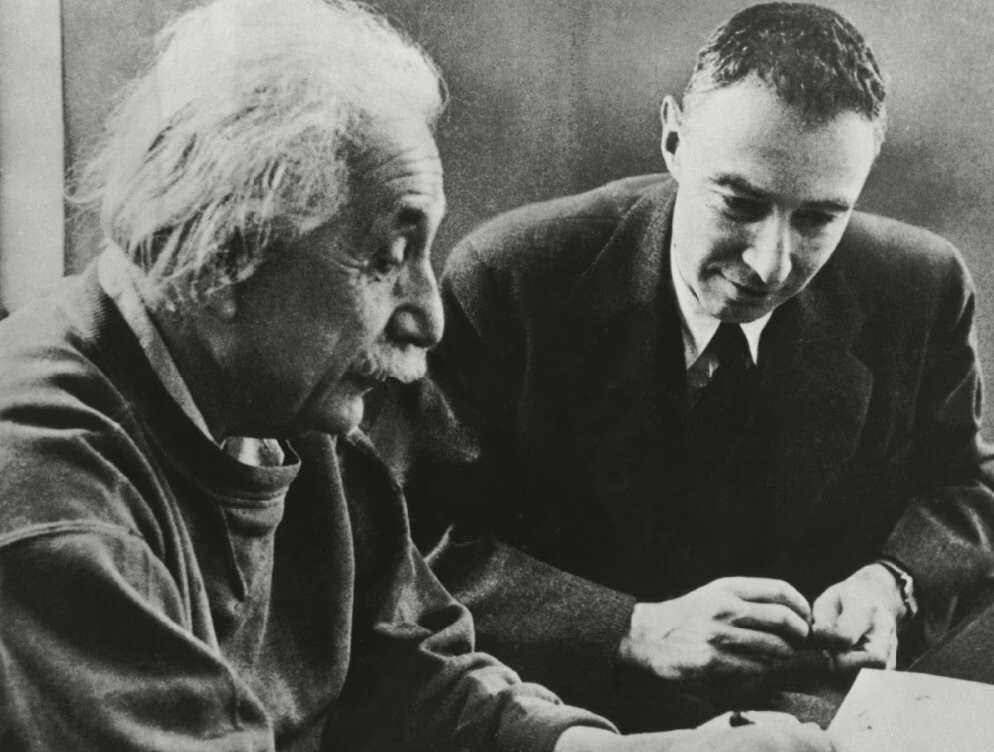
Despite this setback, Oppenheimer continued to influence science and philosophy. He became director of the Institute for Advanced Study in Princeton, where he worked alongside Albert Einstein and other leading thinkers. In 1963, he received the Enrico Fermi Award as a gesture of political rehabilitation. He died of throat cancer in 1967 at the age of 62.
J. Robert Oppenheimer's Scientific Contributions
Early Contributions to Quantum Physics
Oppenheimer’s academic career began with pivotal work in quantum mechanics. His doctoral thesis at Göttingen under Max Born focused on the quantum theory of continuous spectra. He later co-developed the Born–Oppenheimer approximation, a method crucial for simplifying molecular quantum mechanics by separating nuclear and electronic motion.
Advances in Nuclear Physics
In the 1930s, Oppenheimer made significant contributions to nuclear physics. He worked on the Oppenheimer–Phillips process, which explained certain nuclear reactions involving deuterons. His research also extended to cosmic rays and quantum field theory, areas that were at the frontier of physics at the time.
Astrophysics and Black Holes
Oppenheimer’s theoretical insights into astrophysics were profound. Alongside George Volkoff, he developed the Tolman–Oppenheimer–Volkoff equation, which describes the structure of neutron stars. With Hartland Snyder, he proposed the Oppenheimer–Snyder model, predicting gravitational collapse and laying the foundation for the modern concept of black holes.
The Manhattan Project
Oppenheimer’s most famous role was as scientific director of the Los Alamos Laboratory during World War II. He coordinated the efforts of leading physicists to design and build the first atomic bombs. The project culminated in the Trinity test in July 1945, followed by the bombings of Hiroshima and Nagasaki. This achievement earned him the title “father of the atomic bomb,” though he later expressed deep moral concerns about its use.
Postwar Policy and Controversy
After the war, Oppenheimer became a key advisor on nuclear policy. As chairman of the General Advisory Committee of the Atomic Energy Commission, he opposed the development of the hydrogen bomb and advocated for international control of nuclear weapons. His stance led to political conflict during the Cold War, and in 1954 he was stripped of his security clearance in a public hearing, a major blow to his career.
J. Robert Oppenheimer's Accomplishments
Major Honours and Awards
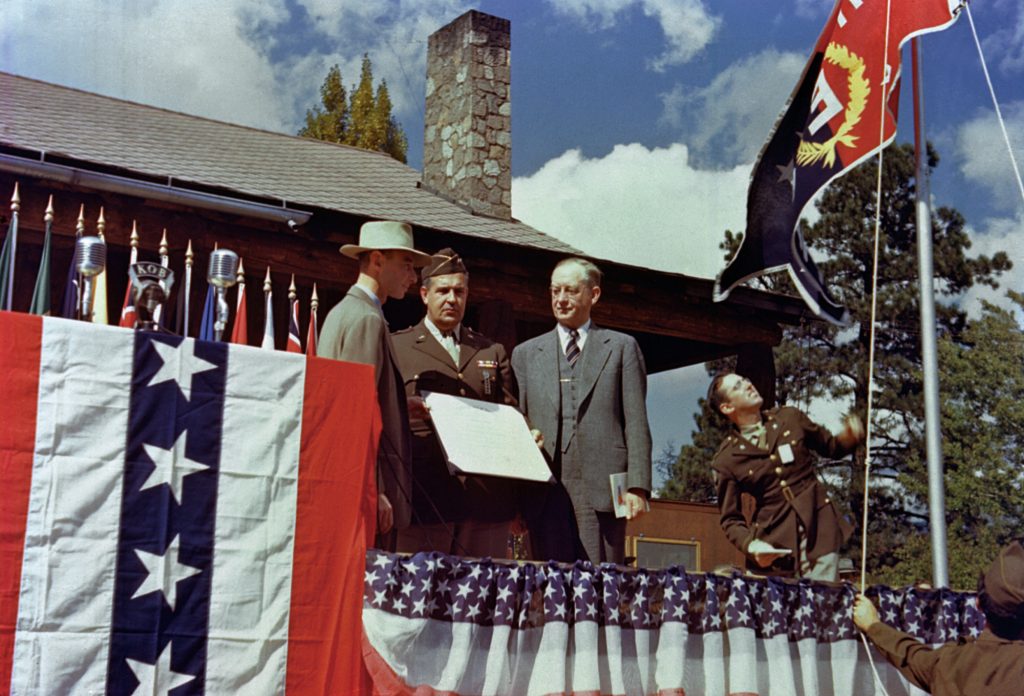
Oppenheimer received several prestigious recognitions during and after his career. In 1946, he was awarded the Medal for Merit, one of the highest civilian honours in the United States, for his leadership in the Manhattan Project. Later, in 1963, he was granted the Enrico Fermi Award by President Lyndon B. Johnson, which served as a symbolic rehabilitation after his earlier political controversies. This award recognised his lifelong contributions to theoretical physics and his role in advancing American science.
Leadership and Public Service
As director of the Los Alamos Laboratory, Oppenheimer successfully coordinated the efforts of thousands of scientists to produce the world’s first nuclear weapons. After the war, he became chairman of the General Advisory Committee of the Atomic Energy Commission, where he advocated for international control of nuclear arms and opposed the hydrogen bomb. His leadership extended into academia as director of the Institute for Advanced Study in Princeton, where he fostered intellectual collaboration among leading scientists, including Albert Einstein.
Controversy and Rehabilitation
Despite his achievements, Oppenheimer’s career was marred by political controversy. In 1954, he was stripped of his security clearance during a public hearing, accused of communist sympathies and opposing U.S. nuclear policy. This event damaged his reputation and excluded him from government influence. However, the Enrico Fermi Award in 1963 marked a partial rehabilitation, acknowledging his scientific brilliance and contributions to national security.
Legacy
Oppenheimer’s legacy is deeply complex. He is remembered as the “father of the atomic bomb”, a title that reflects both his scientific triumph and the moral burden he carried for the destructive power unleashed. His famous reflection on the Trinity test—quoting the Bhagavad Gita, “Now I am become Death, the destroyer of worlds”—symbolises his lifelong struggle with the ethical consequences of science. Beyond nuclear weapons, his theoretical contributions continue to shape physics and astrophysics. Today, Oppenheimer stands as a figure embodying the dual nature of scientific progress: immense innovation paired with profound responsibility.
Explore Further
Continue learning about the lives of the people that shaped nuclear history.
Abram Alikhanov – The Rise of Soviet Nuclear Research
Hyman G. Rickover – Father of the Nuclear Navy
Ernest Lawrence – The Physicist Who Built Big Science
Irène Joliot-Curie – A Legacy of Science and Service
Did you know? Explore Nuclear also offers great careers information and learning resources.
Below you can find references to the information and images used on this page.
Content References
- Who was the real Robert Oppenheimer? – BBC Future
- J. Robert Oppenheimer – Nuclear Museum
- J. Robert Oppenheimer | Biography, Manhattan Project, Atomic Bomb, Significance, & Facts | Britannica
- J. Robert Oppenheimer – Wikipedia
- J. Robert Oppenheimer | Biographies
- Who is Oppenheimer? The controversial man behind the atomic bomb | National Geographic
- Julius Robert Oppenheimer: biography of the father of the atomic bomb
Image References
- Oppenheimer Los Alamos portrait – Los Alamos National Laboratory – Unless otherwise indicated, this information has been authored by an employee or employees of the Los Alamos National Security, LLC (LANS), operator of the Los Alamos National Laboratory under Contract No. DE-AC52-06NA25396 with the U.S. Department of Energy. The U.S. Government has rights to use, reproduce, and distribute this information. The public may copy and use this information without charge, provided that this Notice and any statement of authorship are reproduced on all copies. Neither the Government nor LANS makes any warranty, express or implied, or assumes any liability or responsibility for the use of this information.
- Oppenheimer ID badge – Los Alamos National Laboratory – Public Domain
- Trinity Test – Oppenheimer and Groves at Ground Zero 002 – U.S. Army Corps of Engineers – Public Domain
- Albert Einstein with J. Robert Oppenheimer – US Govt. Defense Threat Reduction Agency – Public Domain
- Army-Navy E Award – Los Alamos National Laboratory – See LANS copyright notice above
- Robert Oppenheimer 1964 – ETH Bibliothek Zürich – CC BY-SA 4.0