
Table of Contents
Eugene Wigner's Life
Life and Work
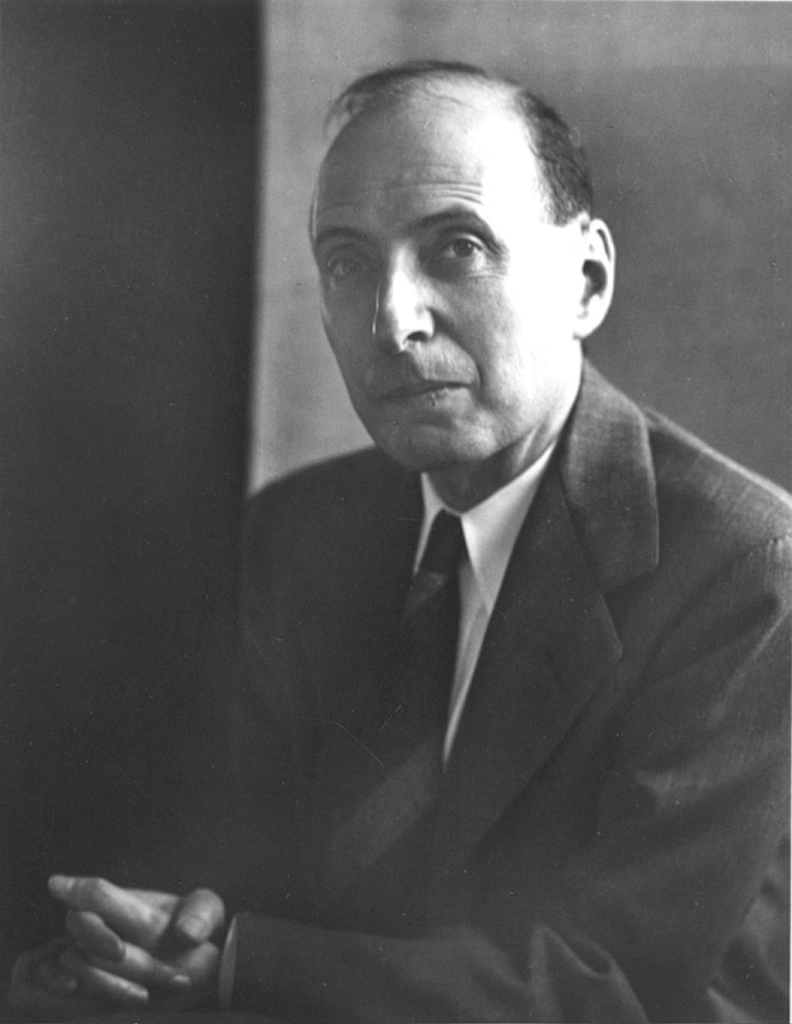
Born in 1902 in what was then Austria‑Hungary, Eugene Wigner grew up in a middle‑class Jewish family and showed an early aptitude for mathematics and science. After studying chemical engineering in Budapest, he continued his education in Berlin, where he earned his doctorate and entered the vibrant intellectual world of early 20th‑century physics.
His career took shape across Europe and the United States as he became one of the key figures developing the mathematical foundations of quantum mechanics. Wigner’s work on symmetry principles, group theory, and the structure of atomic nuclei reshaped theoretical physics. His insights into how symmetry governs physical laws became some of the most influential ideas in the field, ultimately earning him the 1963 Nobel Prize in Physics for contributions to nuclear and particle theory.
During the Second World War, Wigner played a crucial role in the Manhattan Project. Working at the University of Chicago, he helped design the first nuclear reactors and contributed to the theoretical groundwork for controlled nuclear fission. After the war, he continued to influence nuclear science as Director of Research and Development at Clinton Laboratories (later Oak Ridge National Laboratory) before returning to academia at Princeton University, where he spent the bulk of his career and eventually retired in 1971.
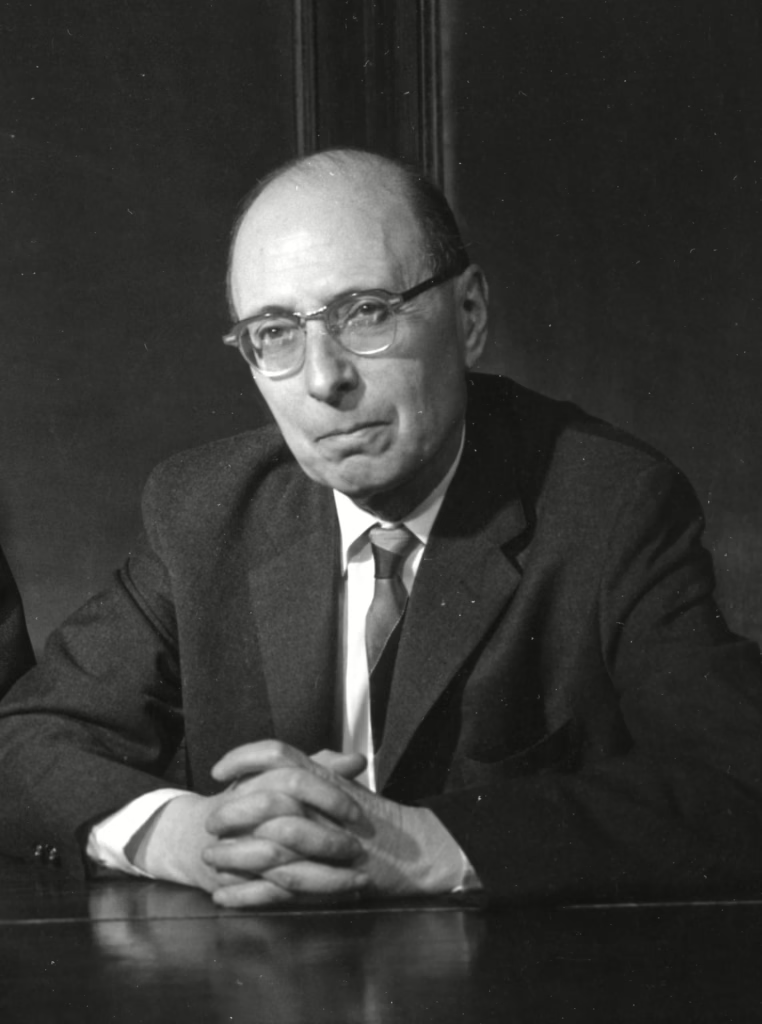
Beyond his scientific achievements, Wigner was known for his thoughtful reflections on the nature of science and consciousness, including his famous “Wigner’s friend” thought experiment. He became a U.S. citizen in 1937, married twice, and raised two children. Wigner lived a long life, remaining intellectually active well into old age, and died in Princeton, New Jersey, in 1995 at the age of 92.
Eugene Wigner's Work
Symmetry and the Foundations of Quantum Mechanics
Eugene Wigner’s most influential work lies in his rigorous use of symmetry principles to understand the laws of physics. Drawing on group theory, he showed how the symmetries of nature determine the possible states and behaviours of quantum systems. His results include Wigner’s theorem, which formalised how symmetry transformations act on quantum states, and the Wigner–Eckart theorem, which became a cornerstone of atomic and particle physics. These contributions helped establish the mathematical language that modern quantum theory still relies on today.
Nuclear Structure and the Strong Force
Wigner made pioneering advances in nuclear physics, particularly in understanding how protons and neutrons interact. In 1933, he demonstrated that the force binding nucleons is extremely strong at short distances but weak at larger separations, a key insight into the nature of the strong nuclear force. He also developed models of nuclear energy levels and introduced symmetry classifications that shaped the shell model of the nucleus. His work in this area was central to the Nobel Prize he received in 1963 for applying symmetry principles to nuclear and particle theory.
Contributions to the Manhattan Project
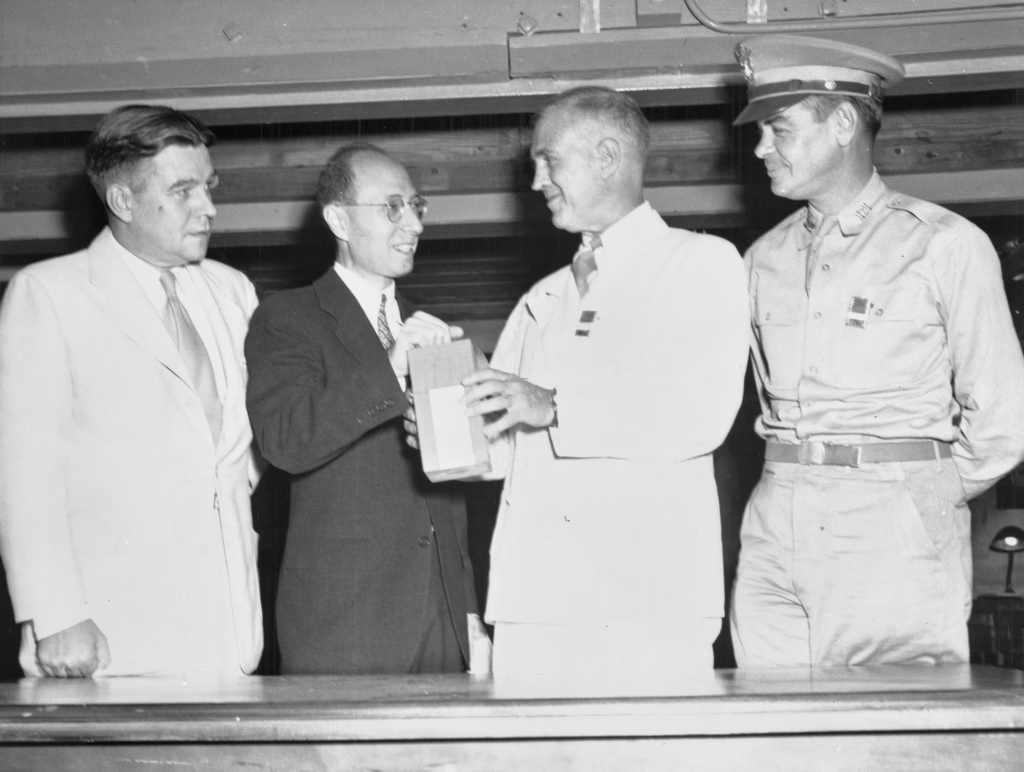
During the Second World War, Wigner played a crucial role in the development of nuclear reactors. At the University of Chicago, he led the team that designed the first production reactors used to generate plutonium for the Manhattan Project. His engineering and theoretical insights helped make controlled nuclear chain reactions feasible, laying the groundwork for both nuclear energy and nuclear weapons.
Mathematical Physics and Beyond
Wigner’s influence extended far beyond nuclear and quantum theory. He introduced concepts such as the Wigner distribution function, widely used in signal processing and quantum mechanics, and the Wigner crystal, a predicted state of electrons at low density. His work also touched on the philosophy of science, most famously through the “Wigner’s friend” thought experiment, which explores the role of consciousness in quantum measurement.
Eugene Wigner's Legacy
Awards and Honours
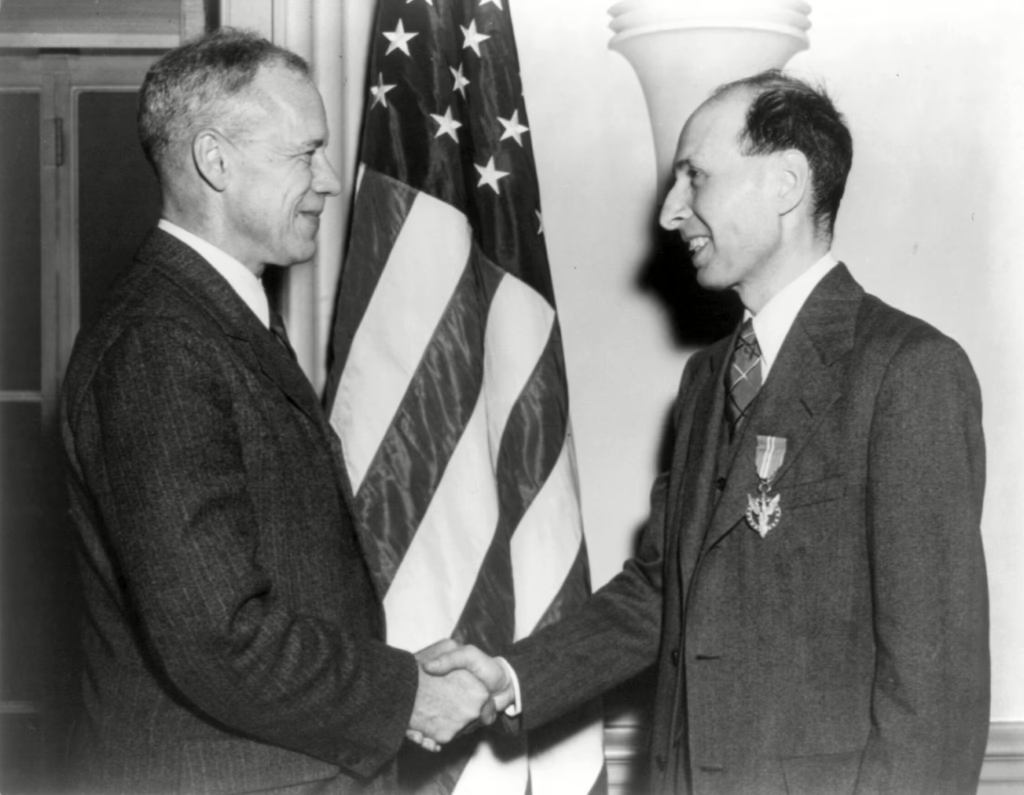
Eugene Wigner received some of the most prestigious distinctions in 20th‑century science. His highest accolade was the 1963 Nobel Prize in Physics, awarded for his application of symmetry principles to nuclear and particle physics. This work reshaped the mathematical foundations of quantum theory and remains central to modern physics. His influence also inspired the creation of the Wigner Medal, an award established in 1978 to honour outstanding contributions to physics through group theory. The medal became one of the most respected honours in mathematical physics, reflecting the depth of Wigner’s impact on the field.
Institutional Recognition and Named Lectures
Wigner’s legacy is also preserved through institutions and scientific communities that continue to celebrate his contributions. At Oak Ridge National Laboratory, where he once served as Research Director, his influence is commemorated through the Wigner Distinguished Lecture Series, which brings leading scientists to speak on major advances in science, technology, and policy. His role in shaping early nuclear engineering and reactor design is still recognised as foundational to the laboratory’s identity and mission.
Enduring Legacy in Physics and Beyond
Eugene Wigner’s name lives on not only through medals and lecture series but also through the countless physicists and mathematicians whose work builds on his ideas. Wigner’s blend of mathematical rigour, physical insight, and philosophical curiosity ensures that his influence remains deeply woven into the fabric of modern science.
Explore Further
Continue learning about the lives of the people that shaped nuclear history.
He Zehui – Pioneer of Modern Chinese Physics
Chien-Shiung Wu – The First Lady of Physics
Werner Heisenberg – The Man Behind the Uncertainty
John H. Lawrence – Pioneering the Atom in Medicine
Did you know? Explore Nuclear also offers great careers information and learning resources.
Below you can find references to the information and images used on this page.
Content References
Image References
- Eugene Wigner – Argonne National Laboratory – CC BY-NC-SA 2.0
- Wheeler Rabi Wigner – AIP Emilio Segrè Visual Archives, Wheeler Collection – Free to use
- First shipment of radioisotopes – Oak Ridge National Laboratory – CC BY 2.0
- Eugene Wigner receiving Medal for Merit – United States Army Signal Corps – Public Domain