
Table of Contents
Harold Urey's Life
Life and Work
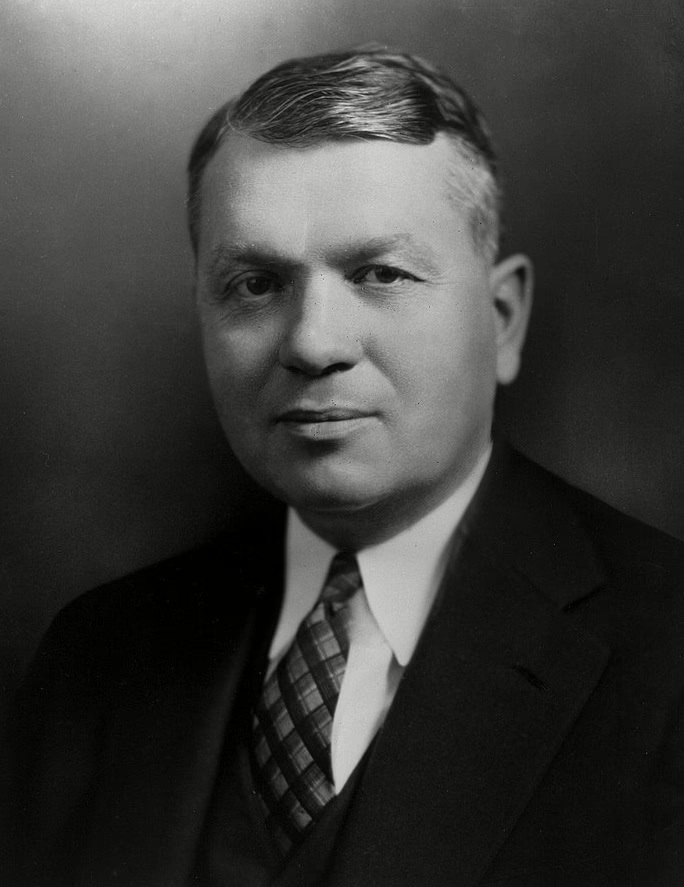
Harold Clayton Urey (1893–1981) was an American physical chemist whose work reshaped modern science. Born in Walkerton, Indiana, he grew up in a rural environment and initially trained as a teacher before pursuing higher education. After earning a bachelor’s degree in zoology from the University of Montana in 1917, he worked as a research chemist and later returned to academia, completing a PhD in chemistry at the University of California, Berkeley, in 1923.
Urey’s early career included a formative year at Niels Bohr’s Institute for Theoretical Physics in Copenhagen, which helped shape his scientific outlook. He went on to hold academic positions at several major institutions, including Johns Hopkins University, Columbia University, and the University of Chicago. His ground-breaking discovery of deuterium, an isotope of hydrogen, earned him the Nobel Prize in Chemistry in 1934 and established him as a leading figure in isotope research.
During World War II, Urey played a significant role in the Manhattan Project, overseeing a large team working on isotope separation. After the war, his interests expanded into planetary science and cosmochemistry. He proposed influential ideas about Earth’s early atmosphere and mentored Stanley Miller, whose Miller–Urey experiment demonstrated how organic molecules could form under primordial conditions. These contributions helped lay the foundation for modern studies of the origins of life.
Over his long career, Urey received numerous awards, including the National Medal of Science and the Gold Medal of the Royal Astronomical Society. He continued to influence scientific thought well into his later years, ultimately passing away in San Diego, California, in 1981. His legacy spans chemistry, planetary science, and our understanding of Earth’s early environment.
Harold Urey's Work
Research on Atomic and Molecular Structure
Before his Nobel-winning discovery, Urey conducted influential research on entropy in diatomic gases, atomic structure, absorption spectra, and molecular structure. These early investigations helped refine theoretical models of how atoms and molecules behave, contributing to the broader development of quantum chemistry.
Contributions to Isotope Chemistry
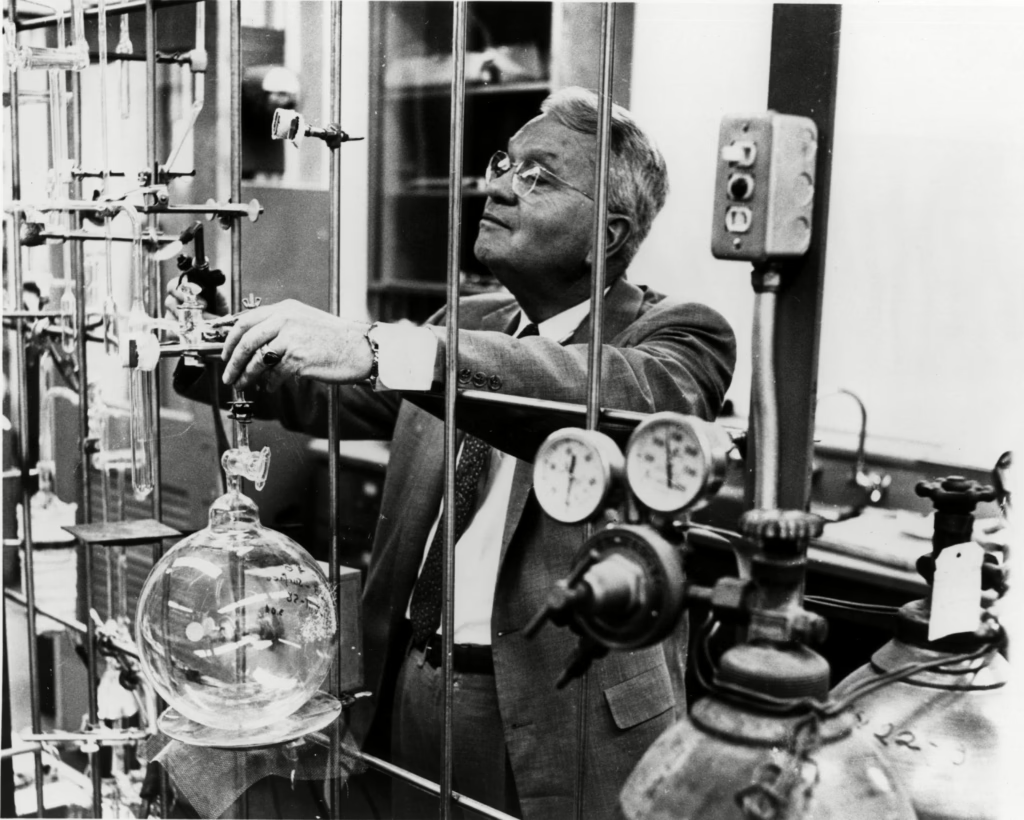
Harold Urey’s most celebrated achievement was the discovery of deuterium, a heavy isotope of hydrogen, in 1931. This breakthrough earned him the 1934 Nobel Prize in Chemistry and opened the door to modern isotope chemistry. His work established foundational methods for separating and studying isotopes, influencing fields ranging from nuclear science to geochemistry.
Role in the Manhattan Project
During World War II, Urey played a major role in the Manhattan Project, overseeing large-scale efforts in isotope separation for the development of atomic energy. His expertise in isotopes made him a key scientific leader in the project’s early phases, shaping the U.S. nuclear program.
Planetary Science and the Origins of Life
After the war, Urey shifted his focus to cosmochemistry and planetary science. He proposed influential theories about Earth’s early atmosphere, suggesting it was rich in hydrogen, methane, ammonia, and water—conditions that could support the formation of organic molecules. His mentorship of Stanley Miller led to the famous Miller–Urey experiment, which demonstrated that amino acids could form under simulated primordial conditions. These ideas helped launch modern research into the origins of life.
Later Scientific Influence
Urey continued contributing to science through studies of the Moon, meteorites, and planetary formation. His work helped establish cosmochemistry as a discipline and influenced NASA’s early lunar research. Over his career, he received numerous prestigious awards, reflecting the breadth and impact of his scientific contributions.
Harold Urey's Legacy
Major Awards and Scientific Distinction
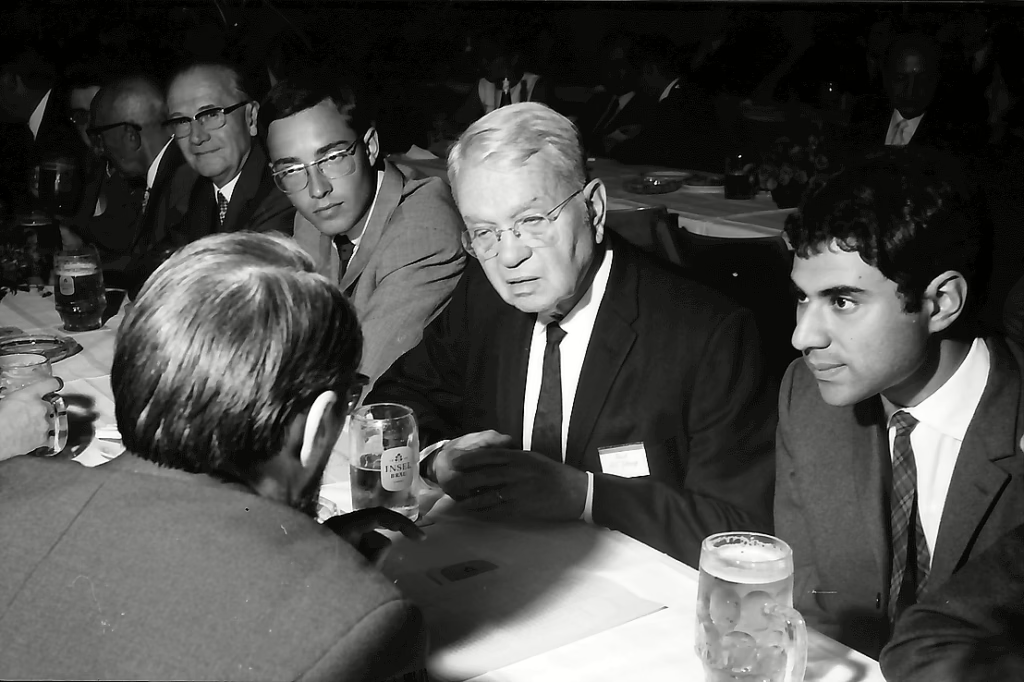
Harold Urey received some of the most prestigious scientific honours of the 20th century, reflecting the breadth of his influence across chemistry, geochemistry, and planetary science. His most notable recognition was the 1934 Nobel Prize in Chemistry for the discovery of deuterium, a breakthrough that reshaped isotope research. He went on to receive the Willard Gibbs Award (1934), the Davy Medal (1940), the Franklin Medal (1943), and the Medal for Merit (1946), acknowledging both his scientific achievements and his wartime contributions. Urey was also elected a Foreign Member of the Royal Society (1947), one of the highest honours in British science.
Later Career Honours and Recognition
As his career progressed, Urey continued to accumulate accolades that highlighted his expanding impact on planetary science and cosmochemistry. These included the J. Lawrence Smith Medal (1962) for contributions to mineralogy and meteoritics, the National Medal of Science (1964) for lifetime scientific achievement, and the Gold Medal of the Royal Astronomical Society (1966) for his work on the Moon and planetary formation. He later received the Priestley Medal (1973), the highest honour of the American Chemical Society, and the V. M. Goldschmidt Award (1975), underscoring his leadership in geochemistry.
Legacy in Science and Beyond
Urey’s pioneering work in isotope chemistry laid the foundation for modern nuclear science, geochemistry, and cosmochemistry. His theories about Earth’s early atmosphere helped shape the scientific study of the origins of life, and his mentorship of Stanley Miller led to the iconic Miller–Urey experiment. His influence is commemorated through honours such as the H.C. Urey Award, bestowed annually by the European Association of Geochemistry to recognise outstanding lifetime contributions to the field, a testament to the enduring impact of his ideas and leadership.
Explore Further
Continue learning about the lives of the people that shaped nuclear history.
Dmitri Mendeleev – The Man Who Brought Structure to the Elements
John H. Lawrence – Pioneering the Atom in Medicine
Alvin M. Weinberg – The Visionary Behind America’s Early Reactors
Ernest Rutherford – The Father of Nuclear Physics
Did you know? Explore Nuclear also offers great careers information and learning resources.
Below you can find references to the information and images used on this page.
Content References
- Harold C. Urey – Biographical – NobelPrize.org
- Harold Urey – Nuclear Museum
- Harold C. Urey | Nobel Prize-Winning Chemist | Britannica
- Research Profile – Harold Urey | Lindau Mediatheque
- Harold C. Urey: Multi-Disciplinary Chemist | AMNH
- Harold Urey – Wikipedia
- Harold C. Urey: Science, Religion, and Cold War Chemistry | Science History Institute
- Harold Urey – Biography, Facts and Pictures
Image References
- Harold Urey, 1934 – ENERGY.GOV – Public Domain
- 20. Tagung 1970 Chemiker; Auf dem Schiff- Harold C. Urey über der Karte – Willy Pragher – CC BY 4.0
- HD.3F.003 (11086395496) – ENERGY.GOV – Public Domain
- 20. Tagung 1970 Chemiker; Verabschiedung- Leopold Ruzicka, Harold C. Urey, Graf Lennart Bernadotte, Lord George Porter of Luddenham, Werner Forßmann – Willy Pragher – CC BY 4.0
- 20. Tagung 1970 Chemiker; Studentenabend Nobelpreisträger im Gespräch- Harold C. Urey im Gespräch – Willy Pragher – CC BY 4.0