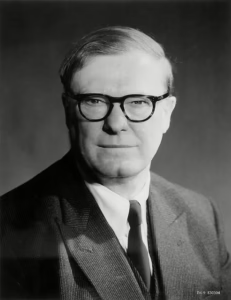
William Penney – Building the UK’s Nuclear Deterrent
William Penney became the chief architect of the United Kingdom’s first atomic bomb and a central figure in shaping the nation’s post‑war nuclear programme.

William Penney became the chief architect of the United Kingdom’s first atomic bomb and a central figure in shaping the nation’s post‑war nuclear programme.
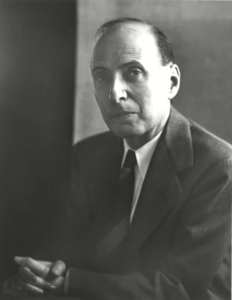
Eugene Wigner contributed to the development of the theory of the atomic nucleus and elementary particles, receiving the Nobel Prize in Physics for his efforts.
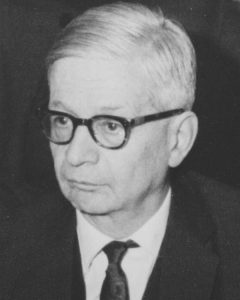
Rudolf Peierls, along with Otto Robert Frisch, were the first to propose the possibility of an atomic fission weapon using small quantities of uranium.
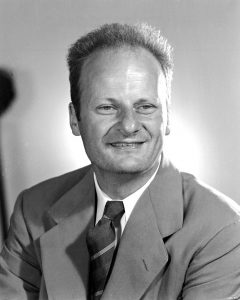
Hans Bethe served as head of the Theoretical Division at Los Alamos during WW2, and received the Nobel Prize in Physics in 1967.
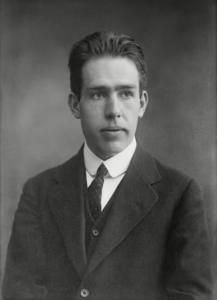
Niels Bohr was a Danish physicist whose work on atomic structure and quantum theory made him one of the most influential scientists of the 20th century.
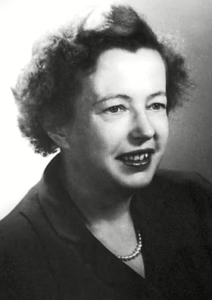
Maria Goeppert Mayer work on the nuclear shell model earned her the Nobel Prize in Physics in 1963, making her only the second woman in history to win one.
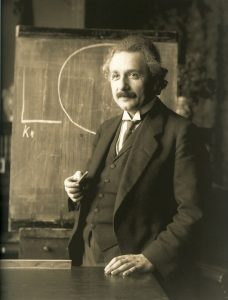
Albert Einstein is possibly the most famous scientist to ever live. He is most well known for discovering the equivalence between mass and energy.
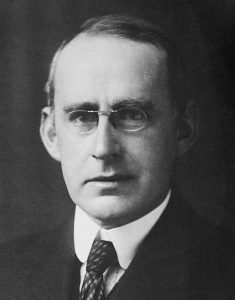
Arthur Eddington was a pioneering astrophysicist whose work shaped modern astronomy and brought Einstein’s theory of general relativity to global attention.
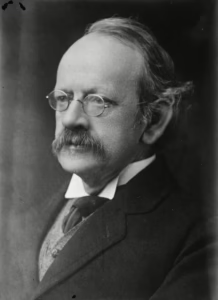
Joseph John Thomson discovered the first subatomic particle; the electron. He received a Nobel Prize for his work on the conduction of electricity in gases.