
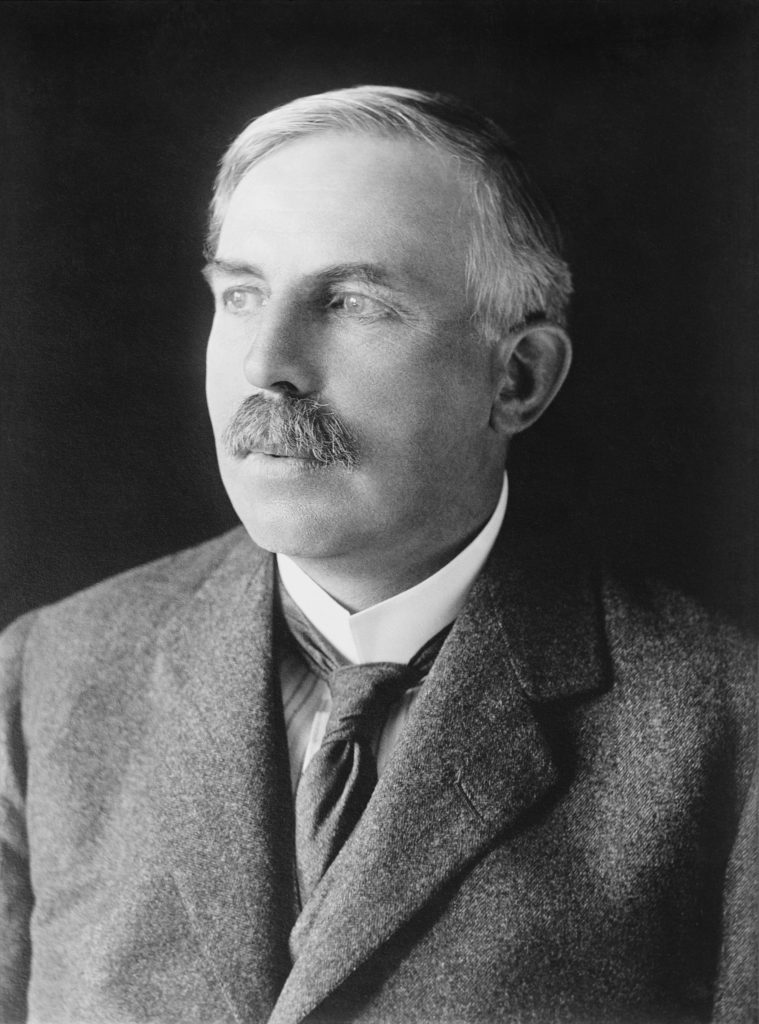
Ernest Rutherford's Life
Life and Work
Ernest Rutherford was born on 30 August 1871 in Brightwater, near Nelson, New Zealand, into a large family of Scottish and English descent. He excelled academically, winning scholarships that allowed him to study at Canterbury College, University of New Zealand, where he earned degrees in mathematics and physical sciences. In 1895, he moved to England to attend Trinity College, Cambridge, beginning the research career that would make him one of the most influential scientists of the 20th century.
Rutherford’s early work focused on radioactivity, where he classified radiation into alpha, beta, and gamma rays. His ground-breaking experiments earned him the 1908 Nobel Prize in Chemistry for investigations into the disintegration of elements and the chemistry of radioactive substances. He later became famous for the gold foil experiment (1911), which revealed that atoms consist mostly of empty space with a dense, positively charged nucleus at the centre. This discovery overturned the prevailing “plum pudding” model of the atom and laid the foundation for modern atomic theory.
In subsequent years, Rutherford continued to push boundaries. He was the first to artificially induce a nuclear reaction, transforming nitrogen into oxygen, and he predicted the existence of the neutron, later confirmed by his student James Chadwick in 1932. He also identified the proton as a fundamental particle within the nucleus.
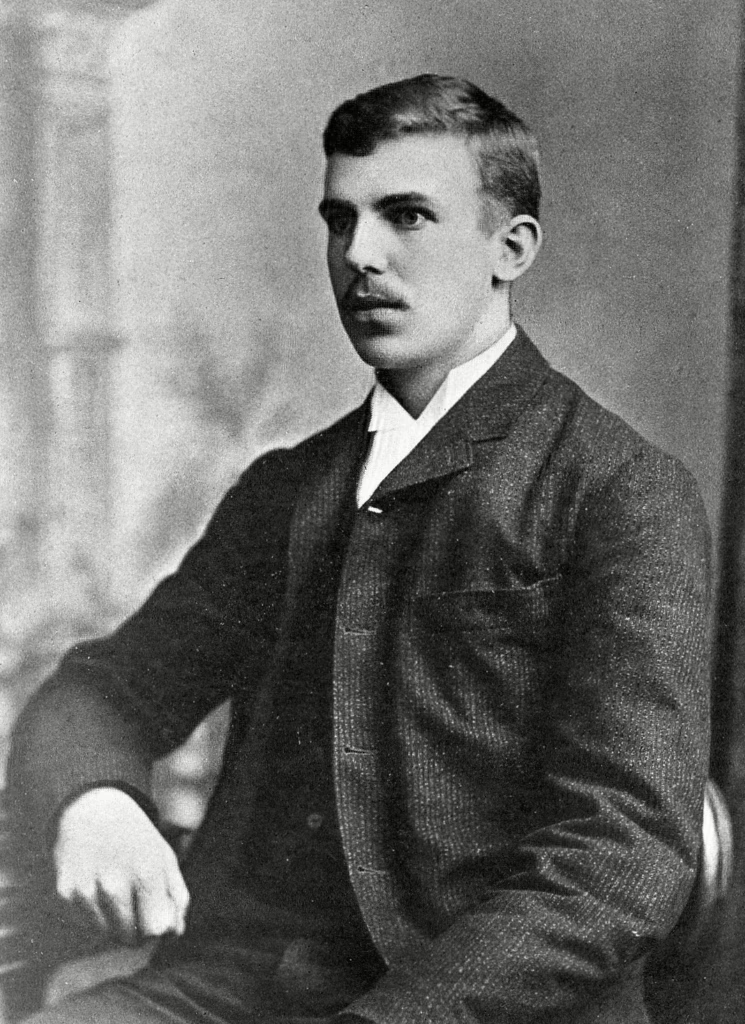
Rutherford held prestigious academic positions, including professorships at McGill University in Canada and later at the University of Manchester, before becoming director of the Cavendish Laboratory at Cambridge. He served as President of the Royal Society (1925–1930) and was ennobled as Lord Rutherford of Nelson in 1931.
He died on 19 October 1937 in Cambridge, England, at the age of 66, and was buried in Westminster Abbey, near other great scientists such as Isaac Newton. His legacy endures in the field of nuclear physics, where his discoveries paved the way for quantum mechanics, nuclear energy, and the eventual development of atomic power.
Ernest Rutherford's Scientific Contributions
Early Work on Radioactivity
Rutherford began his career studying radioactivity, where he discovered alpha and beta radiation and established the laws of radioactive decay. He showed that radioactive elements break down into other elements over time, introducing the concept of the half-life. His experiments also identified alpha particles as helium nuclei, clarifying the nature of radiation.
Nobel Prize in Chemistry
For his ground-breaking research into the chemistry of radioactive substances, Rutherford was awarded the Nobel Prize in Chemistry in 1908. This recognition highlighted his role in transforming radioactivity from a mysterious phenomenon into a measurable and predictable process.
Discovery of the Atomic Nucleus
Perhaps Rutherford’s most famous contribution came from the gold foil experiment (1911). By directing alpha particles at thin gold foil, he demonstrated that atoms are mostly empty space, with nearly all their mass concentrated in a dense, positively charged nucleus. This overturned J.J. Thomson’s “plum pudding” model and laid the foundation for modern atomic theory.
Identification of Fundamental Particles
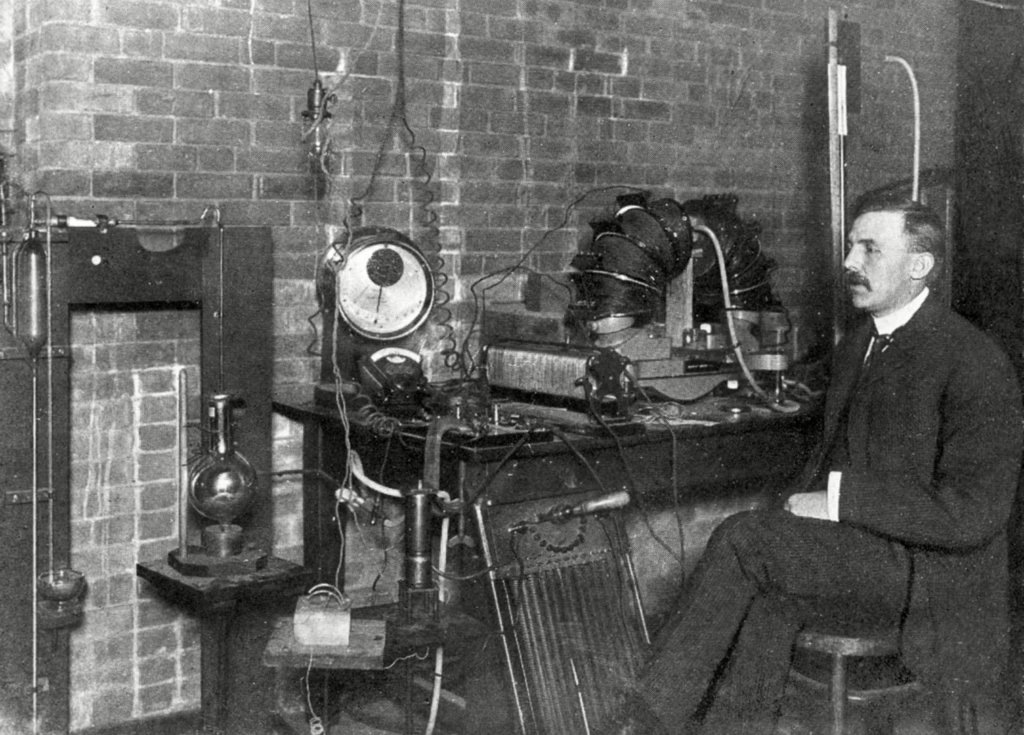
Rutherford’s work led to the discovery of the proton (1917), which he identified as the nucleus of the hydrogen atom. He also theorised the existence of the neutron, later confirmed by his student James Chadwick in 1932. These discoveries were crucial for understanding atomic structure and nuclear reactions.
First Artificial Nuclear Reaction
In 1919, Rutherford achieved the first artificially induced nuclear reaction, converting nitrogen into oxygen by bombarding it with alpha particles. This was the first demonstration that one element could be transformed into another, proving that nuclear reactions could be controlled in the laboratory.
Ernest Rutherford's Accomplishments
Awards and Distinctions
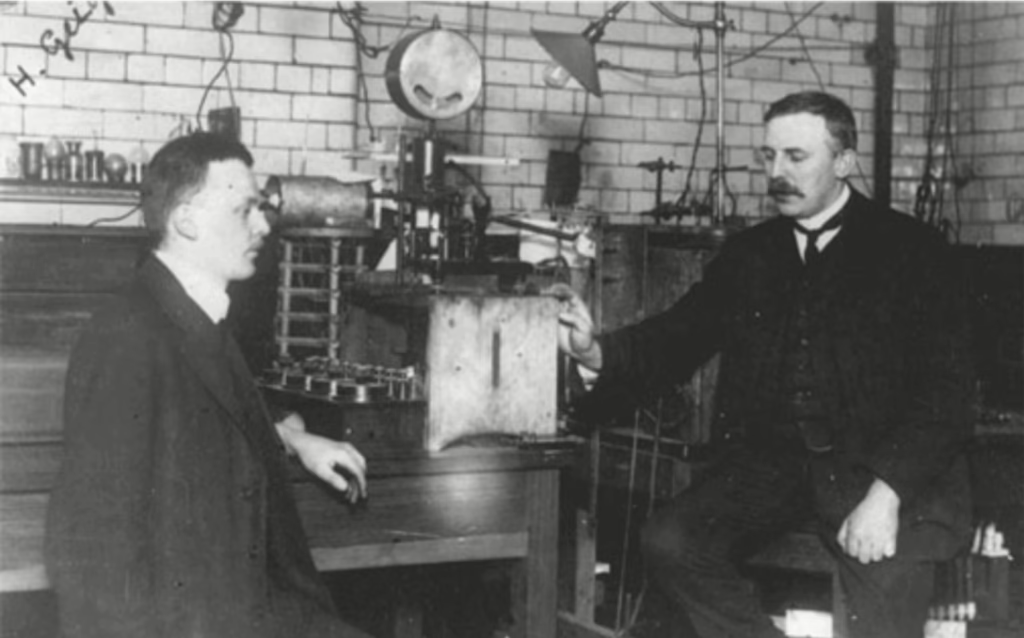
Ernest Rutherford’s work in radioactivity and atomic physics earned him numerous prestigious awards. Most notably, he received the Nobel Prize in Chemistry in 1908 for his investigations into the disintegration of elements and the chemistry of radioactive substances. He was also awarded the Rumford Medal (1904) for his research on radiation, the Copley Medal (1922) from the Royal Society for outstanding scientific achievement, and the Franklin Medal (1924) for his leadership in nuclear physics. These awards reflected the international recognition of his pioneering contributions.
Honours and Distinctions
Rutherford’s achievements were celebrated not only in science but also in society. He was knighted in 1914, appointed to the Order of Merit in 1925, and elevated to the peerage as Lord Rutherford of Nelson in 1931, becoming the first New Zealander to receive such a distinction. He served as President of the Royal Society (1925–1930), guiding Britain’s foremost scientific institution. His death in 1937 was marked by his burial in Westminster Abbey, alongside Isaac Newton and other scientific giants, a rare honour reserved for the most influential figures in science.
Legacy
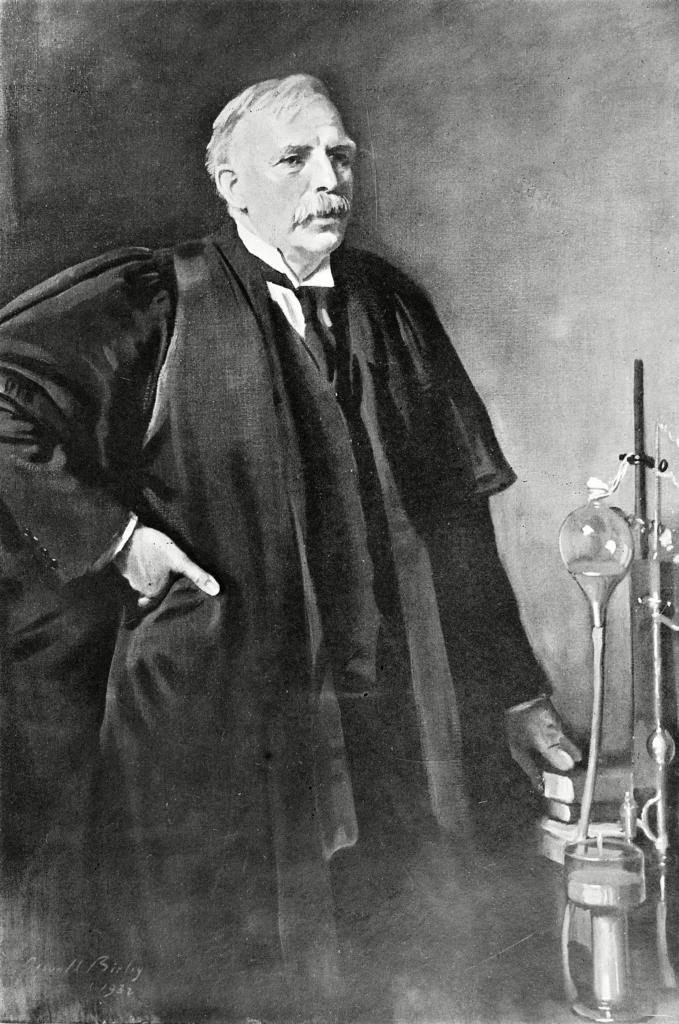
Rutherford is remembered as the “Father of Nuclear Physics”, having discovered the atomic nucleus, the proton, and initiating the first artificial nuclear reaction. His name lives on through the Rutherford Medal and Prize, awarded by the Institute of Physics for distinguished contributions to nuclear physics. Institutions such as the Rutherford Appleton Laboratory in the UK and memorials in New Zealand commemorate his legacy. Perhaps most importantly, his mentorship of students like Niels Bohr, James Chadwick, and Patrick Blackett ensured that his influence extended across generations, shaping quantum mechanics, nuclear science, and the development of atomic energy.
Explore Further
Continue learning about the lives of the people that shaped nuclear history.
Henri Becquerel – The Dawn of Atomic Discovery
Hans Bethe – From Quantum Mechanics to the Stars
J. Robert Oppenheimer – Father of the Atomic Bomb
Qian Sanqiang – Architect of China’s Nuclear Dawn
Did you know? Explore Nuclear also offers great careers information and learning resources.
Below you can find references to the information and images used on this page.
Content References
- Ernest Rutherford – Biographical – NobelPrize.org
- Ernest Rutherford | Science History Institute
- Ernest Rutherford – Nuclear Museum
- Ernest Rutherford | Science Museum Group Collection
- Ernest Rutherford – Wikipedia
- Ernest Rutherford | Accomplishments, Atomic Theory, & Facts | Britannica
- Ernest Rutherford – Biography, Facts and Pictures
Image References
- Sir Ernest Rutherford – Bain News Service – Public Domain
- Ernest Rutherford 1892 – Unknown Author – CC BY 4.0
- Ernest Rutherford 1905 – Unknown Author – Public Domain
- Geiger-Rutherford – Unknown Author – Public Domain
- Portrait of Ernest Rutherford – Oswald Birley – CC BY 4.0