
Table of Contents
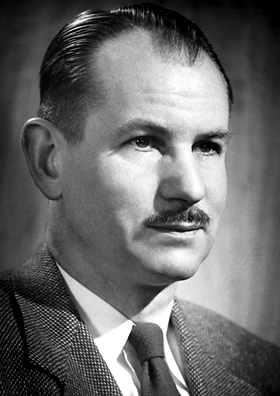
Edwin McMillan's Life
Life and Work
Born in 1907 in Redondo Beach, California, Edwin McMillan grew up in an academically minded family and quickly gravitated toward physics. After studying at Caltech and earning his PhD at Princeton, he joined the University of California, Berkeley.
During the 1930s and 1940s, McMillan worked at the forefront of nuclear physics. At Berkeley’s Radiation Laboratory, he collaborated with Ernest O. Lawrence and helped push the boundaries of particle acceleration. His most famous breakthrough came in 1940 when he co‑discovered neptunium, the first transuranium element. This work earned him the Nobel Prize in Chemistry in 1951, shared with Glenn T. Seaborg, who extended McMillan’s discoveries by identifying plutonium and other transuranium elements.
McMillan’s career was also shaped by wartime research. During World War II, he contributed to radar development and later worked on the Manhattan Project, applying his expertise to the emerging field of nuclear weaponry. After the war, he returned to Berkeley and succeeded Lawrence as director of the Radiation Laboratory, guiding it through a period of rapid expansion and technological innovation, including the development of more powerful particle accelerators.
Beyond his scientific achievements, McMillan was known for his calm leadership and collaborative spirit. He remained active in research and administration until his retirement, leaving a legacy that helped define modern nuclear and particle physics. He died in 1991, remembered as a pioneer who expanded humanity’s understanding of the atomic world.
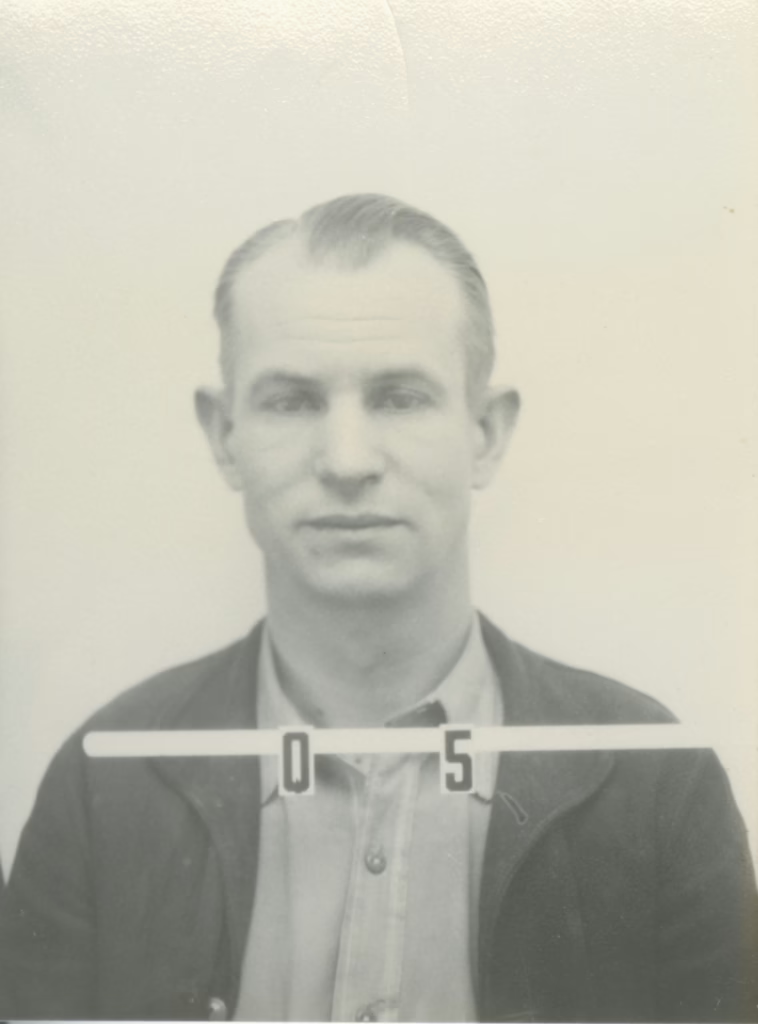
Edwin McMillan's Work
Advancing Early Nuclear Physics
McMillan’s early career unfolded at the University of California, Berkeley, where he worked with Ernest O. Lawrence at the Radiation Laboratory. This was the birthplace of the cyclotron, a machine that accelerates charged particles using magnetic fields and alternating electric fields. By bombarding atomic nuclei with these high‑energy particles, physicists could probe the structure of matter and create new elements.
McMillan became one of the leading experimentalists using these machines. His work helped refine the techniques of particle acceleration and nuclear bombardment, laying the groundwork for modern particle physics.
Discovery of Neptunium and the Birth of Transuranium Chemistry
McMillan’s most celebrated achievement came in 1940 with the discovery of neptunium, the first element beyond uranium in the periodic table. He produced it by bombarding uranium‑238 with neutrons, creating uranium‑239, an unstable isotope. This isotope undergoes beta decay, a process in which a neutron transforms into a proton while emitting an electron. Because the number of protons determines an element’s identity, this decay increased the atomic number from 92 to 93, forming a new element. McMillan identified this product as neptunium, demonstrating that synthetic elements heavier than uranium could exist. This discovery opened the door to the entire family of transuranium elements and ultimately earned him the Nobel Prize in Chemistry, shared with Glenn T. Seaborg.
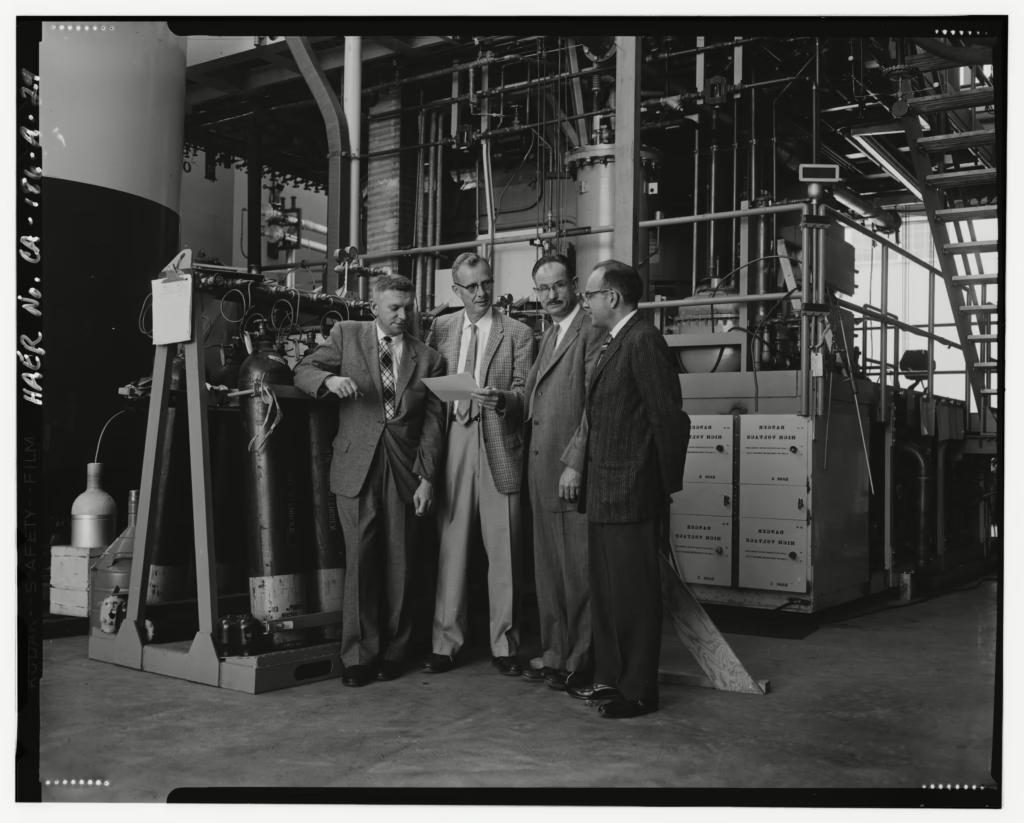
The Principle of Phase Stability and the Rise of the Synchrotron
After World War II, McMillan made a breakthrough that reshaped accelerator physics. Early accelerators struggled to keep particles in stable orbits as they gained energy; even small timing errors caused particles to drift out of sync with the accelerating electric field. McMillan independently discovered the principle of phase stability, which showed that particles naturally correct their timing if they fall slightly ahead or behind the ideal phase. This insight made it possible to design the synchrotron, a new type of accelerator capable of reaching far higher energies than cyclotrons. Modern particle accelerators still rely on this principle, making McMillan’s contribution foundational to high‑energy physics.
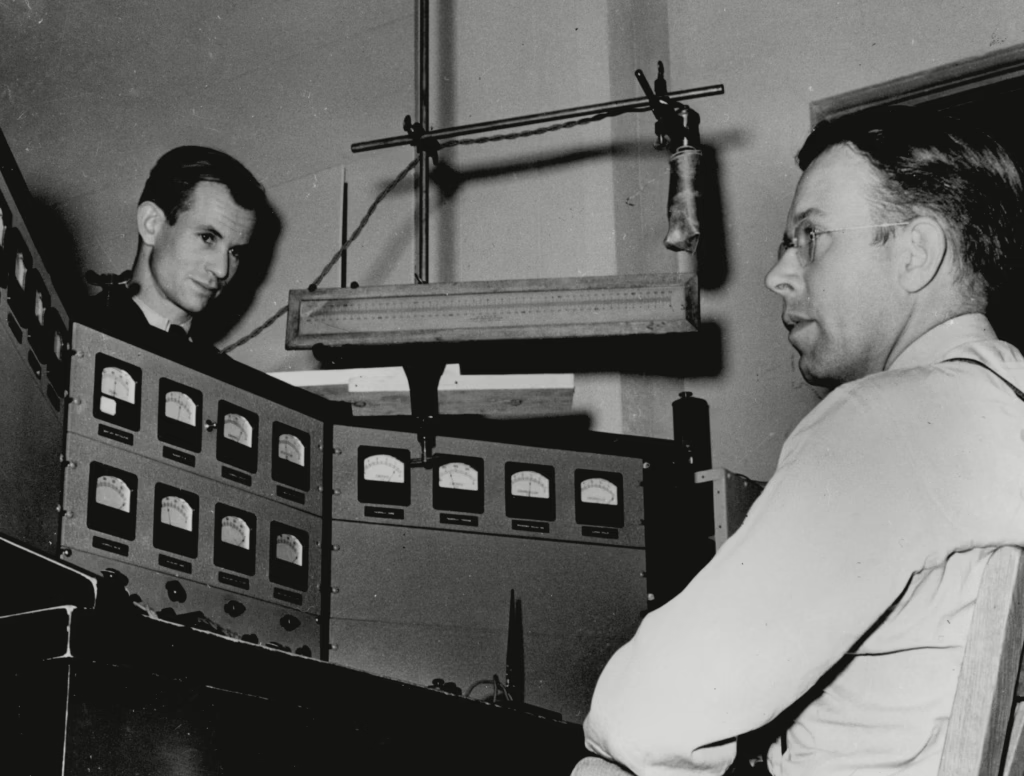
Scientific Contributions During World War II
Following Ernest Lawrence’s death, McMillan became director of the Radiation Laboratory. Under his leadership, the lab expanded its accelerator programme and maintained its position as a world leader in nuclear and particle physics. He oversaw the construction of increasingly powerful machines and supported research that pushed the boundaries of both fundamental science and applied nuclear technology. His leadership style was known for being steady, thoughtful, and collaborative.
Edwin McMillan's Legacy
Awards and Honours
Edwin McMillan received numerous major scientific awards, the most prominent being the 1951 Nobel Prize in Chemistry, which he shared with Glenn T. Seaborg for the discovery of the first transuranium elements. This recognition placed him among the central figures of 20th‑century nuclear science. He was also elected to the National Academy of Sciences, reflecting the high esteem in which his peers held his work. Over the course of his career, he received honorary doctorates from several universities and was awarded prestigious medals from scientific societies, including honours from the American Physical Society and the American Chemical Society. These awards acknowledged both his experimental skill and his theoretical insight.
Leadership Roles and Institutional Influence
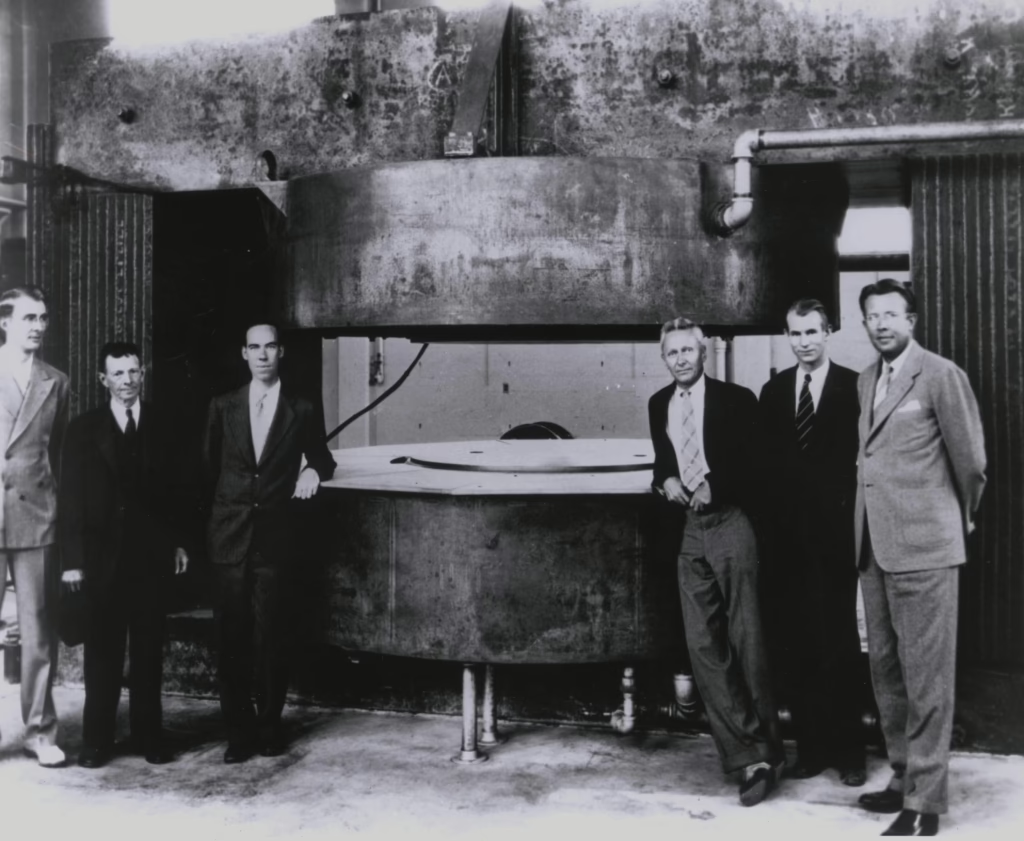
Beyond formal awards, McMillan’s influence was cemented through his leadership at the Berkeley Radiation Laboratory, where he succeeded Ernest Lawrence as director. In this role, he guided one of the world’s most important physics laboratories through a period of rapid expansion. His leadership helped shape the development of increasingly powerful particle accelerators and ensured that Berkeley remained at the forefront of nuclear and particle physics. His administrative style earned him respect across the scientific community and helped maintain stability during a time of intense scientific and political change.
Influence on Future Generations
As a mentor and leader, McMillan helped train and support generations of physicists and chemists who would go on to make major contributions of their own. His work on accelerator design laid the foundation for the machines that enabled discoveries such as quarks, neutrino oscillations, and the Higgs boson. His role in expanding the periodic table inspired decades of research into heavy and superheavy elements. Through both his scientific achievements and his leadership, he shaped the direction of modern physics and chemistry.
Enduring Reputation
Today, Edwin McMillan is remembered as a quiet but transformative figure in 20th‑century science. His discoveries reshaped the periodic table, his theoretical insights revolutionised accelerator technology, and his leadership helped build one of the world’s great research institutions. His legacy lives on in the laboratories that use the principles he developed, the elements he helped discover, and the scientific culture he helped foster.
Explore Further
Continue learning about the lives of the people that shaped nuclear history.
Henri Becquerel – The Dawn of Atomic Discovery
Alvin M. Weinberg – The Visionary Behind America’s Early Reactors
Albert Einstein – A Journey Through Space and Time
Irène Joliot-Curie – A Legacy of Science and Service
Did you know? Explore Nuclear also offers great careers information and learning resources.
Below you can find references to the information and images used on this page.
Content References
- Edwin M. McMillan – Biographical – NobelPrize.org
- Edwin M. McMillan – Facts – NobelPrize.org
- Edwin McMillan – Nuclear Museum
- Research Profile – Edwin McMillan | Lindau Mediatheque
- Edwin McMillan biography. American physicist, Nobel Prize in Chemistry, 1951, shared with Glenn T. Seaborg
- Edwin McMillan – Wikipedia
- Edwin Mattison McMillan | Biography & Discovery of Neptunium | Britannica
Image References
- Edwin McMillan Nobel – Nobel Foundation – Public Domain
- Mcmillan-edwin m – Los Alamos National Laboratory – Unless otherwise indicated, this information has been authored by an employee or employees of the Los Alamos National Security, LLC (LANS), operator of the Los Alamos National Laboratory under Contract No. DE-AC52-06NA25396 with the U.S. Department of Energy. The U.S. Government has rights to use, reproduce, and distribute this information. The public may copy and use this information without charge, provided that this Notice and any statement of authorship are reproduced on all copies. Neither the Government nor LANS makes any warranty, express or implied, or assumes any liability or responsibility for the use of this information.
- Photocopy of photograph (original print located in LBNL Photo Lab Collection). Photographer unknown. July, 1959. Morgue 1959-46 (P-1). ALVAREZ BUBBLE CHAMBER GROUP (L. TO R.) HAER CAL,1-BERK,4-29 – National Park Service – Public Domain
- HD.1A.009 (12662188285) – ENERGY.GOV – Public Domain
- HD.1A.012 (12662190635) – ENERGY.GOV – Public Domain