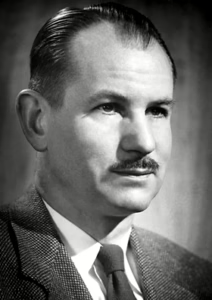
Edwin McMillan – The Innovator Behind Modern High‑Energy Science
Edwin McMillan was a pioneering physicist whose discovery of neptunium and innovations in particle accelerators shaped modern nuclear and high‑energy science.

Edwin McMillan was a pioneering physicist whose discovery of neptunium and innovations in particle accelerators shaped modern nuclear and high‑energy science.
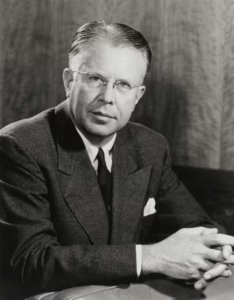
Ernest Lawrence lived a life that reshaped modern physics and set the stage for the era of large‑scale scientific research.
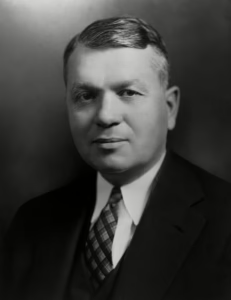
Harold Urey was an American chemist best known for discovering deuterium and pioneering modern isotope and planetary science.
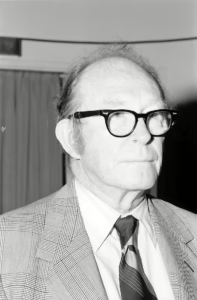
Willard Libby was an American chemist whose development of radiocarbon dating transformed archaeology, geology, and our understanding of the past.
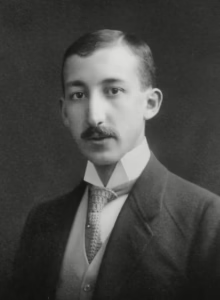
George de Hevesy was a pioneering chemist whose development of radioactive tracer techniques reshaped modern chemistry, biology, and nuclear medicine.
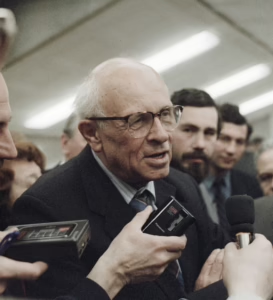
Andrei Sakharov bridged two strikingly different worlds: the secretive realm of Soviet nuclear research and the openly defiant sphere of human rights activism.
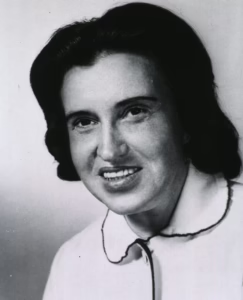
Rosalyn Sussman Yalow was an American medical physicist who co‑developed radioimmunoassay, a technique that revolutionised diagnostic medicine.
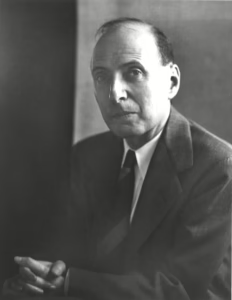
Eugene Wigner contributed to the development of the theory of the atomic nucleus and elementary particles, receiving the Nobel Prize in Physics for his efforts.
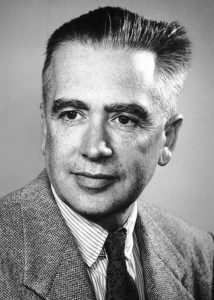
Emilio Segrè discovered technetium, astatine, and plutonium-239. He also discovered the antiproton earning him a Nobel Prize in physics.
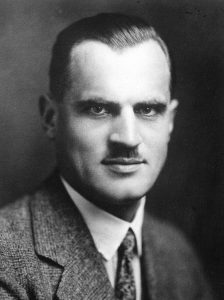
Arthur Compton discovered the particle nature of electromagnetic radiation, and received a Nobel Prize in physics for his efforts.